

EMERGENCE
Every complex system begins with a simple rule.
26th August

CHAPTER IV
Society
Language · Interaction · Culture
Once meaning is shared, how do we verify it?
The preceding chapters traced the emergence of increasingly complex forms of organisation: first the cell, then pattern, then organism. Each explored how complexity emerges within individual systems. Society marks the next transition. Intelligence is no longer understood as a property of an isolated entity, but as something distributed across language, memory, protocols and collective interaction.
The artists gathered in this section examine the structures through which meaning is created, negotiated and preserved. Rather than asking whether machines can think, they ask how thinking becomes shared and how shared intelligence begins to shape culture.
If language allows intelligence to become shared, a new question follows: how do we know what shared meaning actually is? In an era of machine-generated language, verification becomes as important as generation.
Zeroichi Arakawa
Conversation II
“As more is generated for us, deciding for yourself where to verify seems to matter more, not less."
The conversation continues with Zeroichi Arakawa, whose Executed Poetry shifts attention from producing computation to reading it. Rather than asking what code generates, his work asks what it means to verify, execute and understand it. Meaning is not contained in code itself, but emerges through the relationship between writing, execution and the reader.
Next: Society — Conversation III
— 27th August
EARLIER CHAPTERS
Chapter III — Organism
Living Systems
Organism explores the threshold between computation and life. Across three conversations, the discussion moves from emergence and resilience to learning, embodiment and consciousness, culminating in Memo Akten's provocative proposition that perhaps consciousness did not emerge from life—but life evolved to embody consciousness.
Conversation III
"I used to believe consciousness is evolution's solution to dealing with big data. I've now come to wonder whether life evolved to embody consciousness."
Memo Akten
Conversation II
Alexander Mordvintsev
"I think AIs will 'become' conscious once people start recognising them as such."
Conversation I
Jared S. Tarbell
"Biological life has a kind of thirst for life."
Chapter II — Pattern
Emergent Structure
Pattern marks the moment when local interactions become legible as higher-order structure. No individual cell contains the pattern; it exists only through the relations established between many simple behaviours. Emergence appears here as a property of organisation itself, revealing forms that exceed both their constituent parts and the intentions that produced them.
Conversation I
David Young
"Computation becomes interesting when behaviour cannot be predicted from individual parts."
Chapter I — Cell
How can simple rules produce unexpected complexity?
Cell begins with the smallest possible unit of organisation: the rule. Before there are forms, organisms or intelligence, there are only local interactions repeated across time. Computation appears here not as a tool for producing images, but as a medium through which complexity can arise without authorship, intention or central control. The chapter considers the cell not as a biological object, but as a conceptual threshold where autonomous behaviour first becomes possible.
Conversation II
Jonathan McCabe
"A complicated state, undergoing transformation by the simplest of rules"
Conversation I
Casey REAS
“The artwork exists in the relationships among things”

Current state — Chapter IV — Society
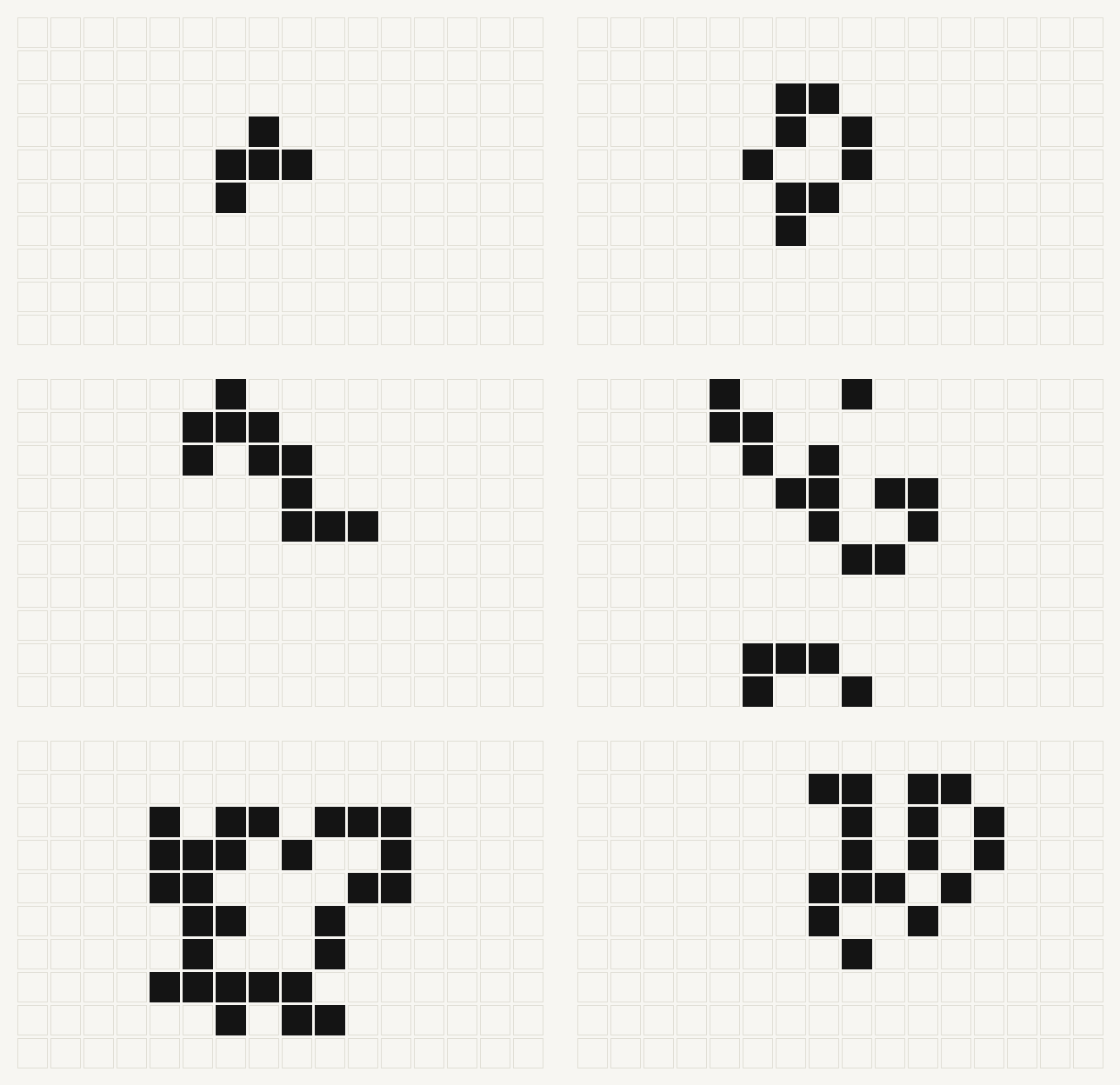
EMERGENCE unfolds one chapter at a time.
Beginning on 28 July, the exhibition reveals itself one chapter each Tuesday. New artists, works and conversations gradually assemble the exhibition before its public opening on 8 September 2026.
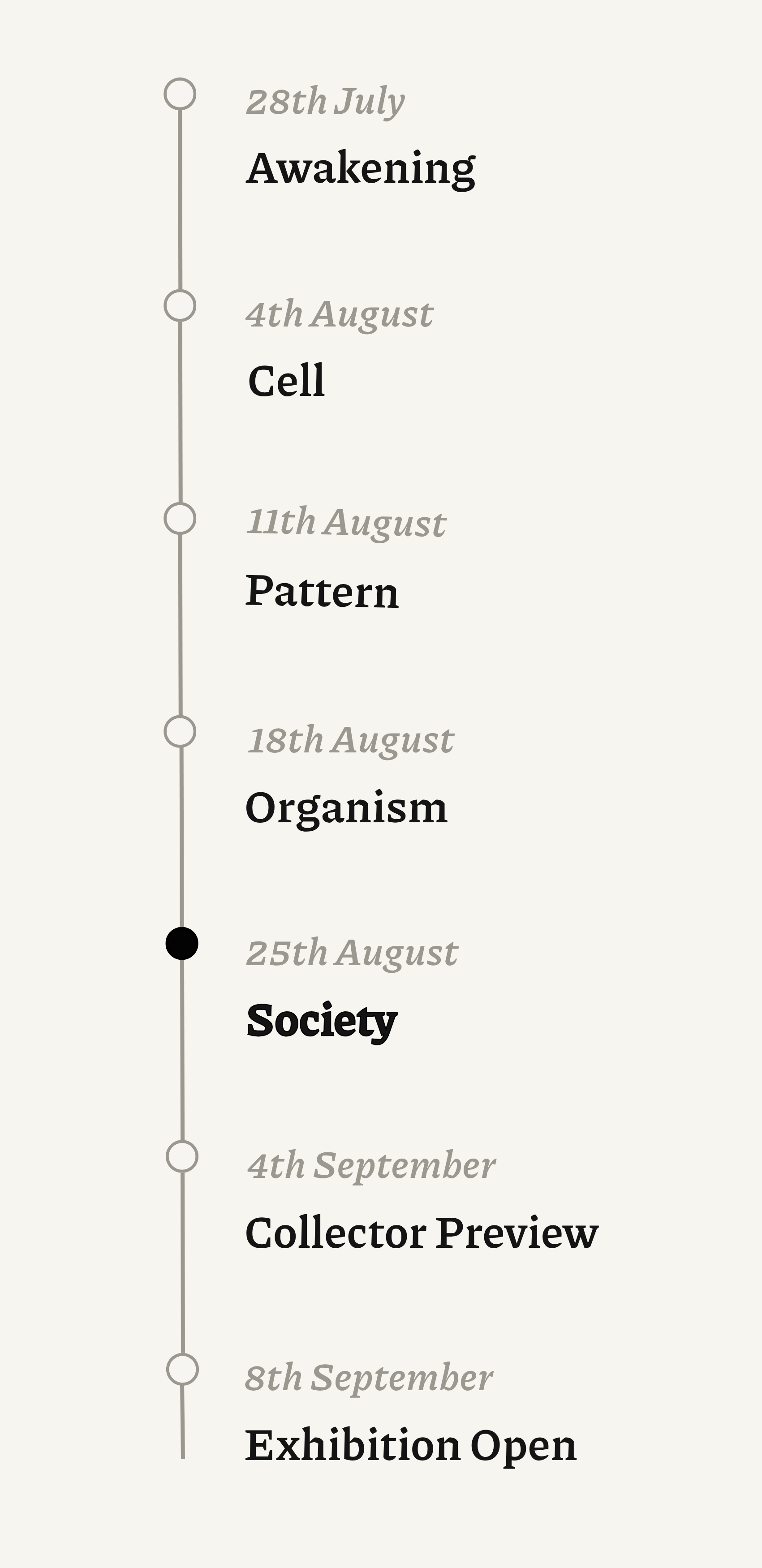
The exhibition emerges weekly until its public opening on 8 September.