
★attention economy: Beeple’s Regular Animals — Who’s a Good Dog? Whoever Gets the Most Attention.
Attention is a strange currency. The more information we receive, the less we can hold. Psychologists warned this decades ago: overstimulation erodes focus; cognition collapses under overload. Yet we keep reacting — faster, louder, more impulsively.
My last post made this painfully clear.
It generated discussion, outrage, agreement, confusion — everything except one thing: very few people actually read the full article.
Without time, slow reception, or attention to detail, no one can form a real opinion or offer meaningful critique. And that, precisely, is the point.
The most valuable currency today isn’t gold, oil, or even Bitcoin. It’s attention — the invisible architecture determining what becomes visible, valuable, celebrated, or quietly erased.
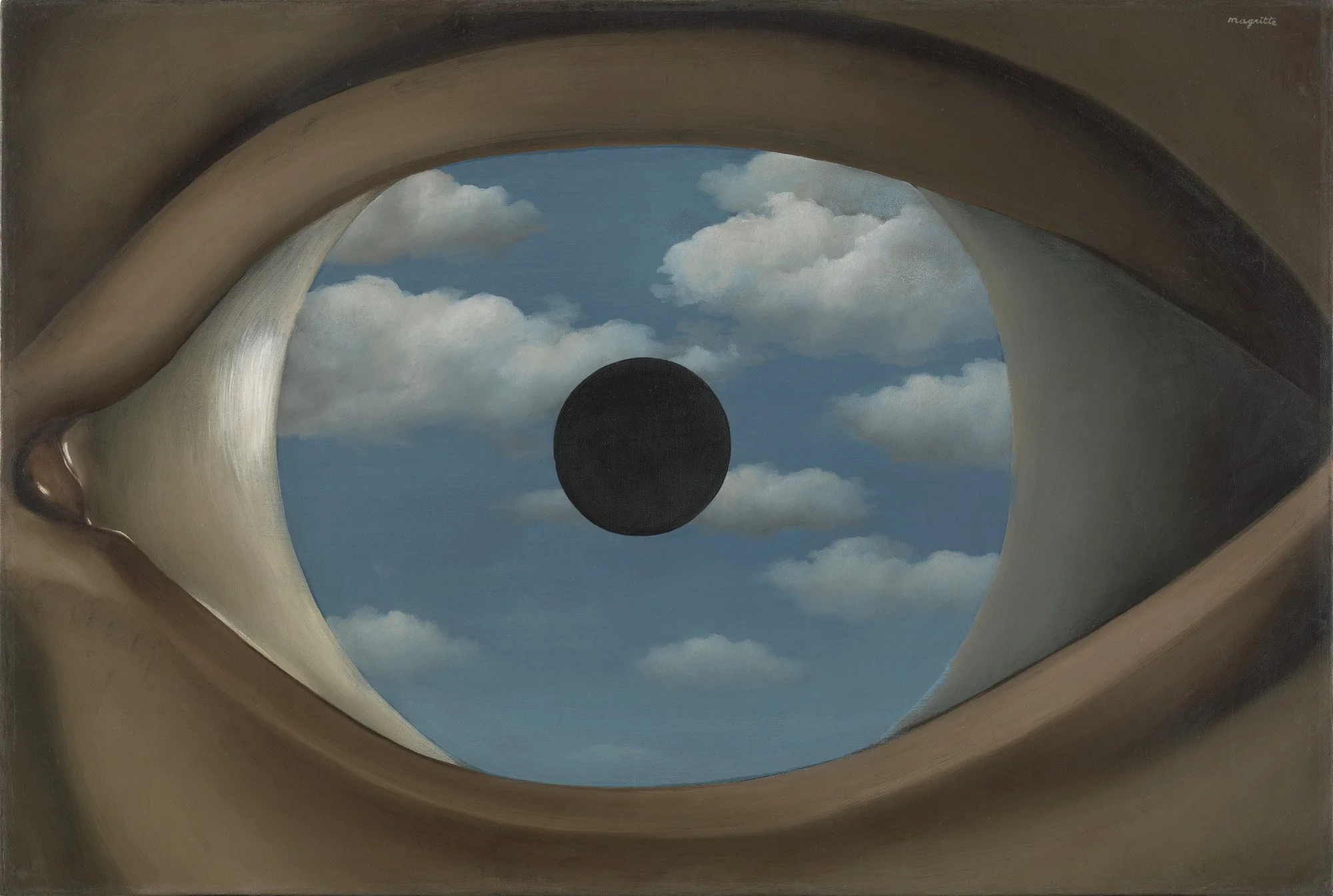
René Magritte, The False Mirror, 1928. A literal diagram of the modern internet: the eye doesn't see reality; it reflects the system back at itself. Image source: moma.org
In a world drowning in information and starved of cognition, attention is not just scarce — it is weaponized.
Psychologists warned that attention collapses under overload. Economists warned that scarcity creates markets. Today, culture forms inside the two.
Whoever shapes attention shapes narrative. Whoever shapes narrative shapes the future.
Open X and within seconds you’re pulled into a storyline you never chose — not an artwork, not an idea, but a frame engineered to feel organic.
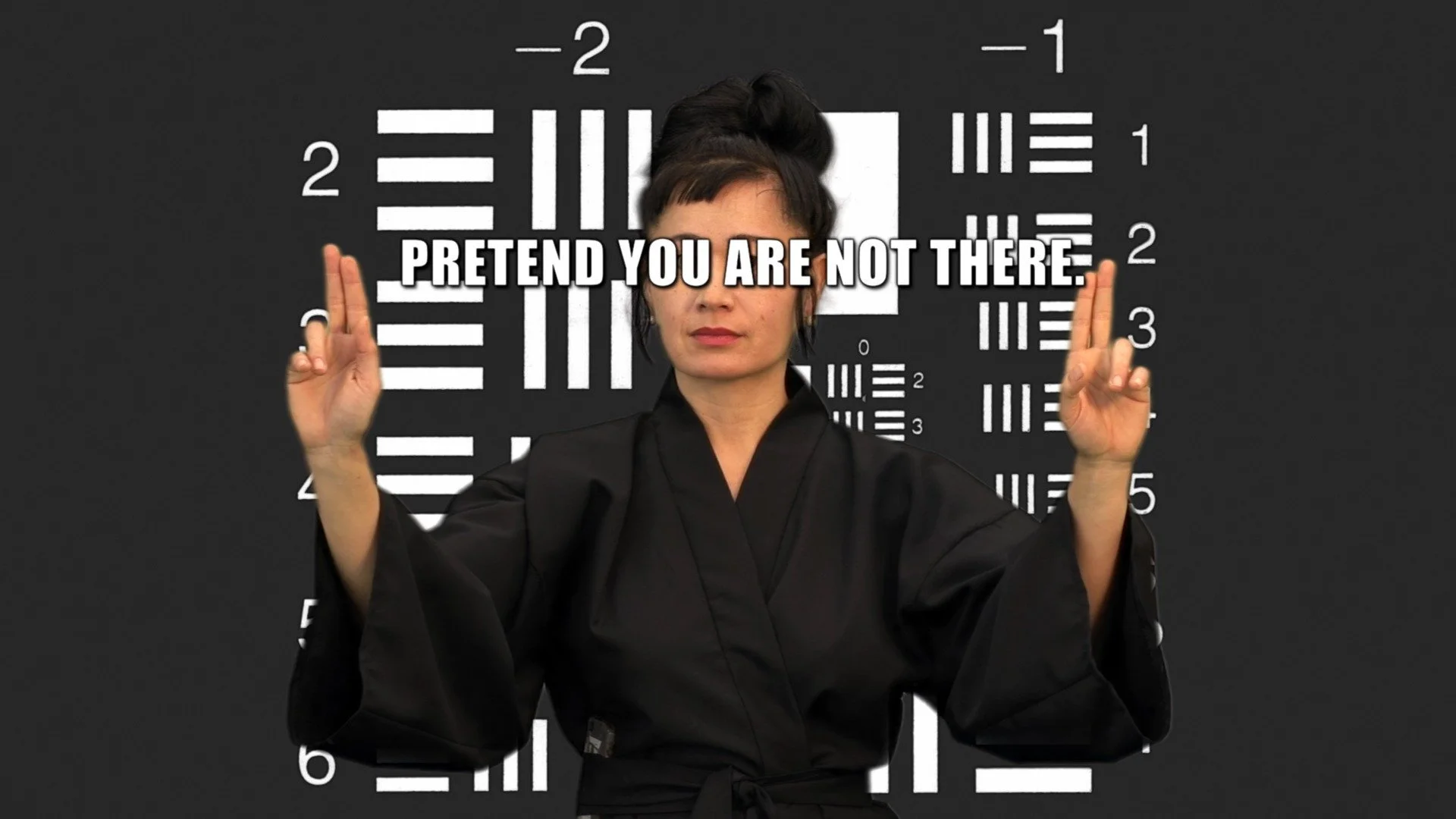
Hito Steyerl, How Not to Be Seen, 2013. A manual for surviving the visual regime. Steyerl shows what most people still refuse to admit: images aren't just pictures — they're systems of power. They compress social forces into a single frame. Image source: moma.org
Most people don’t form opinions independently — not from lack of intelligence, but because independent judgment requires three things modern culture erodes: time, context, resistance.
It’s easier to mirror what appears “liked” than risk thinking differently. And when someone diverges, the crowd rushes in to “correct” them — social pressure disguised as consensus.
Behavioral psychology has documented this for decades: when uncertainty is high, humans outsource judgment to the group. Digital art, still lacking stable institutions or literacy, amplifies this effect.
Those who command or manufacture attention now determine more than price. They determine cultural reality itself — what is seen, forgotten, declared important, or omitted entirely.
Abundance vs. the Limits of the Mind
Herbert Simon captured our era perfectly: “A wealth of information creates a poverty of attention.”
Information can scale infinitely. The mind cannot.

Pak, The Merge, 2021. Pak's highest-selling NFT, generating $91.8 million. The work is one of the best expressions of how attention becomes value. The supply of the artwork increased as more people bought “mass” during the sale — meaning the artwork literally grew through attention. Image source: barrons.com
Behavioral economists call this the attention budget: a cognitive limit beyond which every additional input forces the brain to neglect something else. When information grows exponentially and attention does not, scarcity emerges — not of capital or objects, but of focus.
Where scarcity emerges, markets form. And in attention markets:
• what stands out overwhelms what matters
• visibility becomes shorthand for value
• velocity outruns understanding
Digital culture is frantic by design. Platforms scale speed, not meaning. Web3 simply added financialization.
When the system rewards immediacy, depth becomes a risk.
Attention as a Tradeable Asset
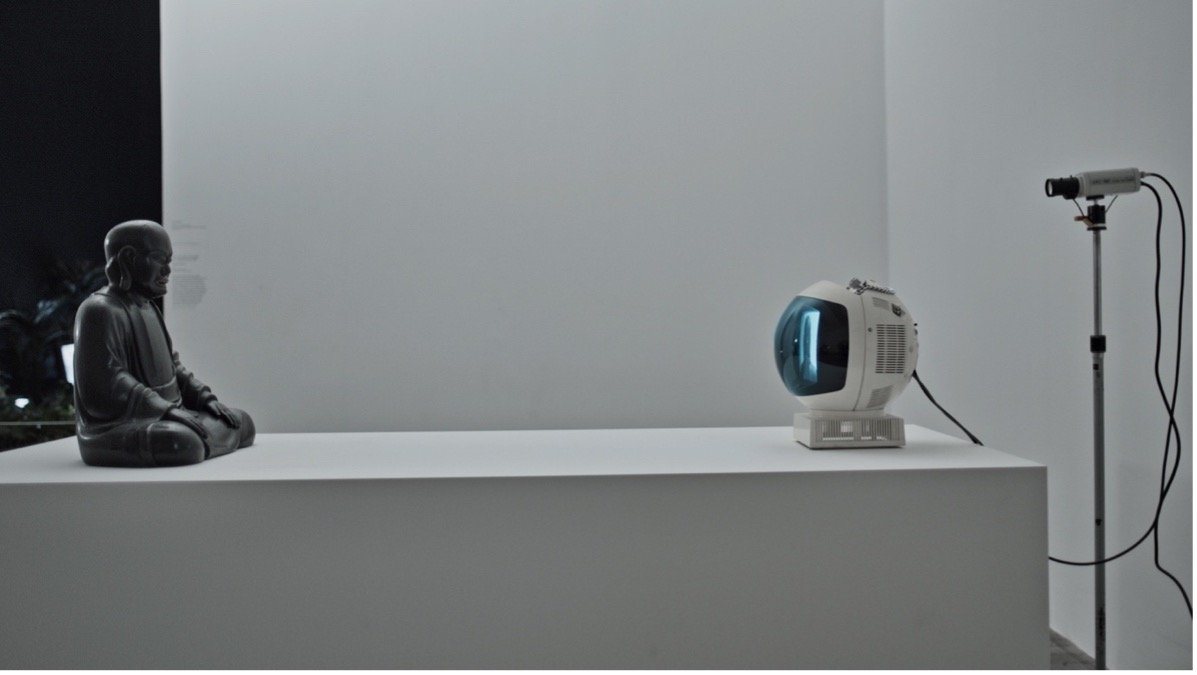
Nam June Paik, TV Buddha, 1974. Paik's recursive loop between observer and machine symbolizes a contemporary self-reinforcing cycle of attention: a recursive loop of watching ourselves watching ourselves. Image source: pbs.org
Metrics like likes, retweets, follower counts, wallet trackers, and “top sales” dashboards became market indicators → indicators became liquidity → liquidity became narrative.
A reflexive loop emerged:
Attention lifts prices.
Rising prices attract attention.
Attention endorses the narrative.
Narrative legitimizes value.
George Soros described this in reflexivity theory; behavioral economists map the same pattern in speculative cycles. Perception becomes reality long before reality is understood.
In Web3, this loop runs at hyperspeed. Not a bug — the design.
The Psychology Behind Reflexive Culture
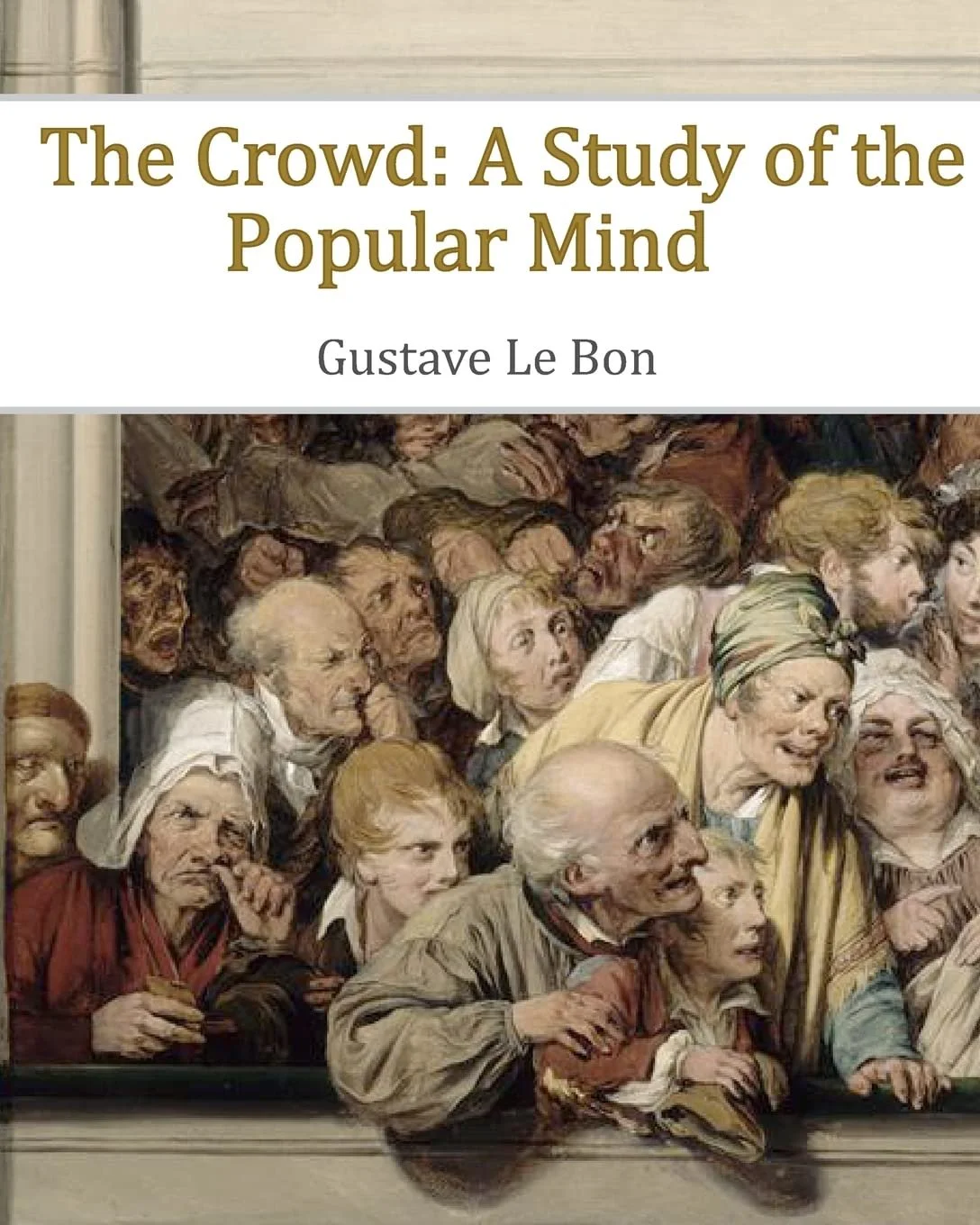
Gustave Le Bon, The Crowd: A Study of the Popular Mind, 1895. Le Bon's diagrams of crowd behavior illustrate how individuals become reflexive and irrational under social signals. Image source: amazon.com
Consumer behavior research shows that human cognition relies on fast heuristics, especially under uncertainty. Digital art — new, unstable, lightly contextualized — is the perfect breeding ground for these biases.
We are neurologically wired to prioritize:
novelty (dopamine response)
emotion (amygdala activation)
social validation (the social proof heuristic)
urgency (scarcity effect)
repetition (the mere-exposure effect)
Web3 triggers these on a continuous loop:
Quick cues override slow thinking (Kahneman’s System 1 dominates System 2).
Collective enthusiasm substitutes for personal judgment.
FOMO compresses decision-making time.
People align with what feels socially safe rather than what feels true.
In such an environment, independent taste becomes a high-cost activity. Most people, rationally, choose the alternative: they follow the signal.
The louder something is celebrated, the more “true” it feels — not because it has been understood, but because our cognition is structured to avoid social and cognitive friction.
This is not stupidity. It is psychology. It is economics.
And in Web3, it is infrastructure.
★ Case Study: Beeple’s Regular Animals. Who’s a Good Dog?
(A short analysis of attention economy dynamics — not a review of the artwork itself.)

Beeple, Regular Animals, 2025. The installation itself is an attention engine — faces, movement, absurdity. A real-world embodiment of engineered attention.
Beeple’s Regular Animals at Art Basel Miami did not simply “go viral.” It engineered virality — a deliberate construction of Dogconomy™, where spectacle converts directly into liquidity and narrative.
This is not an artistic judgment. This is an analysis of how the attention economy behaves when someone understands its mechanics with extraordinary clarity.
Beeple reads contemporary culture with unusual precision. His Everydays practice operates at the same speed, compression, and hyper-reactivity that define our digital present. In many ways, Regular Animals is a testament to that fluency — a kind of virtuosity in attention architecture.
It is also important to say this clearly:
Beeple is not the benchmark for the average artist.
He enters the attention economy with a massive collector base, institutional visibility, and an audience ready to amplify anything he releases. Most artists do not step into the arena with this infrastructure — which is precisely why this activation becomes such a revealing study of how the system behaves at scale.
Anatomy of a Spectacle
Regular Animals made its logic unmistakable.
Robot dogs wearing the faces of Warhol, Picasso, Bezos, Musk, Zuckerberg — and Beeple himself — roamed the Zero10 corner, scanning visitors and ejecting prints. Using famous faces is not incidental: the brain’s face-recognition circuitry (fusiform area) activates automatically, making these images impossible to ignore. They trigger salience, authority cues, and instant recognition — all core levers of the attention economy.
By placing his own face among cultural icons, Beeple taps into a known cognitive bias: status association. When unfamiliar and familiar stimuli appear together, the mind unconsciously transfers value and importance across them. It’s not a conscious comparison — it’s automatic associative priming.
The installation stacked the strongest attention triggers at once:
· faces (biologically prioritized),
· movement (evolutionary threat detection),
· novelty/absurdity (pattern break),
· surprise (orienting reflex).
Together, these cues force a reaction before reflection — exactly how attention functions under cognitive load. In this sense, Beeple’s activation didn’t just live inside the attention economy; it demonstrated its mechanics with textbook precision.
This wasn’t designed for slow interpretation.
It was designed for capture — a spectacle operating at the level of instinct rather than intellect.
The “car crash you don’t want to see but slow down for anyway.”
And because Beeple already commands an enormous collector base, the loop accelerated far faster than it would for any emerging artist.
Scale amplifies show.
The Crowd as Engine
The work relied less on the object itself and more on the crowd who looked, filmed, and shared. Their phones and feeds became the distribution infrastructure — a live enactment of Metcalfe’s Law, where each participant increases the network’s power.
Most viewers formed judgments without context, a classic case of heuristic substitution: not “Do I understand this?” but “Is everyone reacting to it?”
The “free poop” prints tapped into casino psychology — randomness, intermittent reward, and anticipation. When a few began trading around 10 ETH, the loop accelerated:
price → posts → spectacle → more buyers → higher price???
But attention-driven pricing follows a well-documented cognitive curve: once the stimulus fades, salience drops, social proof dissolves, and buyers realize their decision was made under attention pressure rather than evaluation.
That’s when the loop reverses:
diminished attention → lower demand → falling price
Which is why many pieces purchased at the peak usually sit at a loss — a predictable outcome in attention markets where momentum, not conviction, drives entry.
A self-reinforcing circuit, until it isn’t.
To Beeple’s credit, none of this is accidental. He has shown up every day for years, building a base, mastering spectacle, and understanding exactly how attention behaves when pushed.
Few artists possess that combination of consistency, scale, and instinct.
So Who’s the Good Dog? — The One Who Gets the Most Attention.
Economically, this is value formed by salience rather than substance — where the artwork matters less than its visibility and the velocity of its circulation.
Beeple did not merely participate in the dynamics of attention. He demonstrated their mechanics with clinical clarity.
A real-time diagram of how contemporary culture — and Web3 markets — now work.
And from an attention-economy perspective, it was almost textbook-efficient.
The Burden (and Beauty) of Slowing Down of being conscious.

Jenny Holzer, Truism: Protect Me From What I Want, 1994. Predates Twitter/X yet operates exactly like a viral command — short, urgent, psychologically loaded. Image source: artsy.net
So What’s the Solution?
In a Culture Drowning in Noise and Starving for Thought**
We live inside a system where information multiplies faster than cognition can process it. Our attention is stolen before we even realize it’s gone. AI completes our sentences. Feeds complete our opinions. And our minds — overstimulated and under-rested — struggle to hold focus long enough to care about anything deeply.
So what do we do?
We slow down.
We reclaim friction.
We choose consciousness over reflex.
Every collector I interviewed in the Collecting Art Onchain book emphasized the same point:
Art needs time. Meaning needs oxygen. Reflection requires slowness.
Yet panic-driven purchases, group-influenced reactions, or emotionally charged “first come, first served” mint frenzies now sit at heavy losses.
Not because the art was weak — but because speed dictated attention. A classic heuristic shortcut: fast decision-making under perceived pressure.
And this is the real consequence of the attention economy:
We scroll. We skim. We react.
We rarely finish reading. We almost never think.
Critical thought requires friction. And friction has been meticulously taken out of our digital lives.
Our gaze moves wherever the crowd tilts — and somehow we still celebrate that as choice, as autonomy, as decentralization.
It’s almost funny, if it weren’t tragic. The “decentralized” mind moves in perfect synchronization with the algorithmic crowd, mistaking mass signals for personal conviction.
Recovering our attention — and our ability to think — isn’t a philosophical luxury. It’s the only way to participate in culture with agency rather than drift as audience.
Audit the Narrative - Ask the Hard Questions
Meaning is not found in the feed. Meaning is found in what the feed tries to distract us from.
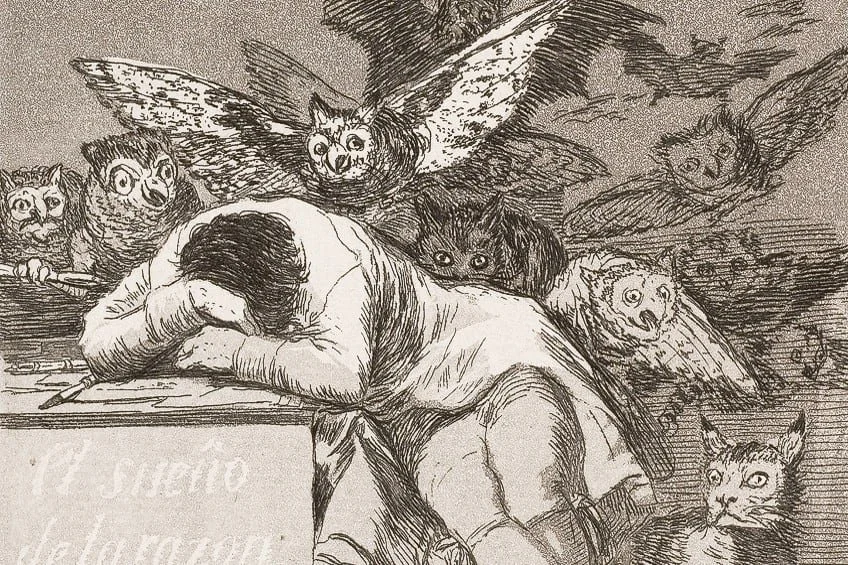
Francisco Goya, The Sleep of Reason Produces Monsters, 1797-1799. Image source: artincontext.org
A moment of metacognition — a brief audit of our own habits before they quietly become our beliefs. Goya’s warning still applies: when awareness sleeps, other forces do the thinking for us.
If we want to reclaim our attention — and with it, our narrative — we have to practice a different discipline:
• read beyond the scroll
• think longer than we react
• look before we like
• disagree without exile
• reward depth over noise
• design systems that slow us down when the world accelerates
Meaning is almost never found in the feed. Meaning lives in everything the feed rushes us past.
In an economy built on attention, choosing where to look is the last form of freedom we fully control. And the future of digital art — of any culture worth preserving — depends on whether we exercise that freedom consciously.
xxx
★ Featured Artists/Artworks
René Magritte — The False Mirror (1928)
Pak — The Merge (2021)
Hito Steyerl — How Not to Be Seen (2013)
Nam June Paik — TV Buddha (1974)
Jenny Holzer — Truisms: Protect Me From What I Want (1994)
Francisco Goya — The Sleep of Reason Produces Monsters (1797–1799)
Beeple — Regular Animals (Art Basel Miami)