
Are We Doomed - or Simply Miscommunicating?
(XCOPY, Mixed Signals, and the Psychology of Seeing).
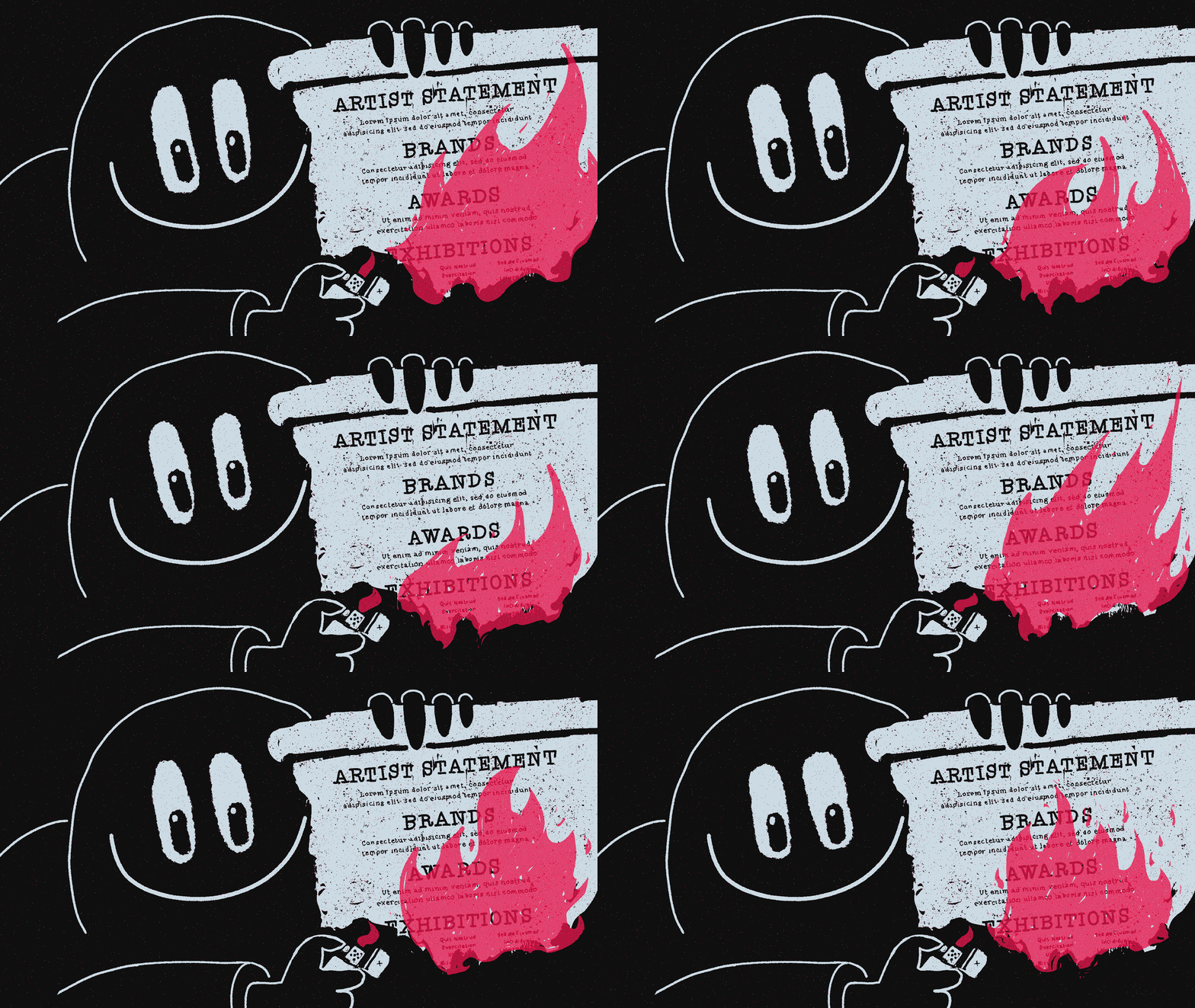
XCOPY, CryptoArtLand, 2020.
In the days following Art Basel Miami’s Zero 10 activation, an Observer article reignited a familiar standoff between Web3 and the traditional art world. On one side, Web3 participants argued- once again -that critics had “missed the point” of XCOPY’s work: its critique of systems, its intentional instability, its refusal to behave like art is supposed to behave. On the other hand, traditional critics insisted they had done nothing more than describe what they encountered: a laundromat installation, millions of free NFTs, and a spectacle that vanished almost as quickly as it appeared.
But this recurring debate misses the more interesting question.
The issue is not who is right.
The issue is whether any of us Web3, institutions, critics, collectors truly understand how XCOPY is being communicated, and how that communication shifts as it moves across contexts.
What looks like misunderstanding may, in fact, be a structural problem of transmission.
The Paradox of Displaying Non-Canonical Art
XCOPY’s art is often discussed in relation to entropy, unreliability, and systems collapsing under their own weight, frequently understood as reflecting the volatility, speed, chaos and repetition of internet culture itself. From the beginning, it existed in unstable conditions: distributed across ephemeral platforms, endlessly looped, circulating as files that felt disposable rather than fixed. Images repeated themselves, copied, saved, reposted, and reinterpreted.
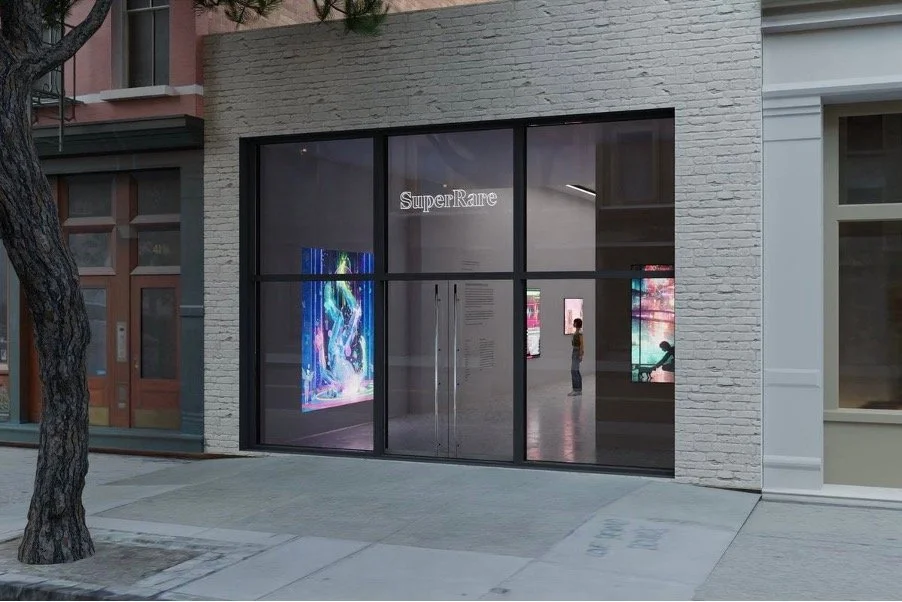
His work did not invite slow contemplation in controlled environments; it thrived on friction, volatility, and misalignment. It resisted the mechanisms through which art typically stabilizes: archival coherence, institutional framing, and the gradual smoothing of edges that accompanies canon formation.
In this sense, XCOPY’s work was not merely anti-canonical in style.
It was anti-canonical in behavior.
Something feels askew about seeing XCOPY, in 2025, neatly displayed on wall-mounted screens inside a physical gallery. Presenting these works as a stabilized “timeline” within a clean white-cube setting risks softening the very instability that gives them their force. This is not a critique of the display itself, but a reflection on the viewer’s perception, especially when approaching an artist whose work was conceived to disrupt canonization rather than settle into it.
The SuperRare gallery, however, stands as a meaningful exception. It carries a particular legitimacy as a kind of homecoming: the platform where XCOPY minted his early 1/1 digital works. In this context, the exhibition, Tech Won’t Save Us, reads less as institutional containment and more as an evolution, both of SuperRare and of the artist, tracing a trajectory from the digital canvas into physical gallery space.
Rather than neutralizing the work, the setting reveals an interesting expansion of XCOPY’s practice, and of the platform itself, as both move beyond their original digital parameters.
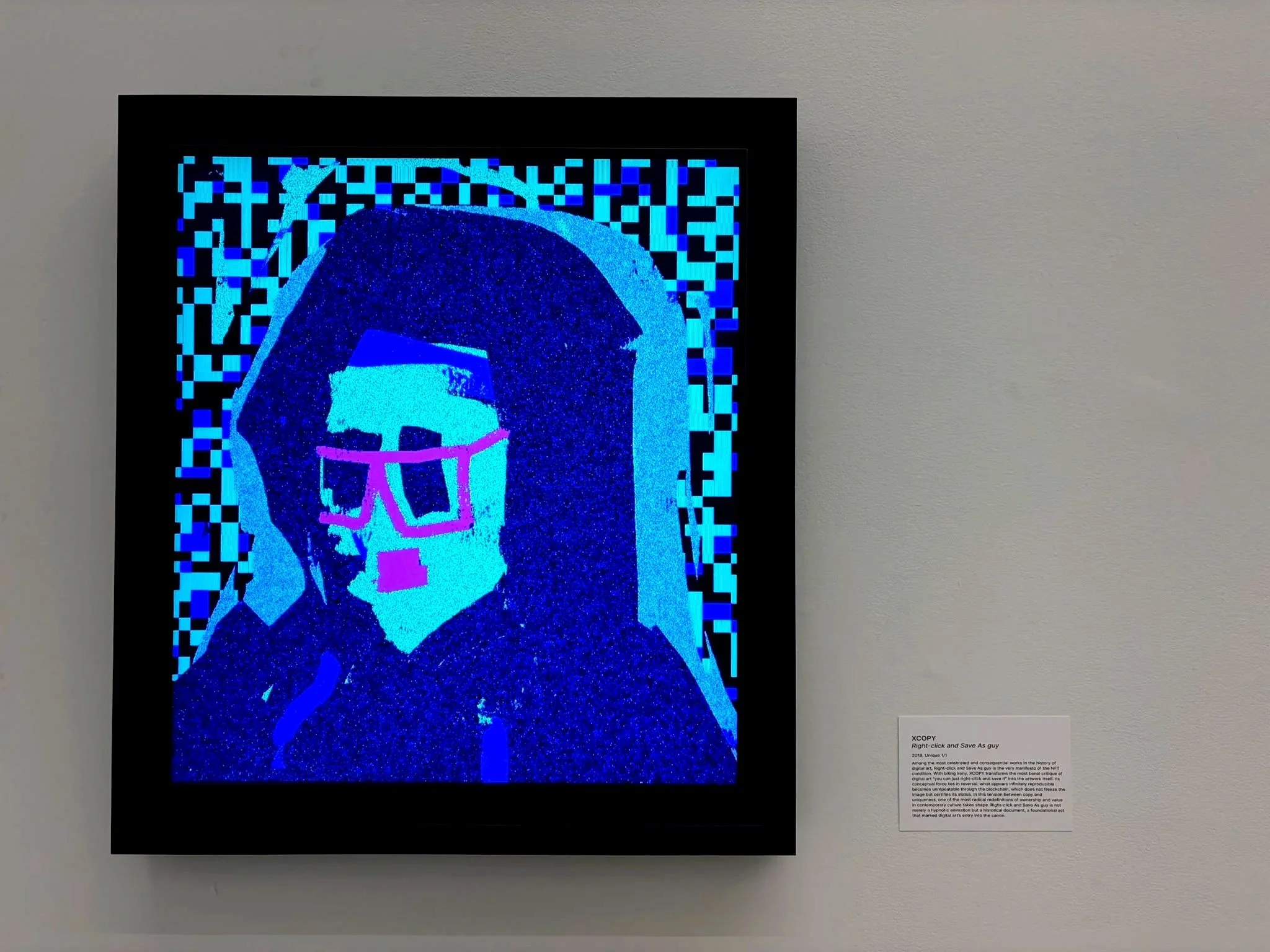
XCOPY, Right-click and Save As guy, 2018, exhibited in Tech Won’t Save Us, organized by SuperRare in collaboration with The Doomed DAO, Offline Gallery, New York.
The question is not whether this form of presentation is legitimate.
The question is more fundamental:
What does it mean to canonize anti-canonical art?
Canonization is one of the most powerful context-shifts an artwork can undergo. To canonize a work is to relocate it, to place it within new spatial, cultural, and interpretive frameworks that actively shape how it is seen.
In this sense, canonization cannot be separated from a deeper issue: how artworks change meaning as they move across contexts.
So when XCOPY appears in a white cube gallery, an underground basement, and a global art fair within the same month, radically different interpretations are inevitable.
The work has not changed.
The contexts have.
The message fractures because framing alters how the work is perceived.
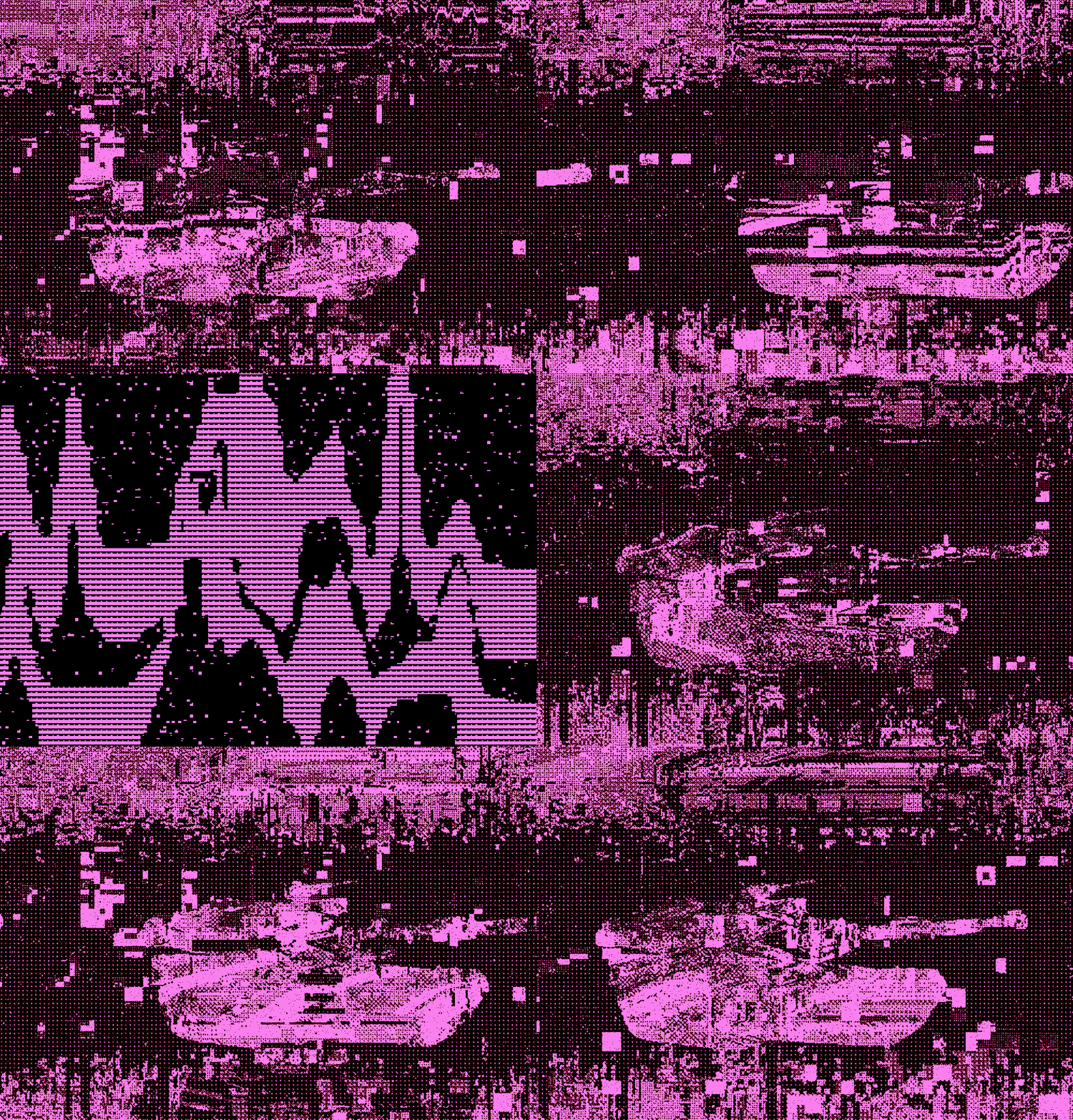
XCOPY, Loading New Conflict... Redux 5, 2018.
Perception Is Never Neutral
Psychology offers a useful lens here. We do not encounter artworks as blank slates. Perception is filtered through expectation long before the eye meets the object. Cognitive science refers to this as top-down processing: the mind supplies meaning in advance, filling gaps with assumptions, cultural cues, and prior beliefs.
In other words, we rarely see what is.
We see what we expect to see.
As art historian Ernst Gombrich famously observed, there is no such thing as the innocent eye. Seeing is never neutral; it is conditioned by habit, context, and belief.
From the early twentieth century, artists and theorists have challenged the idea that an artwork carries a stable meaning independent of where and how it is encountered. Marcel Duchamp’s readymades marked a decisive turning point. They demonstrated that placement alone could transform interpretation.
Context was no longer a neutral backdrop.
It became an active producer of meaning.
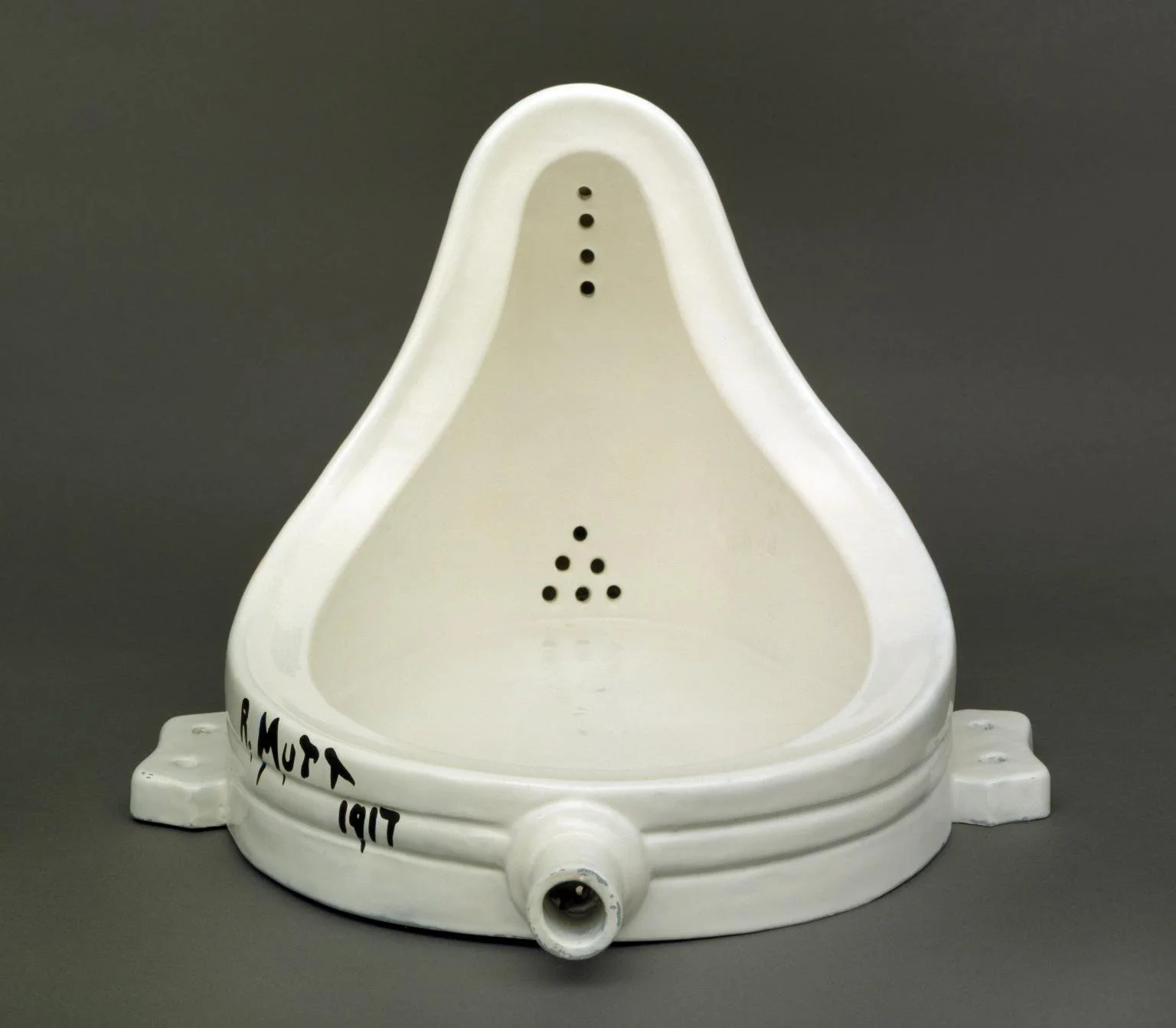
Marcel Duchamp, Fountain, 1917. Source: tate.org.uk
By the late 1960s and early 1970s, this expanded into a broader awareness of framing. Daniel Buren, in essays such as The Function of the Museum (1970), argued that museums and galleries do not merely display artworks, but they also actively shape how works are perceived, valued, and understood.
Meaning does not reside solely in the object. It emerges at the intersection of work, space, and expectation.
This becomes even clearer with digitally native works. They often accumulate meaning, value, and interpretation before they ever enter a physical exhibition space. The gallery or museum is not their point of origin, but one context among many. When they appear in physical form, they do not arrive as neutral objects. They arrive already shaped by prior circulation, community belief, and expectation.
What emerges is not a single meaning, but a series of encounters, each shaped by the conditions in which the work is met.
New York: “Tech won’t save us,” community might.
SuperRare was among the first environments in which XCOPY’s 1/1 works were minted, circulated, and meaningfully understood. Hosting Tech Won’t Save Us in New York, in collaboration with The Doomed DAO, is not an act of appropriation but of continuity, a homecoming that honors where both the artist and the platform began, while acknowledging how profoundly each has evolved over years.
Seen through this lens, the apparent tension between XCOPY’s destabilized, glitch-driven aesthetic and the gallery’s institutional calm becomes reflective rather than adversarial. What once existed, as often described, as raw disruption now carries history. What once resisted framing now tests it. The glitches remain, but they arrive with memory. The instability is intact, yet it is viewed through the accumulated weight of time, community, and belief.
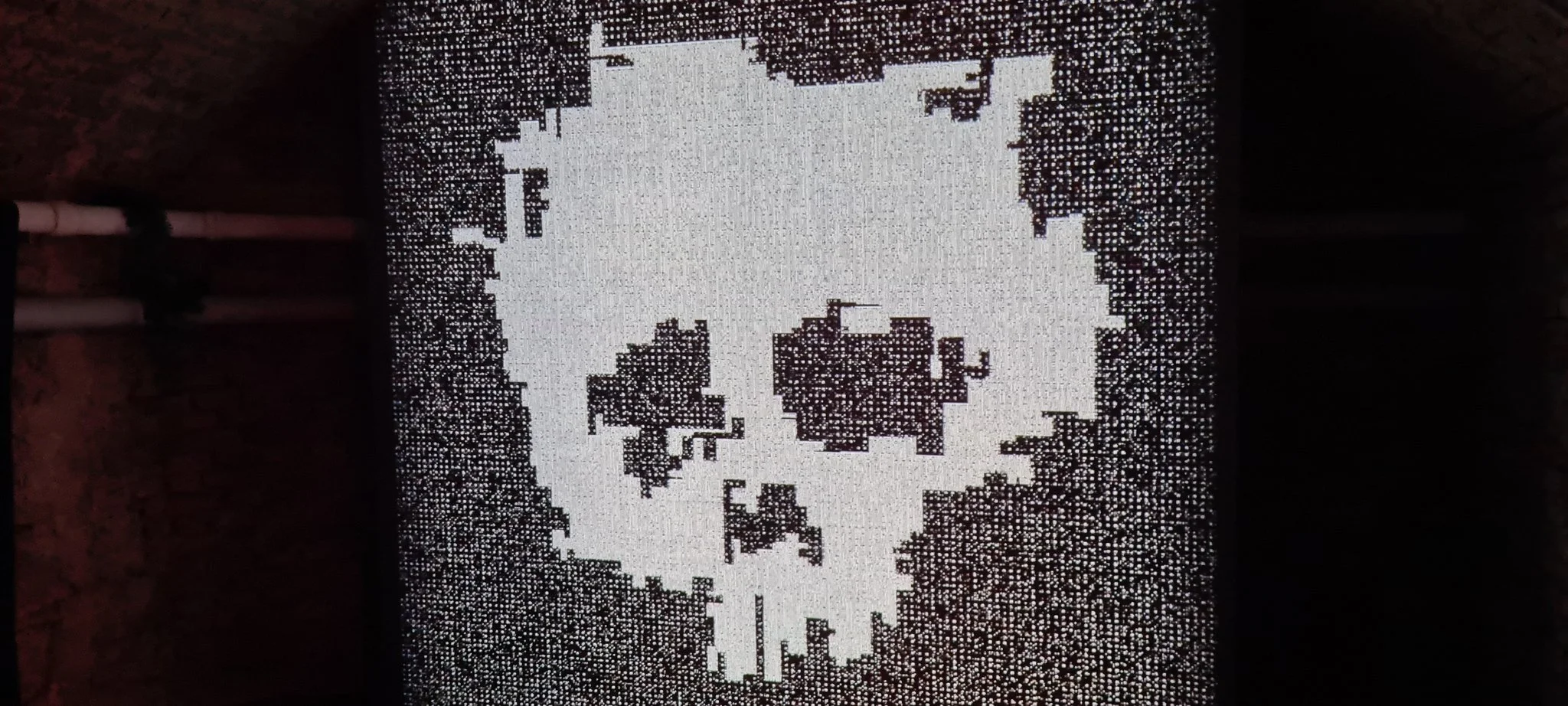
XCOPY, The Doomed (Mono), 2019, exhibited in Tech Won’t Save Us, organized by SuperRare in collaboration with The Doomed DAO, Offline Gallery, New York.
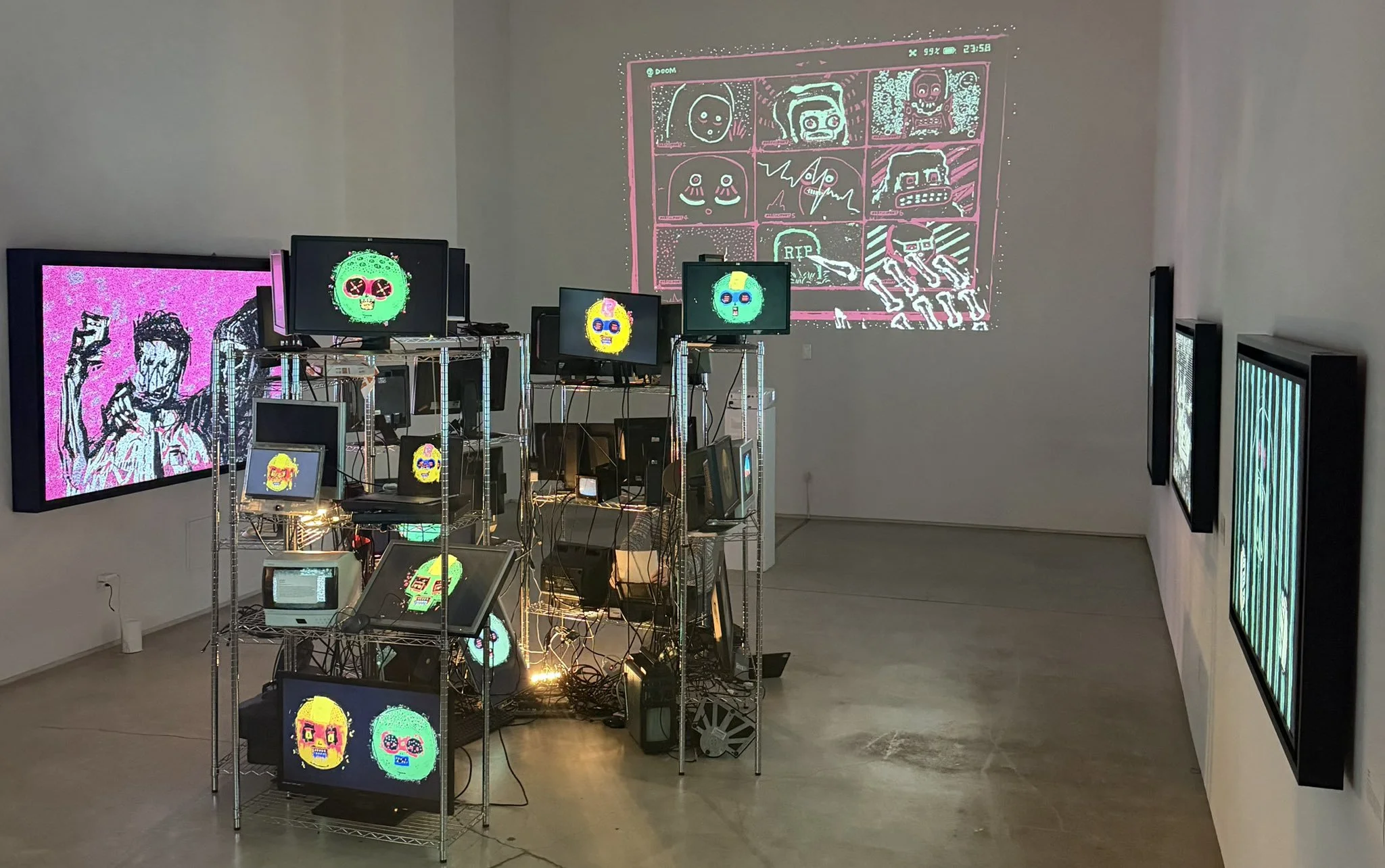
The exhibition Tech Won’t Save Us, organized by SuperRare in collaboration with The Doomed DAO, Offline Gallery, New York.
Psychologically, the gallery still activates art-historical expectation. Viewers arrive prepared to analyze, contextualize, even canonize. But here, that expectation becomes part of the work. The framing suggests permanence; the imagery resists it. The friction is not a flaw, it is evidence of change.
The exhibition’s real gravity, however, lies beyond the screens. XCOPY, SuperRare, The Doomed DAO, and a deeply committed community occupy the same space, collapsing distance between artist, platform, and audience. The artwork becomes relational not because it demands interaction, but because it is inseparable from the network that carried it forward. In this moment, the network is no longer abstract, it is embodied.
What shifts in this context is not the content of the work, but its function. The work enters the white cube already carrying its own history, beginning to operate as a cultural artifact. XCOPY’s disruption is no longer only an act of refusal, it becomes an object of sustained attention. Volatility is slowed. Instability is held long enough to be examined. The work does not lose its critical force, but it changes how it is experienced, from immediate disruption to something viewers can stay with and examine.
Perception still diverges: Some viewers see canonization. Some see contradiction. Some see celebration.
All are correct.
And perhaps that, too, is a measure of how time changes us, not only the artist and the platform, but the way we learn to see, and what we believe art should be.
Vienna & Melbourne: When Art Becomes a Signal Rather Than an Object
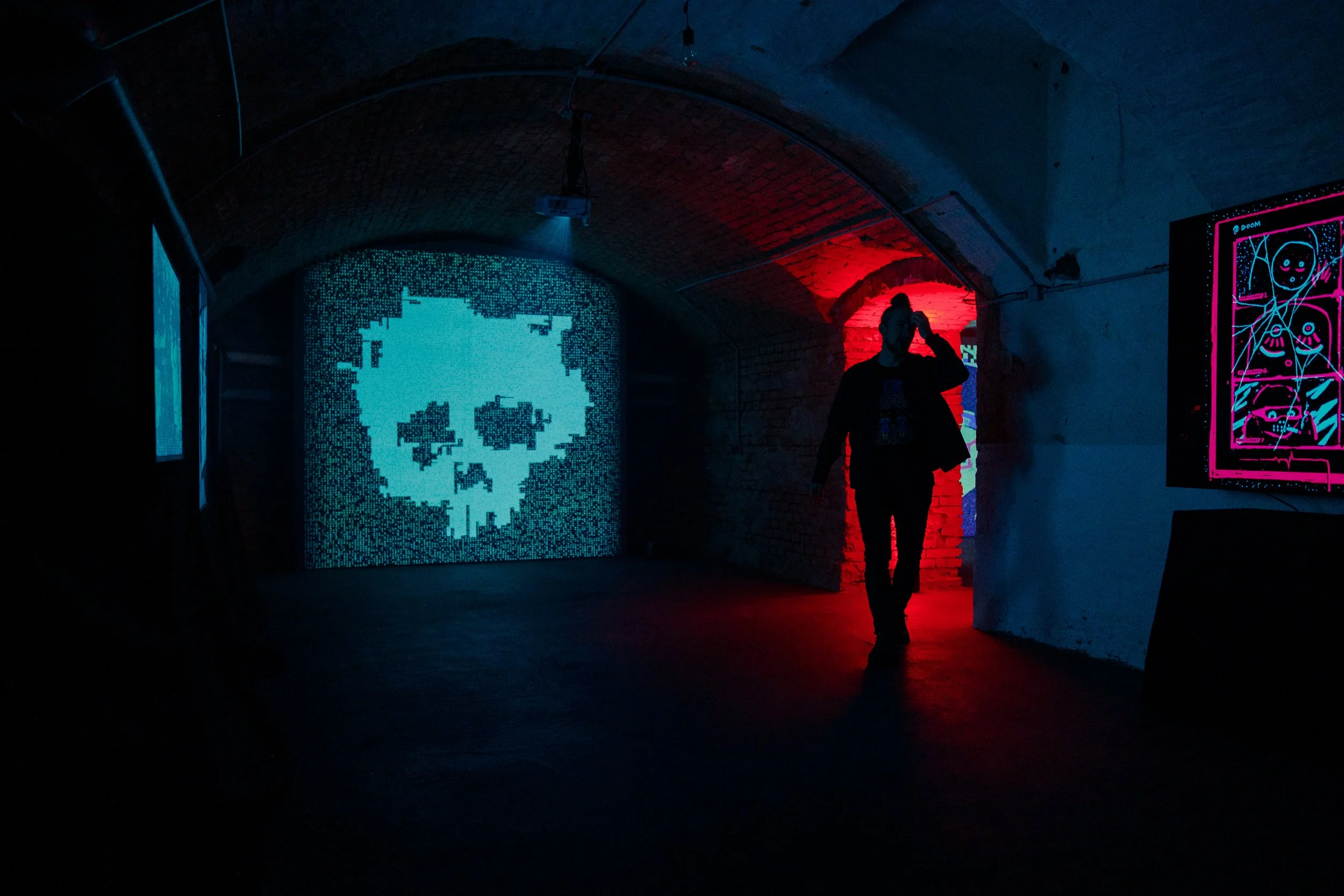
The satellite exhibition of Tech Won’t Save Us, Vienna, Austria. Organized by The Doomed Dao members @nessnisla.eth, @_mp9x
If New York renders XCOPY a cultural artifact, Vienna treats him as a transmission.
As a satellite exhibition of Tech Won’t Save Us in Vienna, the works are installed in a basement, where screens flicker against concrete walls indifferent to institutional decorum. Nothing in the space instructs the viewer on how to behave or what to think. Meaning is not ‘curated’; it is encountered.
Here, framing bias weakens. Without cues that signal “high art,” viewers generate interpretation more freely. A screen underground triggers adjustment rather than analysis. The work feels discovered, not presented.
In this environment, the work aligns closely with the visual language and cultural conditions from which it originally emerged. The absence of polish and institutional cues allows the work’s instability, discomfort, and refusal to surface more directly.
Responses vary. Some experience nostalgia, echoes of early internet culture. Others sense refusal, art that won’t resolve into comfort. Some dismiss it entirely as “screens in a basement.”
The file, of course, is unchanged.
Only the context shifts again and with it, the meaning.
Art Basel Miami: Expectation, Misperception, and the Laundromat
Art Basel Miami introduces the most acute perceptual conflict: XCOPY’s Coin Laundry, where more than 2.3 million free NFTs were claimed, all but one designed to self-destruct over the next ten years. Coin Laundry was conceived specifically for this scale and setting, where mass participation, speed, and disappearance are not side effects but core elements of the work.
Within Web3, the work was largely read as critique, a dismantling of value stability, liquidity theater, and the fetishization of ownership. Within the traditional art world, it appeared to confirm long-held suspicions: abundance without scarcity, spectacle without substance, volatility masquerading as meaning.
This is confirmation bias at work.
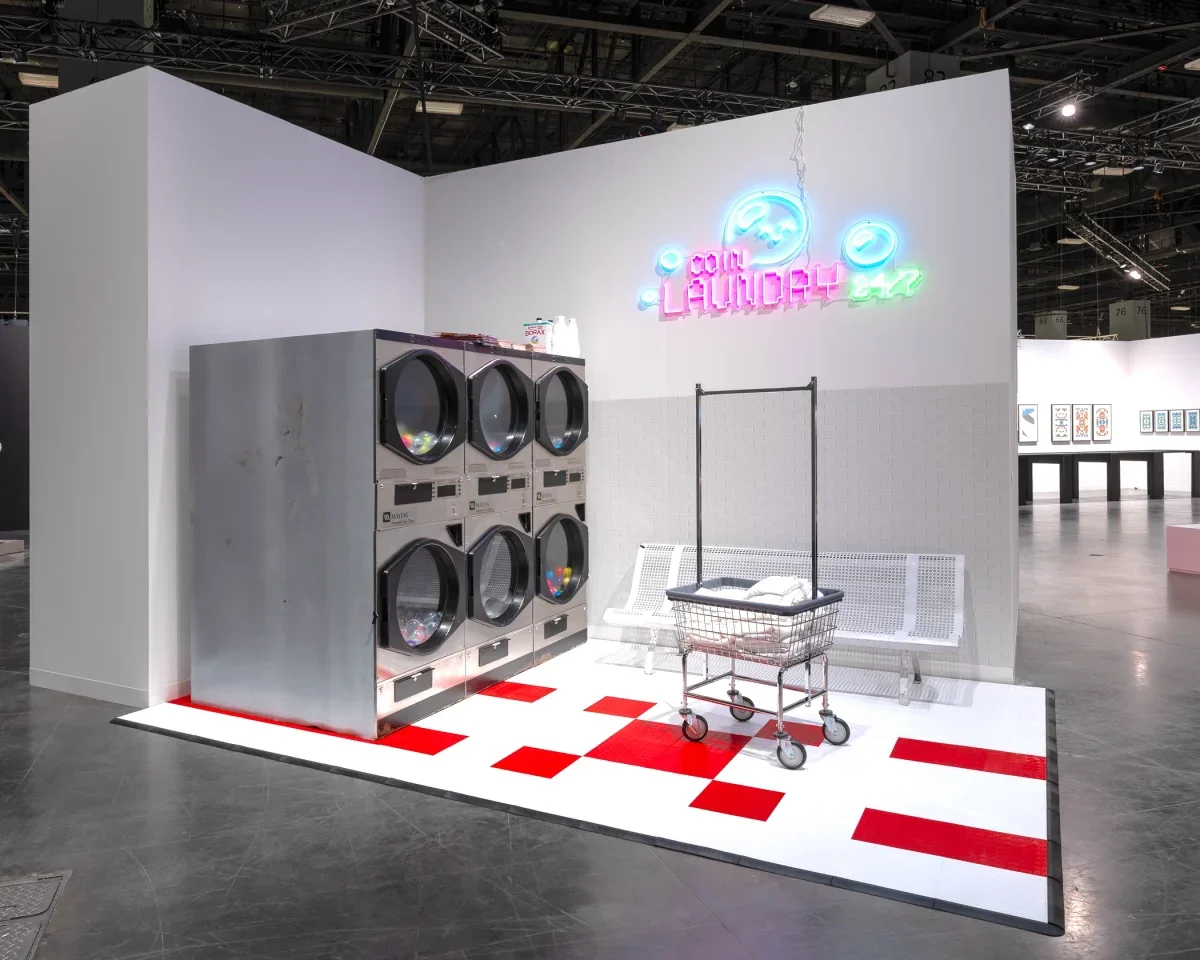
XCOPY, Coin Laundry, 2025, presented by Nguyen Wahed at Art Basel Miami.
People interpret information in ways that reinforce what they already believe. XCOPY dissolves value systems; critics perceive disposability. Their interpretation is not wrong, it’s just partial. They are not, as many claim, ‘missing the point’; they are encountering it through a familiar psychological schema.
Scale does not distort meaning; it accelerates it. When a work reaches millions, interpretation compresses, and familiar expectations assert themselves more quickly. The intention remains intact, but the conditions of reception shift.
Learning How to See and How to Connect
The challenge is not how to show XCOPY’s work.
It is how to connect it to audiences who are not already native to its language, who do not come from crypto, blockchain, or online network cultures.
XCOPY’s practice was never built to explain itself to everyone at once. It emerged from specific conditions: digital scarcity, speculative economies, on-chain identity, and communities that understood value as volatile, temporary, and often performative. When that work enters broader cultural spaces, it encounters viewers who lack not intelligence, but context.
Perspective matters. Expectation matters. Experience matters.
Meaning does not fail here, it collides.
XCOPY’s work operates as conceptual art, but its concepts are encoded in network logic rather than art-historical language. For those outside that logic, the signal can register as noise. This does not invalidate the work; it reveals the gap between worlds that are now colliding.
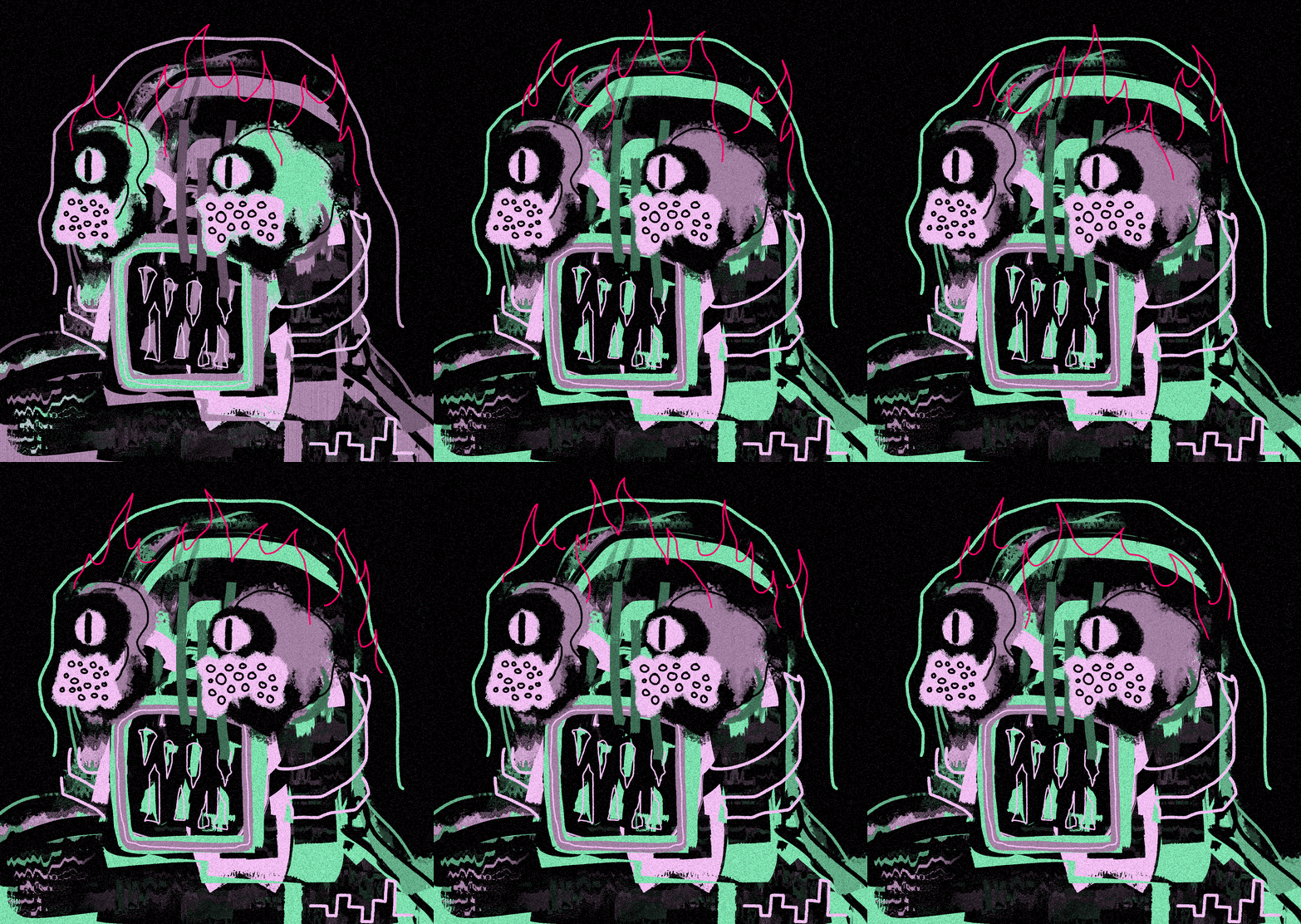
XCOPY, the fuck you looking at?, 2020.
Can we learn to encounter the work without demanding immediate comprehension?
Children do this naturally.
They do not need fluency in systems to respond, they are moved by intuition. They experience first. They remain open to confusion. They allow meaning to form over time rather than insisting on resolution.
Perhaps this is the mode of viewing XCOPY requires; not expertise, but suspension. A willingness to step back from expectation and let the work exist before asking it to perform.
If so, XCOPY’s practice is not about cleanly bridging worlds or translating itself into familiar terms. It exists in advance of mass understanding, inhabiting networked futures that will inevitably spill into physical reality, but never on stable terms.
The work does not ask to be celebrated.
It does not ask to be agreed with.
It asks only to exist long enough to be encountered, before perspective, belief, and expectation decide what it is allowed to mean.
Yet gathering, curating, narrating, canonizing - these are institutional actions no matter who performs them. Decentralization dissolves authority only for it to quietly reassemble elsewhere, often inside a Discord server.
The Doomed DAO does not resolve this tension; it holds it. It attempts to preserve entropy where systems naturally seek permanence. XCOPY never promised stability, longevity, or preservation.
A noble contradiction. In other words -
Very XCOPY ;)
xxx
Disclaimer
This text does not claim to define XCOPY’s intentions. The aim of this article is not to explain XCOPY, but to examine how meaning shifts through context, framing, and viewer perception as the work moves across platforms, spaces, and audiences. What is described here is not what the work is, but how it is seen.
Credits & Congrats
Strong work by all who shaped XCOPY’s work across contexts and cities:
New York - @SuperRare, @_MP9X and the whole @TheDoomedDAO (Tech Won’t Save Us)
Vienna - the satellite organizers who embraced friction and let the work function as signal, not object
Art Basel Miami - @artbasel @zero10art (Coin Laundry)
Melbourne & beyond - independent curators and local teams continuing to test digital art in the wild.
Well done to everyone involved.
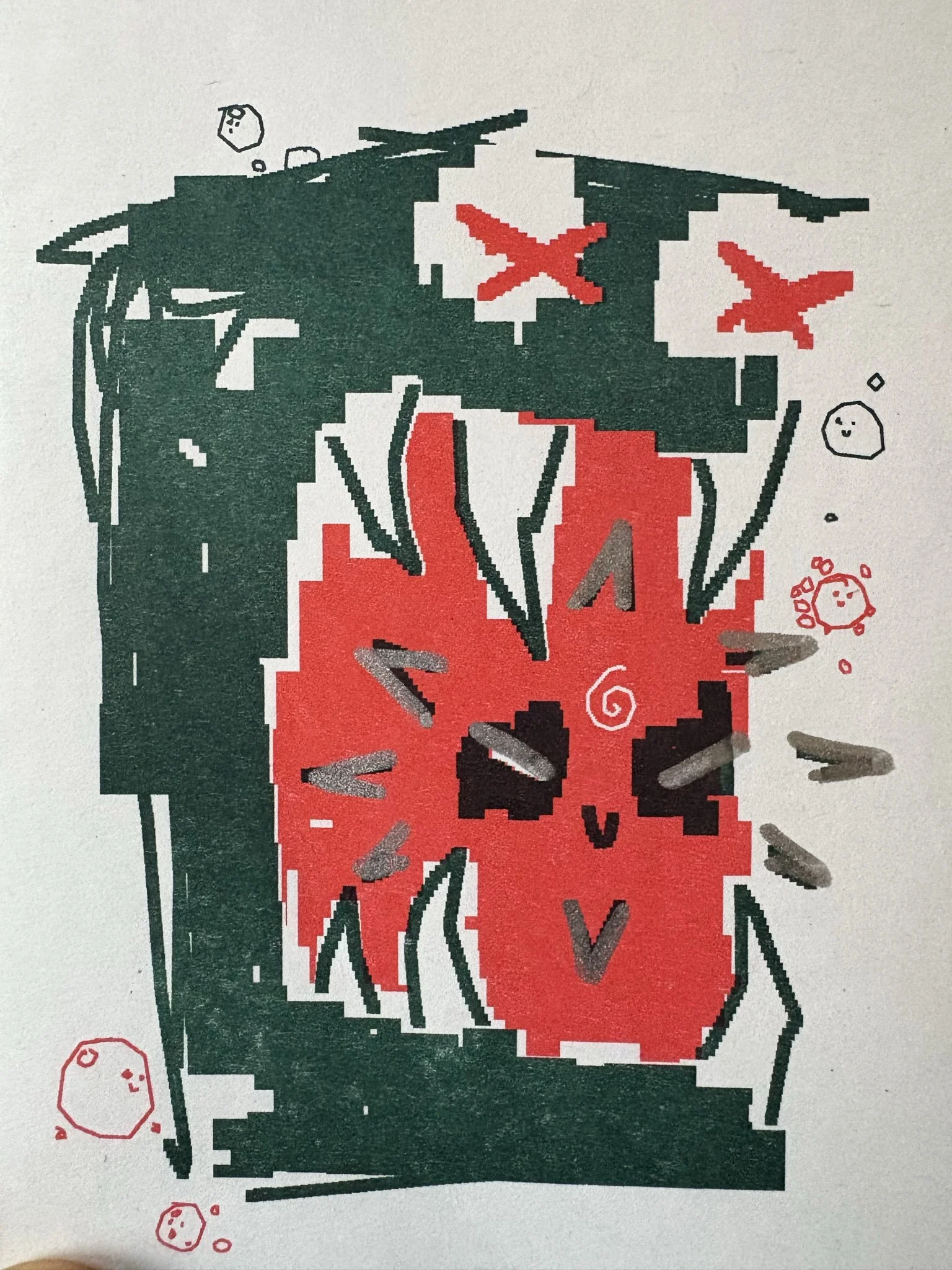
Physical card, signed by XCOPY, distributed at his solo exhibition Tech Won’t Save Us at Offline Gallery, New York.