
A pioneer of blockchain conceptualism, artist and writer Rhea Myers has spent more than a decade interrogating the cultural, political, and philosophical dimensions of cryptography. In this conversation, published by the DIFFRACTIONS collective, she traces her path from net art to protocol art, offering rare insight into the beliefs, tensions, and contradictions that animate her work.
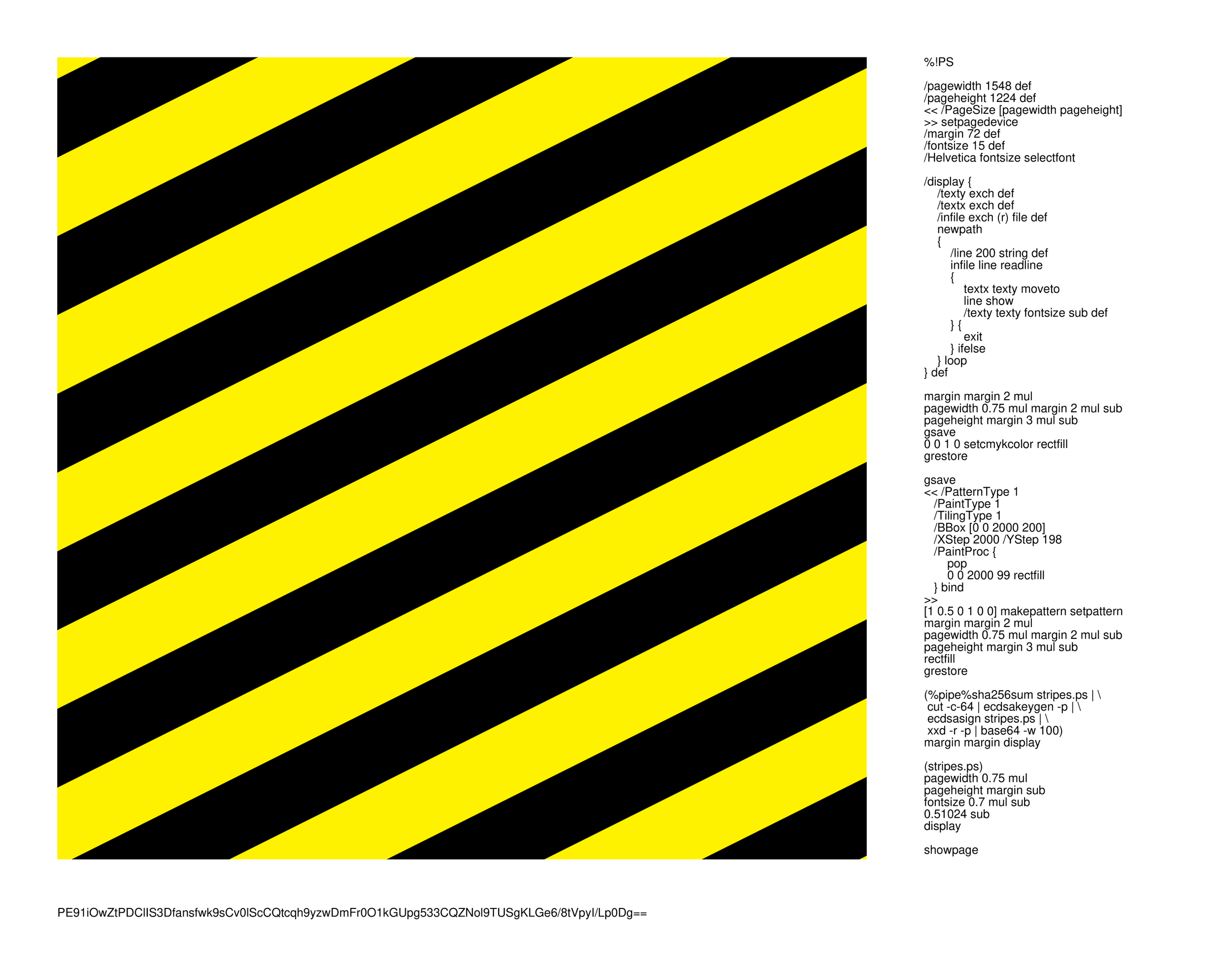
Rhea Myers. Self-Identifying (2025), PostScript code and NFTs/floppy disks.
The Dark Precursor and its Signature // Rhea Myers
10/31/2025, Published at diffractionscollective.com
Rhea Myers is an artist, hacker, and writer based in British Columbia, Canada, originally from the UK. She makes art to understand the world, mutually interrogating technology and culture to produce new ways of seeing the world as it unfolds around us. Since 2014, she has used the blockchain as a medium for embodying, critiquing, and moving beyond the anxieties of post-financial-crisis society.
Inspired by the histories of conceptualism and net art, Rhea has worked with digital imagery and computer code and produced theory, critique, and fiction as the blockchain art world has gone from the imagination to the mainstream. She didn’t invent NFTs, though. Twice.
Rhea’s art has gained international recognition. It is exhibited globally, sold at prestigious auction houses like Sotheby’s, and collected by renowned institutions such as the Albright Knox Gallery in the US.
DIFFRACTIONS: Can you speak to your personal arc and journey? Your work weaves together a number of threads: philosophical, conceptual art, Free and Open Source Software, cryptographic systems, and the interrogation of self-identity are also bound up with your practice. What were some formative moments, artists or encounters for you?
RHEA MYERS: Ever since I was a child, I’ve wanted to understand the world despite it making no sense to me. It felt like everyone else had a secret rule book or instruction manual for society that someone had forgotten to give me a copy of. So I embraced playing with rule systems that created spaces of relative certainty and simplicity—role-playing games, making art, writing software, using alternative copyright licenses, wrangling cryptography. I can see people raising eyebrows at the idea that any of those are simple, but they are nothing compared to understanding other people.
Because of the artists you mentioned and the popular culture of the time, I went to art school in the 1990s to make that sense by making art with computers. As a result, during the dot.com boom, I lucked into being able to work in tech to support my family while still making art. And did not sleep very much as a result. I focused on obscure technologies so my lack of a computer science degree wouldn’t count against me when applying for jobs (this was totally intentional). I viewed this as a decades-long embedded anthropology study. The experience has informed my art by making sure I’m both intimately familiar with and not naive about the imaginary of technocapital.
The pivotal development for me as an artist was coming to understand cultural reference as representation and composition of it as critique. What Maya B Kronic called “aboutness”. Warhol’s use of mass media and his synthesis of Neo-Dada and Colour Field painting inspired me as I read obsessively through the catalogue of his MoMA show in Sixth Form art class. Jeff Koons’ alignment with capitalism and kitsch to critique race, class, and gender; Art & Language’s indexical materialist art criticism embedded in art itself; and Julian Opie’s similarly project-based work stretched my ability to think about art and its production when I was at art school. Philosophically, by the end of art school, I liked Paul Virilio, Jean Baudrillard, Manuel DeLanda, and Nelson Goodman. If you look closely at my writing, you can see me finally giving in and getting into Deleuze & Guattari via the Ccru around the same time that I got into crypto. It’s important to me that I’m never illustrating my theory or writing apologetics for my art. The work is always the work. I follow the ideas where they take me, into the best medium for realizing them, whether that’s a hand-drawn image, a technical standard, or a data visualization of my brain.