
 Image 1 of 1
Processing / Javascript
Archival pigment print on cotton rag.
34 x 14".
Ed 1/1
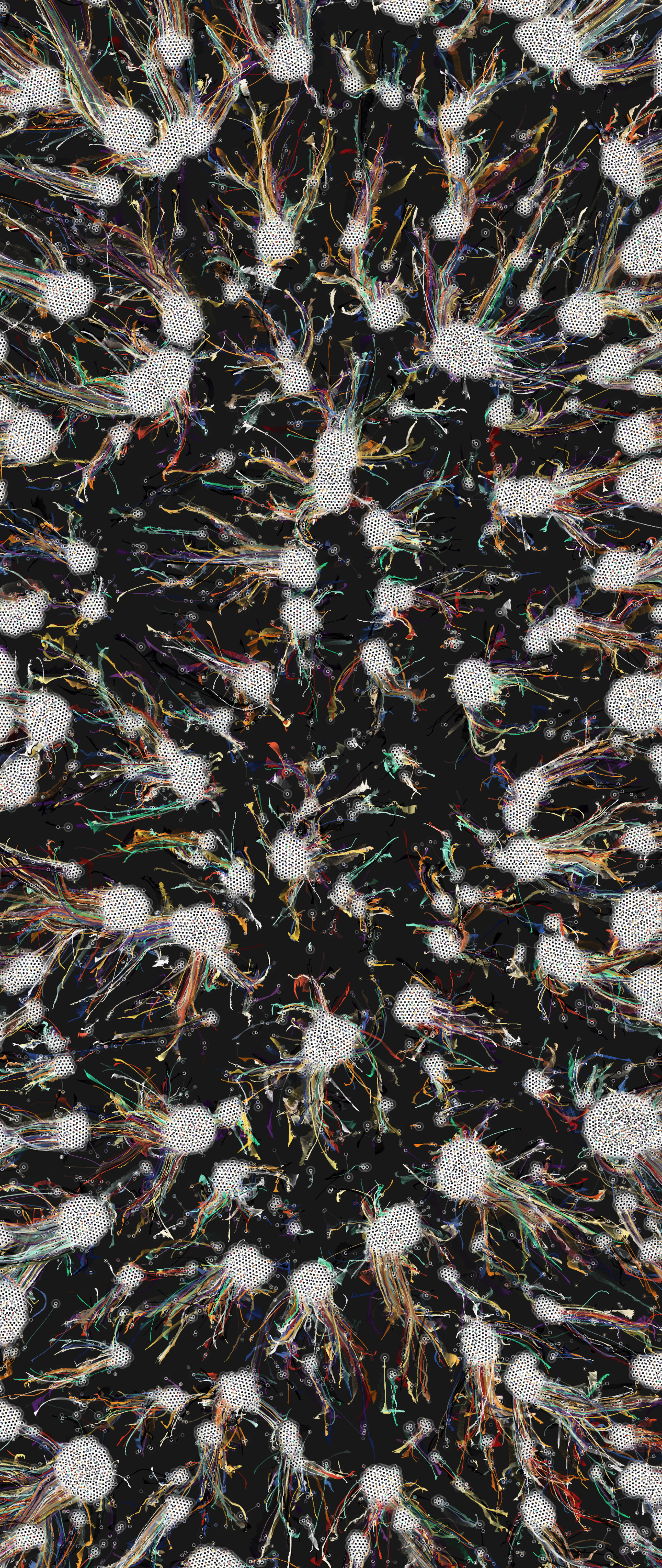
Gravity explores emergent forms resulting from simple gravitational attraction and billiard ball style collision physics. Each particle is a point mass that attracts every other through Newtonian gravity. When particles collide, they bounce with a partial restitution, so some kinetic energy is lost and heat accumulates as a record of how violently they have interacted. Each particle trails a colored pendulum that sandpaints pixels as it swings. The pendulum is a soft elastic body providing visible strokes of both the path of the particle and its inertia. In this way we see a history of structure.
The work is a living drawing. When large numbers of particles begin to amass, energy builds within the system. The mass sometimes appears to breathe, pulsating and spinning while negotiating equilibrium. At a certain threshold, the mass will explode, destroying the structure and ejecting particles at high energy in all directions. In every case, particles dance and spiral in and out of ordered structure.
Interactive controls include the mouse and keyboard. Clicking deposits a small mass of particles at the cursor location. Holding SHIFT and clicking creates a temporary particle emitter. Holding SHIFT and CTRL while clicking creates a laminar plane of particles. The number keys 0-6 create various initial conditions. Press ? for complete interactive controls.
Prolonged inactivity hands the work over to itself. The program begins creating endless compositions in an unattended mode.
First programmed in Processing, later rewritten for the GPU.
I find the uncertain moments of disorder just before explosions most interesting.
Exhibited at EMERGENCE, Kate Vass Galerie, Zürich, Switzerland, 2026.
Processing / Javascript
Archival pigment print on cotton rag.
34 x 14".
Ed 1/1
Gravity explores emergent forms resulting from simple gravitational attraction and billiard ball style collision physics. Each particle is a point mass that attracts every other through Newtonian gravity. When particles collide, they bounce with a partial restitution, so some kinetic energy is lost and heat accumulates as a record of how violently they have interacted. Each particle trails a colored pendulum that sandpaints pixels as it swings. The pendulum is a soft elastic body providing visible strokes of both the path of the particle and its inertia. In this way we see a history of structure.
The work is a living drawing. When large numbers of particles begin to amass, energy builds within the system. The mass sometimes appears to breathe, pulsating and spinning while negotiating equilibrium. At a certain threshold, the mass will explode, destroying the structure and ejecting particles at high energy in all directions. In every case, particles dance and spiral in and out of ordered structure.
Interactive controls include the mouse and keyboard. Clicking deposits a small mass of particles at the cursor location. Holding SHIFT and clicking creates a temporary particle emitter. Holding SHIFT and CTRL while clicking creates a laminar plane of particles. The number keys 0-6 create various initial conditions. Press ? for complete interactive controls.
Prolonged inactivity hands the work over to itself. The program begins creating endless compositions in an unattended mode.
First programmed in Processing, later rewritten for the GPU.
I find the uncertain moments of disorder just before explosions most interesting.
Exhibited at EMERGENCE, Kate Vass Galerie, Zürich, Switzerland, 2026.