
After ‘After Culture’, 4 Years Later
How Ben Davis Explained the Art World We Live In
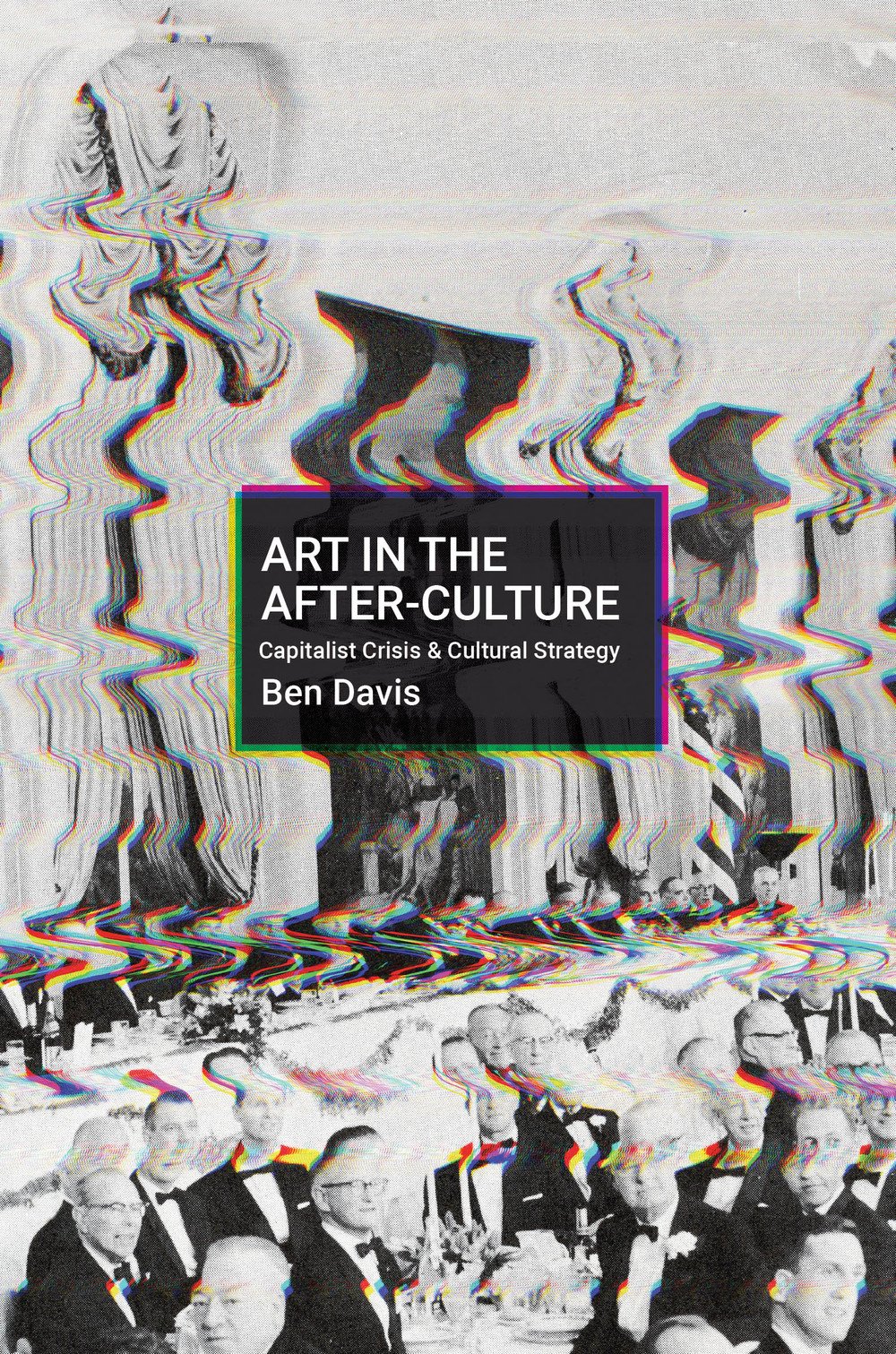
Ben Davis, Art in the After-Culture: Capitalist Crisis and Cultural Strategy, 2022.
I'll be honest: I picked up Ben Davis's Art in the After-Culture as soon as it was published in 2022. Judging by the title, After-Culture, I expected something more nostalgic, another reflection on how we had "lost culture," another art-world insider cycling through the familiar registers of decline.
What I found was something considerably more uncomfortable.
Davis isn't asking whether contemporary art is good or bad. He's asking a more fundamental question: under what conditions does anything, an object, a gesture, or a person, come to mean something at all?
I have to admit, I opened and closed the book many times while reading it. Each chapter demanded time to process. There was simply a lot to think through.
The book's eight chapters appear, at first glance, to be separate essays on separate subjects. In reality, they form a remarkably coherent argument about authority, attention, and who gets to decide what counts.
The book opens with a speculative triptych: one future in which aesthetic experience is generated directly by AI and calibrated to individual preference; another in which art survives primarily as a luxury for elites; and a third in which it becomes the cultural instrument of dissident communities.
At first, the framing reads almost like sci-fiction. By the final chapter, however, it feels less like fiction and more like a description of forces already in motion by 2026.
Davis identified almost every major dynamic that has since shaped the art world and each has only intensified.
Authorsip and its Discontents
The first chpater opens with connoisseurship, and the provocation embedded in that choice is worth pausing on. He draws on Larry Shiner’s The Invention of Art to remind us that “art” as a discrete category is not timeless, it emerged alongside modern capitalism, separating the artist from the artisan precisely as industrialization was transforming what labour meant. Giovanni Morelli and Bernard Berenson enter as the connoisseur’s founding figures: their obsession with attribution, with identifying the authentic hand behind the work, appears at first glance to belong to a vanished world of old masters and museum experts.
The irony at the centre of Morelli’s enterprise, which Davis takes quiet pleasure in exposing, is that the entire apparatus of the singular hand depends on a fiction. Renaissance workshops were collaborative. The lone genius is a story projected backward onto objects made by teams. Foucault’s “author function” generalises this: the author’s name isn’t a fact about the object, it’s a sorting mechanism. Duchamp’s Fountain remains the proof of concept, zero craft, infinite context, and an auction record to prove it.
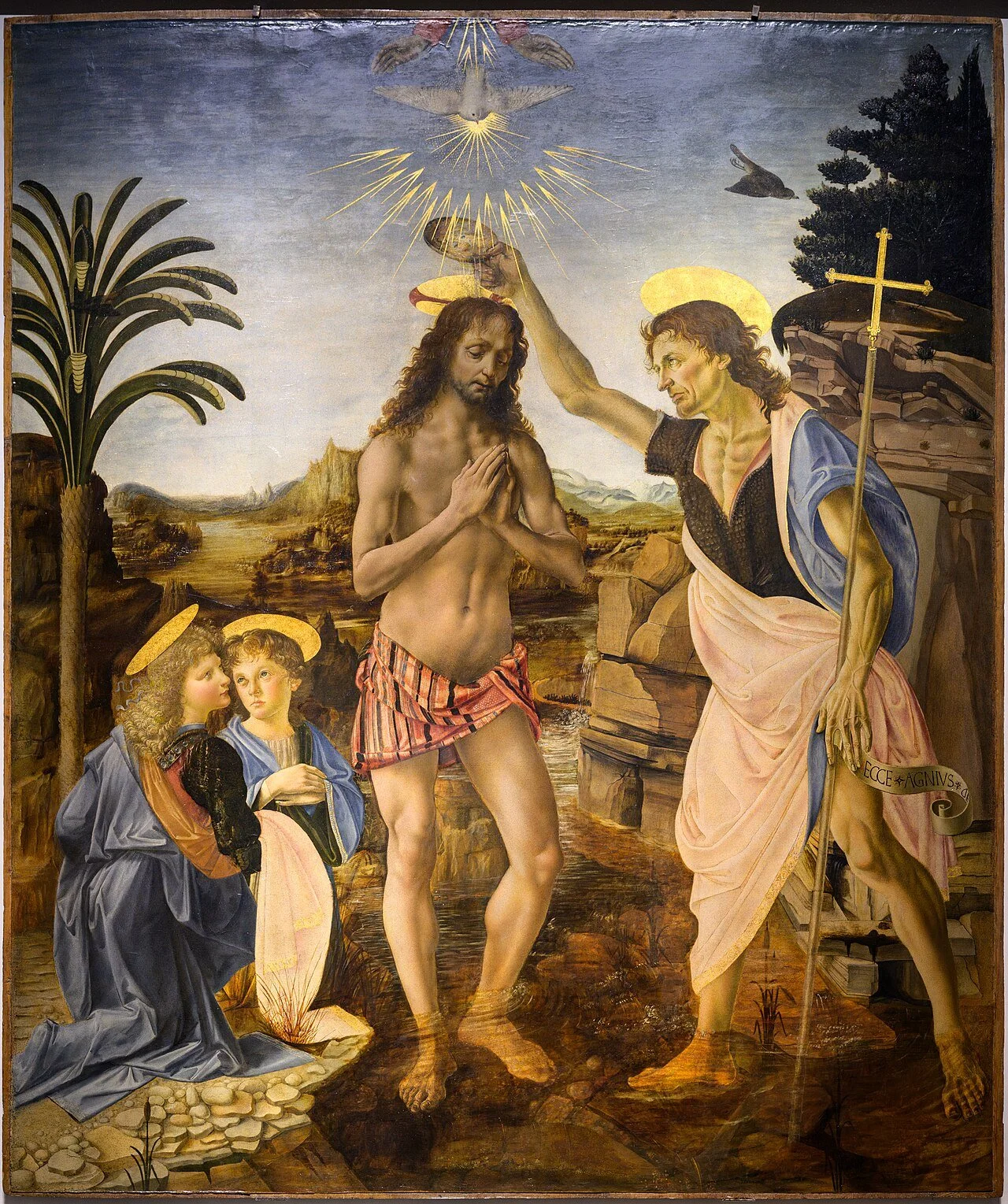
Verrocchio, Baptism of Christ, 1472-1475.Image Source: Uffizi Galleries
A workshop painting in which Leonardo’s angel makes authorship visibly collaborative rather than singular. The work unsettles the fiction of one identifiable hand behind the image.
If the Renaissance workshop is the historical precedent, digital culture is the return of the repressed. The internet transformed art from an isolated object into a networked process; Web3 extended that logic into ownership itself. Collectors now mint, curate, govern, and determine how works evolve. Communities form around collections, CryptoPunks, Art Blocks, where value emerges from continuous participation as much as from the artist’s initial gesture. Creation increasingly resembles orchestration. The “hand” that Morelli has multiplied, and become truly collective. Morelli’s painstaking eye hasn’t disappeared. It has dispersed across collectors, online communities, independent researchers, and, increasingly, recommendation algorithms that now perform their own form of attribution, determining at scale which artists become visible and which remain obscure. Foucault’s author function is no longer granted exclusively by museum boards or critics. It emerges from the interaction between platforms, communities, and the invisible architecture of feeds. Expertise in 2026 belongs less to whoever carries the title than to whoever continues looking carefully enough to find what everyone else has missed.

Larva Labs, CryptoPunk #6529, 2017. Courtesy of the Punk 6529 Collection and the artist duo.
A 10,000-character on-chain collection in which value emerges through ownership, rarity, community, and shared attention. It visualises the artwork as a networked social object rather than a single isolated image.
Which brings us to a broader question: what does curation mean in 2026?
The word itself has acquired a bitter taste. Increasingly, it signals safe selection rather than discovery, a rotation of pre-approved names designed to reassure audiences rather than unsettle them. In an art market driven by financial pressure and shrinking margins, repeating familiar formulas has become a rational strategy. But it is rarely how new histories are written.
What I observe among the most serious on-chain collectors runs directly counter to this. They don't wait for institutions to certify what deserves their attention. They spend months, sometimes years, following artists directly, reading, researching, tracing provenance, participating in communities, and simply looking. Again and again, through the interviews for Collecting Art Onchain, I encountered collectors whose understanding of artists' practices rivals, and sometimes exceeds, the professional consensus.
This may be one of Web3's least discussed consequences: the authority to form taste has become more decentralized. ‘Expertise’ is no longer monopolized by museums, galleries, or critics. It increasingly emerges through networks of collectors, artists, developers, historians, and online communities, all contributing to a more distributed conversation about cultural value.

Fred Wilson, Mining the Museum, 1994. Image Source: Bmore Art
Wilson rearranged the museum’s collection so that its silences became visible. The work shows curation as a structure of power: what is placed together, and what is kept apart, determines what history can be seen.
None of this diminishes the importance of good curators. Quite the opposite, it raises the bar considerably.
If collectors increasingly trust their own judgment, curators can no longer compete by confirming what the market has already validated. Their greatest contribution is revealing what the market has overlooked: drawing unexpected connections, introducing unfamiliar artists, creating contexts that make new work legible.
Great curation should create curiosity before it creates confidence and market.
That, however, requires showing artists before institutions endorse them. It requires conviction before validation, and financial courage before commercial certainty, precisely the qualities that the economics of the contemporary gallery system often discourage. As Marc Spiegler has recently argued, galleries need to rethink the model rather than continue relying on increasingly exhausted formulas. The difficulty, of course, is that changing the game costs money, while repeating it often pays the rent.
Intstitutional Critique and its Limits
The second chapter is where Davis stops sounding like a cultural historian and starts sounding like someone who has spent a long time watching the art world from an uncomfortable position inside it.
His argument begins with a structural observation: both the contemporary art world and much of today's radical politics share the same social base: educated, culturally fluent, often economically precarious members of the professional-managerial class. The politics this produces is sophisticated in its critique and frequently distant from the material realities it addresses.
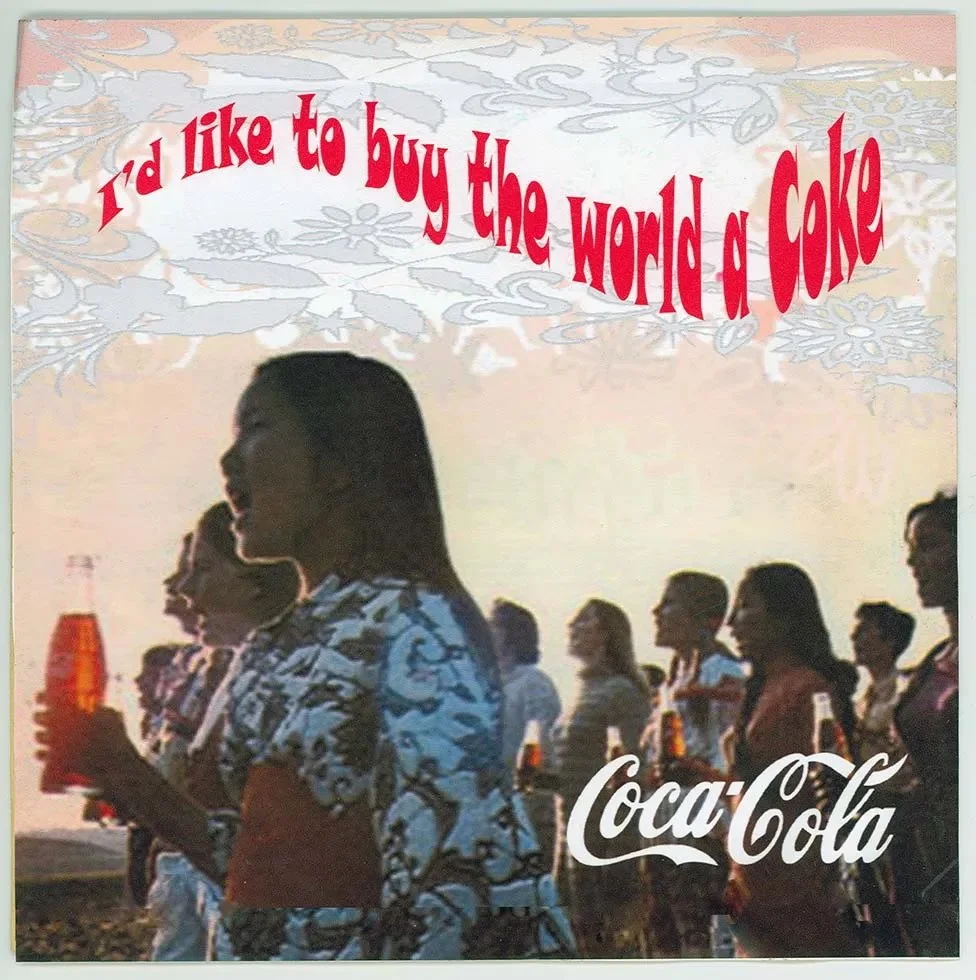
Coca-Cola, “Hilltop” television commercial, 1971. Image Source: The Coca Cola Company
The commercial turns countercultural images of youth, harmony, and collectivity into a global brand language. It shows how idealism can be absorbed almost intact by consumer culture.
Tom Wolfe's Radical Chic is the starting point: elite social circles absorb the aesthetics of political resistance while remaining untouched by its consequences. Coca-Cola's I'd Like to Teach the World to Sing countercultural imagery transformed into one of the most successful advertising campaigns ever produced, becomes the perfect illustration. The Ford Foundation's funding of experimental Black theatre, and Karen Ferguson's question of where genuine political engagement ends and institutional shaping begins, extend the problem into the present.
The intellectual centre of the chapter belongs to Hans Haacke, whose work abandoned atmospheric installations in favour of exposing the economic structures surrounding museums themselves. When the Guggenheim cancelled his exhibition after it revealed trustees' real-estate interests, the institution inadvertently demonstrated his thesis. Davis's point is subtler than a simple story of censorship. General critique can hang comfortably on almost any museum wall. Critique becomes difficult only when it turns back on the institution itself.
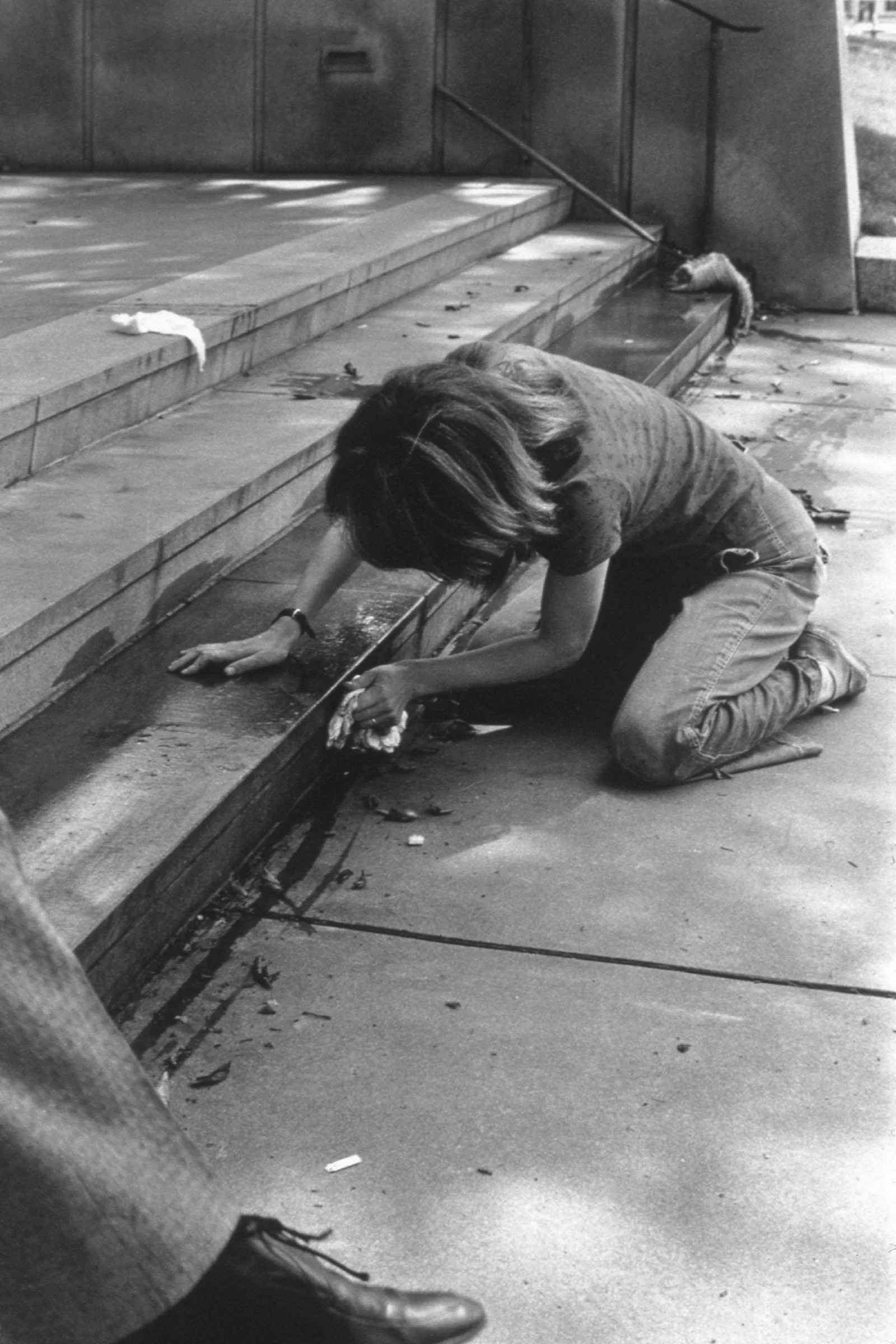
Mierle Laderman Ukeles, Washing/Tracks/Maintenance: Outside, 1973. Image Source: Elephant Art
By scrubbing the museum’s floors and steps as performance, Ukeles made maintenance visible as cultural labour. The work shifts attention from artistic production to the systems of care that sustain it.
Mierle Laderman Ukeles provides the necessary counterweight. Her Maintenance Art Manifesto and decades of collaboration with New York sanitation workers rejected symbolic solidarity in favour of direct engagement with invisible labour. Lucy Lippard's observation that much of Conceptual Art remained trapped within its own "art kettle" leaves the chapter's central question unresolved: is the limitation in the work itself, or in the social world through which it circulates?
Reading the chapter in 2026, Davis's question feels even more pressing. Institutions have become remarkably fluent in the language of critique. Museums and biennials routinely present exhibitions on labour, inequality, colonial histories, surveillance, climate change, and systems of power. The vocabulary of institutional critique has, in many ways, become part of the institutional house style.
Yet this fluency raises an uncomfortable question: when critique becomes expected, does it retain its critical force, or does it become another form of institutional legitimacy?

Hans Haacke, Shapolsky et al. Manhattan Real Estate Holdings, a Real-Time Social System, as of May 1, 1971. Image Source: Whitney Museum
Haacke traced a network of Manhattan tenement properties through photographs and real-estate records. The work exposed social and economic systems with such precision that institutional critique became institutionally intolerable.
This is precisely why Haacke remains so relevant. His work was never controversial because it criticised capitalism in the abstract. It became controversial when it exposed the financial relationships of the institution exhibiting it. The closer critique moves toward an institution's own economic conditions of existence, the less comfortable it becomes.
None of this invalidates institutional critique. Rather, it reinforces Davis's central insight: institutions are never outside the systems they examine. They are embedded within them. The most convincing political art has therefore never been the work that performs opposition most loudly. It is the work that makes visible the economic structures that make both the artwork and its critique, possible.
The Platform and the Self
Davis's argument about what digital platforms do to creators is among the most precise in the book. The dynamic he describes is not simply commodification; it is the collapse of the distinction between the work and the creator. You stop making objects and begin performing "the self" as content, continuously, because that is what the algorithm rewards. Davis reaches for the panopticon as his analogy, and it fits: the structure compels you to behave as though someone is always watching.
What became clear to me while reading recent histories of net art alongside this chapter is that the pressure extends beyond the individual artist. To understand networked art today, the finished artwork is no longer sufficient evidence. You also have to understand the Discord server, the X (formerly Twitter) threads, the collectors, the software, the memes, the friendships, and even the conflicts that produced it. In many cases, these are not simply contexts around the work, they constitute part of the work itself.
The artwork no longer ends at its frame, its screen, or its token. It extends into the network that produced it and continues to sustain it. Which means the contemporary artist now performs twice: first through the work itself, and then through the continuous maintenance of the social infrastructure surrounding it. Community manager, educator, marketer, entertainer, public personality, roles that increasingly become inseparable from artistic practice, yet for which the platform rarely compensates.
Ironically, the very technologies that promised to remove institutional gatekeepers have also multiplied the amount of invisible labour expected from artists.
The story of Jerry Gogosian, who died in 2026, became for many one of the most unsettling illustrations of the emotional pressures surrounding visibility in today's art world. For years, she built one of the most influential satirical voices in contemporary art through an anonymous persona whose authority depended precisely on facelessness. When she eventually stepped into public view as herself, the distinction between the persona and the person appeared increasingly difficult to sustain. Whether her story can be reduced to platform dynamics would be impossible and unfair to claim. But it nevertheless illustrates the human cost of a cultural economy in which identity itself increasingly becomes part of artistic production.
Hilde Lynn Helphenstein / Jerry Gogosian, @jerrygogosian, 2018–2026. Image Source: Instagram @jerrygogosian
Jerry Gogosian turned art-world commentary into a platform-native persona, where critique, visibility, audience management, and identity became inseparable. The project shows how online cultural authority can become both a medium and a form of continuous labour.
I raise this not as a eulogy, but because it genuinely shocked me. Davis's argument, that after-culture does not merely commodify your work, but increasingly commodifies you, is often discussed at the level of "creators" as an abstract category. This is what that dynamic can look like in the singular.
The tragedy is structural. Platforms promise direct access to audiences without institutional intermediaries, and in many ways they deliver on that promise. What they do not advertise is that they simultaneously transfer onto individual creators almost every responsibility that institutions once absorbed. Visibility is no longer the consequence of making compelling work. It has become another form of labour. And the artist is expected to perform it indefinitely.
Artificial Intelligence and the Question of Value
This is the chapter where recent developments make Davis's argument even more forcefully than Davis himself could. Rather than asking whether AI can make art, a question that has generated far more heat than light. he asks a different one: what kind of art does AI encourage us to value? The distinction is consequential.
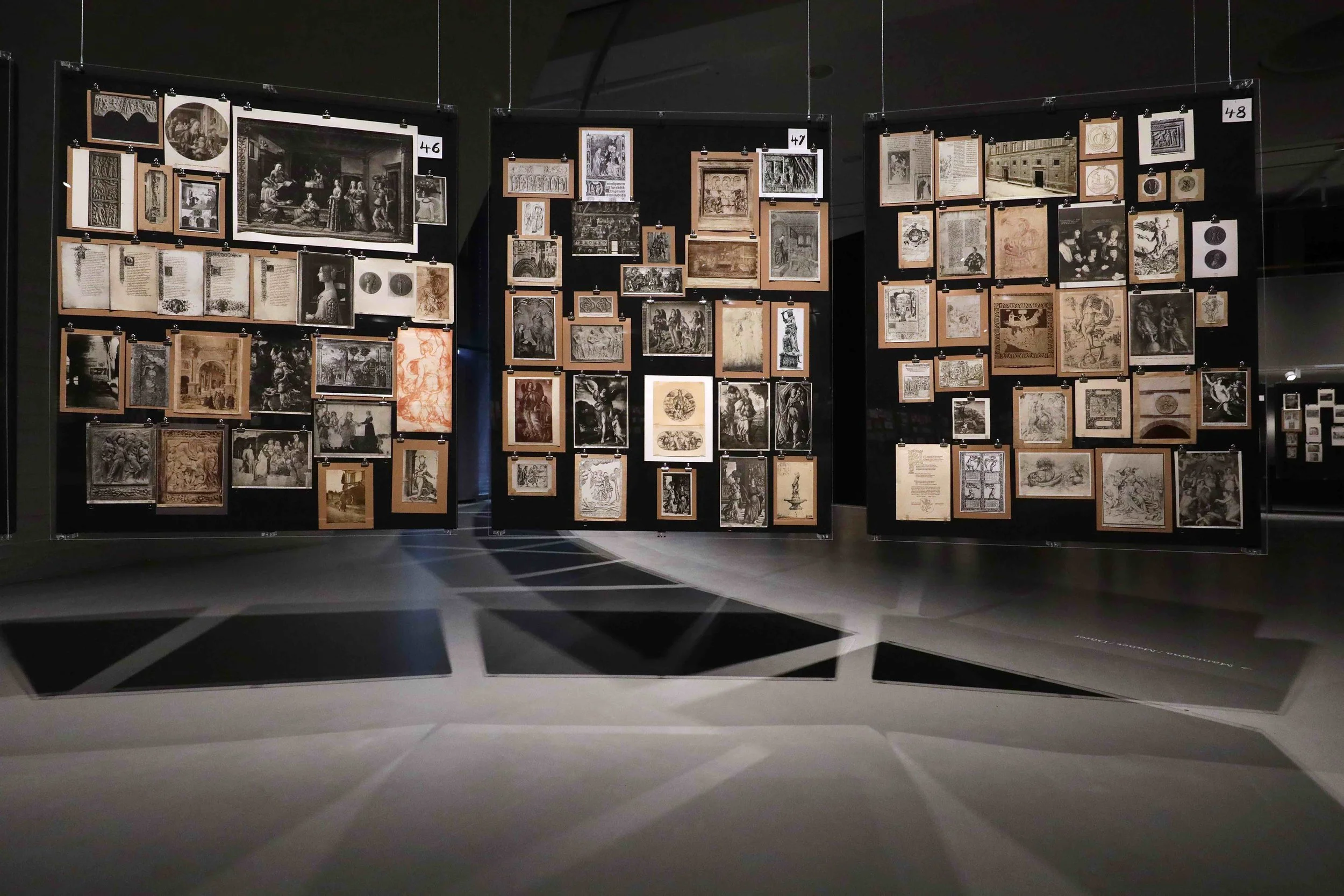
Aby Warburg, Mnemosyne Atlas, 1924–29. Image Source: HWK
Warburg’s image panels map visual echoes across history through interpretation rather than mere resemblance. They show that meaning emerges from relations, but only when someone gives those relations intellectual form.
He places Aby Warburg's Mnemosyne Atlas beside Google's Arts & Culture image-recognition systems. Both identify visual relationships across vast archives. The difference is that Warburg's connections reflected the intellectual journey of a particular mind; Google's algorithms detect statistical patterns. Warburg constructed meaning through interpretation. The machine identifies resemblance without sharing Warburg's historical or intellectual intentions.
Davis follows this into GANs, Edmond de Belamy, and Ahmed Elgammal's AICAN, a system designed not simply to imitate existing art but to optimise novelty by producing images that statistically deviated from their training data while remaining recognisable as art. Linked to the Wundt curve, creativity itself becomes a variable to optimise rather than a faculty to exercise.
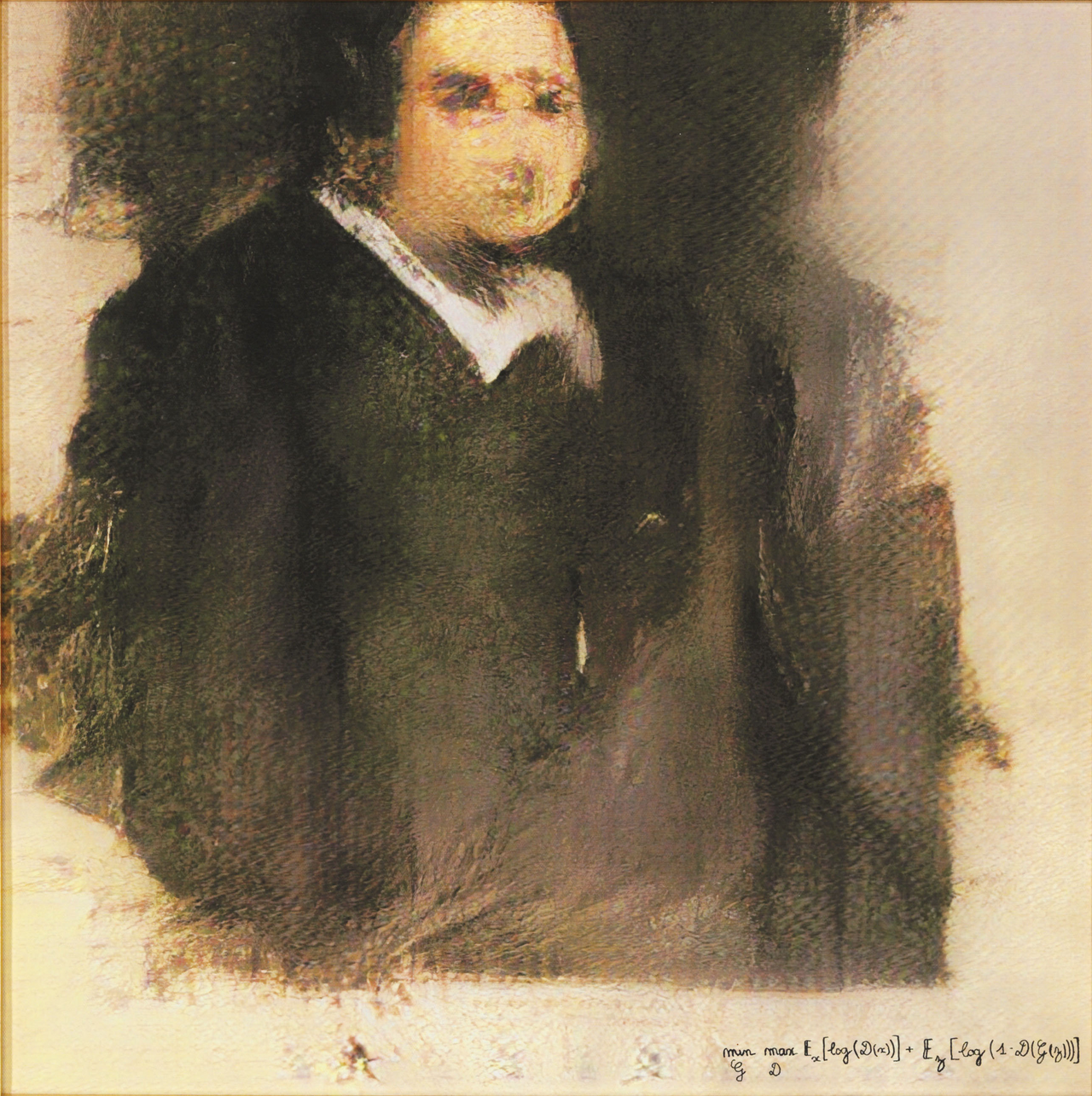
Obvious, Edmond de Belamy, 2018. Image Source: Obvious
The AI-generated portrait became a market spectacle less because of its image than because of its framing, authorship, and auction context. It shows how value gathers around AI through narrative, novelty, and provenance.
Arthur Danto's framework seems almost uncannily suited to this moment. Two visually identical objects can carry entirely different artistic meanings because meaning never resides in appearance alone. Context, intention, history, and authorship are inseparable from the work itself. AI hasn't disproved Danto. It has made his argument empirically verifiable at scale.
Numerous experimental studies now demonstrate what Davis anticipated: merely informing viewers that an image was AI-generated significantly changes how they evaluate it, even when the image itself remains unchanged. Danto needed two Brillo Boxes to make his point. AI needed only one label. People increasingly react to authorship before they examine the image itself. That tells us something more about ourselves and about how thoroughly the Duchampian lesson has been absorbed, even by audiences who have never encountered Duchamp.
As machine-generated novelty became effectively infinite and almost free, its scarcity evaporated. Value migrated toward what machines still struggle to establish: sustained artistic practice, provenance, conceptual coherence, institutional recognition, and demonstrable human intention.
Having curated AI art since 2018, well before the technology acquired a mass audience, what I find most frustrating about today's discussion is the collapse of fundamentally different artistic practices into a single category called "AI art." There is a profound difference between an artist developing a long-term critical dialogue with machine intelligence and someone generating images with a commercial model. The technology may overlap. The artistic practice rarely does.
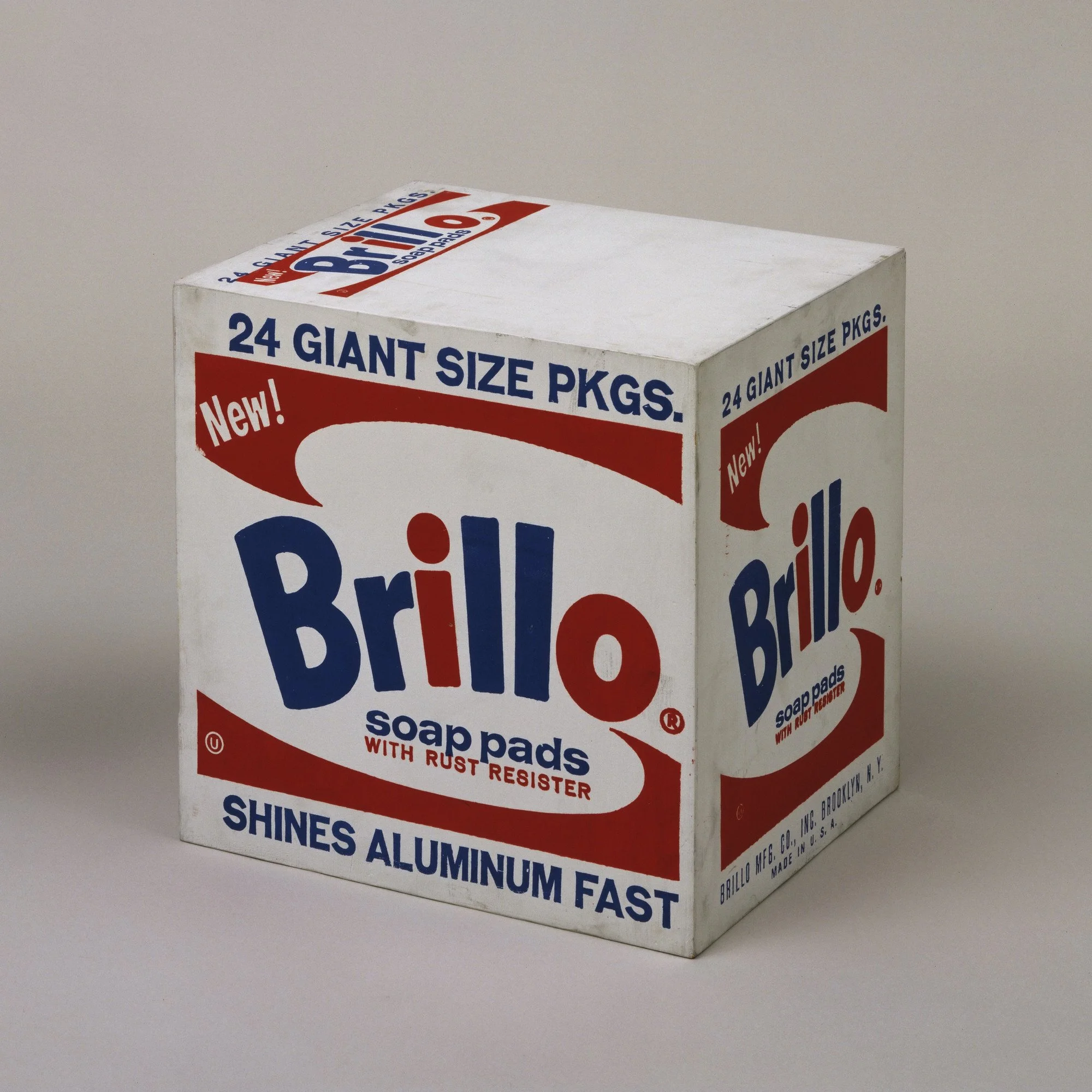
Andy Warhol, Brillo Box, 1964. Image Source: MoMA
Warhol’s box makes Danto’s point visible: two things can look alike and mean entirely different things. Context, authorship, and art-historical framing are not additions to the work, but part of what makes it art.
Another misconception emerged alongside image generators: the belief that AI art is fundamentally about images. Historically, it rarely was. Some of the most important AI artists were never primarily interested in producing beautiful pictures. They investigated perception, agency, learning, emergence, collaboration, language, or the behaviour of complex systems. The image was often only the visible residue of a much larger artistic inquiry. Reducing AI art to image generation is a little like reducing Conceptual Art to typography.
Ironically, public attention arrived just as AI art became visually easiest to produce and philosophically hardest to discuss.
Image generators did not create AI art. They created its first mass audience. Unfortunately, that audience encountered the newest tools before it encountered the history, the artists, or the questions that had occupied the field for decades. Once novelty became effectively infinite and almost free, it inevitably ceased to function as value. AI did not destroy artistic value. It simply exposed where artistic value had always resided: not in the production of images, but in the production of meaning.
Diagnosis without Resolution
Davis's final chapter is his most deliberately open-ended. He frames art's possible responses to ecological crisis through three registers: warning, remediation, and vision, but leaves unresolved the question that runs throughout the book: can art genuinely challenge the systems within which it exists, or does every act of critique ultimately become absorbed by them? Four years later, I don't think I can answer that question either.
One contradiction, however, has become increasingly difficult to ignore.
Contemporary art speaks eloquently about climate change, sustainability, and environmental responsibility, yet the structures through which those conversations take place have changed remarkably little. We continue flying across continents for fairs and biennials, shipping artworks around the world, building temporary architecture, and celebrating spectacle while exhibiting works that critique overconsumption. Whether physical or digital, cultural production remains profoundly resource-intensive.
Perhaps this is Davis's point once again: critique is remarkably easy to accommodate when it does not fundamentally alter the structures that produce the very behaviours being criticised.
Living in Switzerland, I have watched glaciers retreat, summers grow hotter, and forests increasingly marked by drought. Climate change has become part of everyday life. Against that reality, I cannot help wondering whether the art world has become better at representing ecological crisis than responding to it.
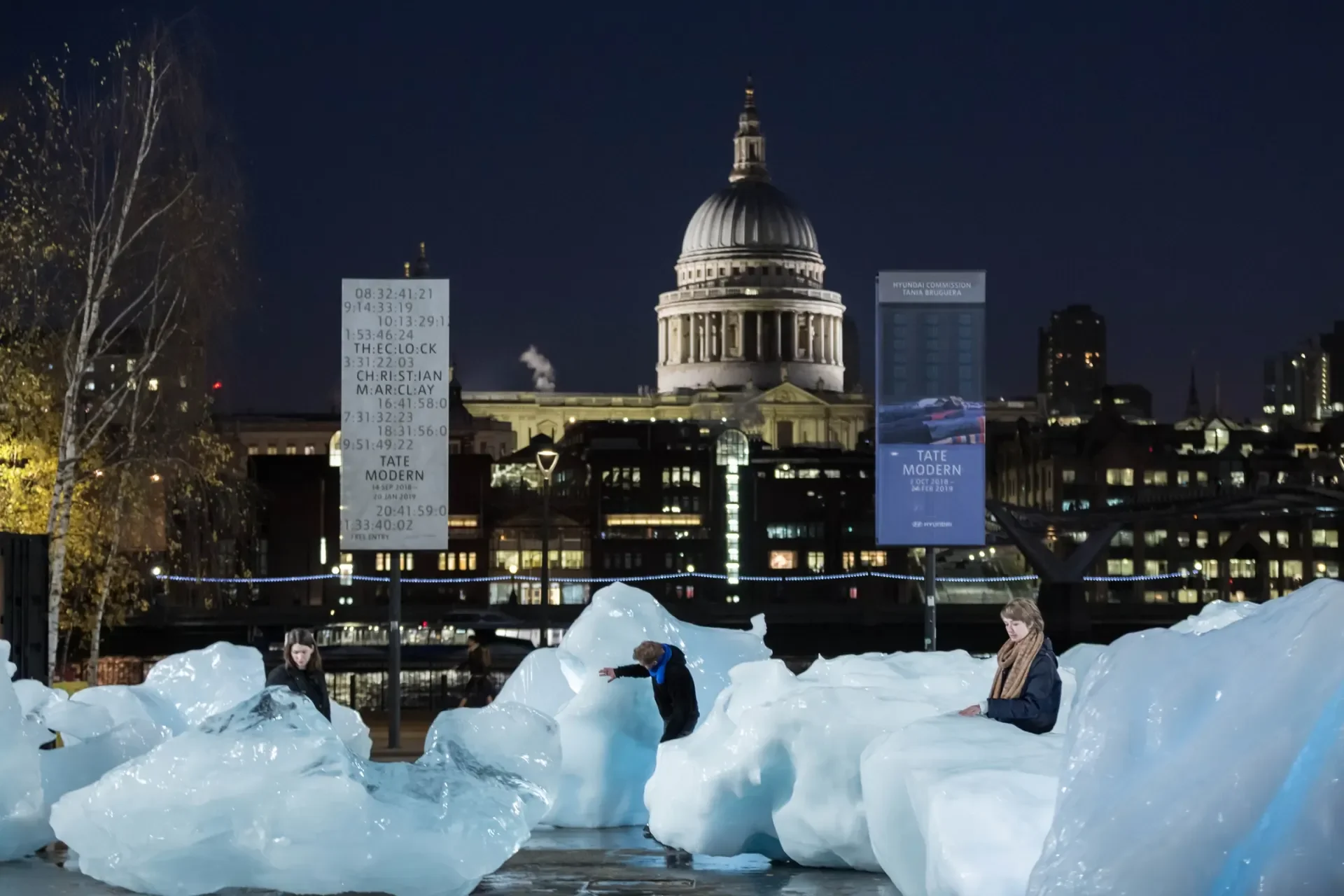
Olafur Eliasson and Minik Rosing, Ice Watch, 2014–2018. Image Source: Olafur Eliasson
Blocks of Greenland ice were placed in public space, making climate change physically present as they melted. The work turns ecological crisis into direct experience while also exposing art’s uneasy dependence on spectacle.
Until our habits begin to change alongside our exhibitions, there will remain a gap between what contemporary art says about the climate and how it continues to operate within it.
Looking back across all eight chapters, I arrived at a different conclusion than the one I expected when I first opened the book. The central question is no longer whether AI will transform art, whether blockchain will change collecting, or whether museums should become immersive or esle. Those are merely expressions of a deeper shift.
Davis is ultimately asking how cultures emerge: how habits become institutions, how incentives become values, and how repeated behaviours solidify into systems that eventually appear inevitable.
That is why After Culture feels even more relevant in 2026 than it did in 2022. Art has always reflected the spirit of its time. If there is one question contemporary art cannot afford to overlook in the decade ahead, it is not what new technologies we create, but what kinds of systems and ultimately what kinds of cultures they allow to emerge.
Talking has never been easier. Producing images has never been easier.
Changing how we act remains the hardest creative act of all.
Featuring artworks by Verrocchio, Larva Labs, Fred Wilson, Mierle Laderman Ukeles, Hans Haacke, Jerry Gogosian, Aby Warburg, Obvious, Andy Warhol, Olafur Eliasson and Minik Rosing.