
When Code Blooms: The Flower as a Generative System
Flowers have appeared across generations of computational art, from procedural studies of plant growth to neural networks trained on private gardens, personal image collections and hand-built archives of tulips. Their appeal is not merely visual. A flower is already a generative structure: ordered but variable, recognisable but never precisely repeated. For artists working with code, data and artificial intelligence, it offers both a natural model and a conceptual challenge. What does a machine learn when it learns a flower?
A fascination as old as art itself
Before any of this, there is a simpler fact: artists have returned to the flower across cultures and historical periods. The lotus and papyrus recur throughout Egyptian relief and painting, while botanical forms such as the acanthus leaf were codified within Greek and Roman architectural ornament. Seventeenth- and early eighteenth-century Dutch and Flemish painters, from Ambrosius Bosschaert to Jan van Huysum, helped establish flower still life as a distinct genre through elaborate, often impossible bouquets composed of flowers that would not naturally bloom in the same season.
The tulip was prominent in Ottoman manuscript illumination, ceramics and textile design centuries before tulip bulbs and contracts became objects of financial speculation in the Dutch Republic. Hokusai and Hiroshige repeatedly depicted chrysanthemums, peonies, irises, cherry blossom and other plants in Edo-period flower-and-bird prints. Pierre-Joseph Redouté fused scientific observation with fine art in his nineteenth-century botanical illustrations, while Georgia O’Keeffe’s magnified blooms and Alphonse Mucha’s ornamental botanical language carried the flower into modern visual culture.
Long before “generative art” existed as a term, botanical form had already become one of art’s most persistent laboratories of repetition and variation.
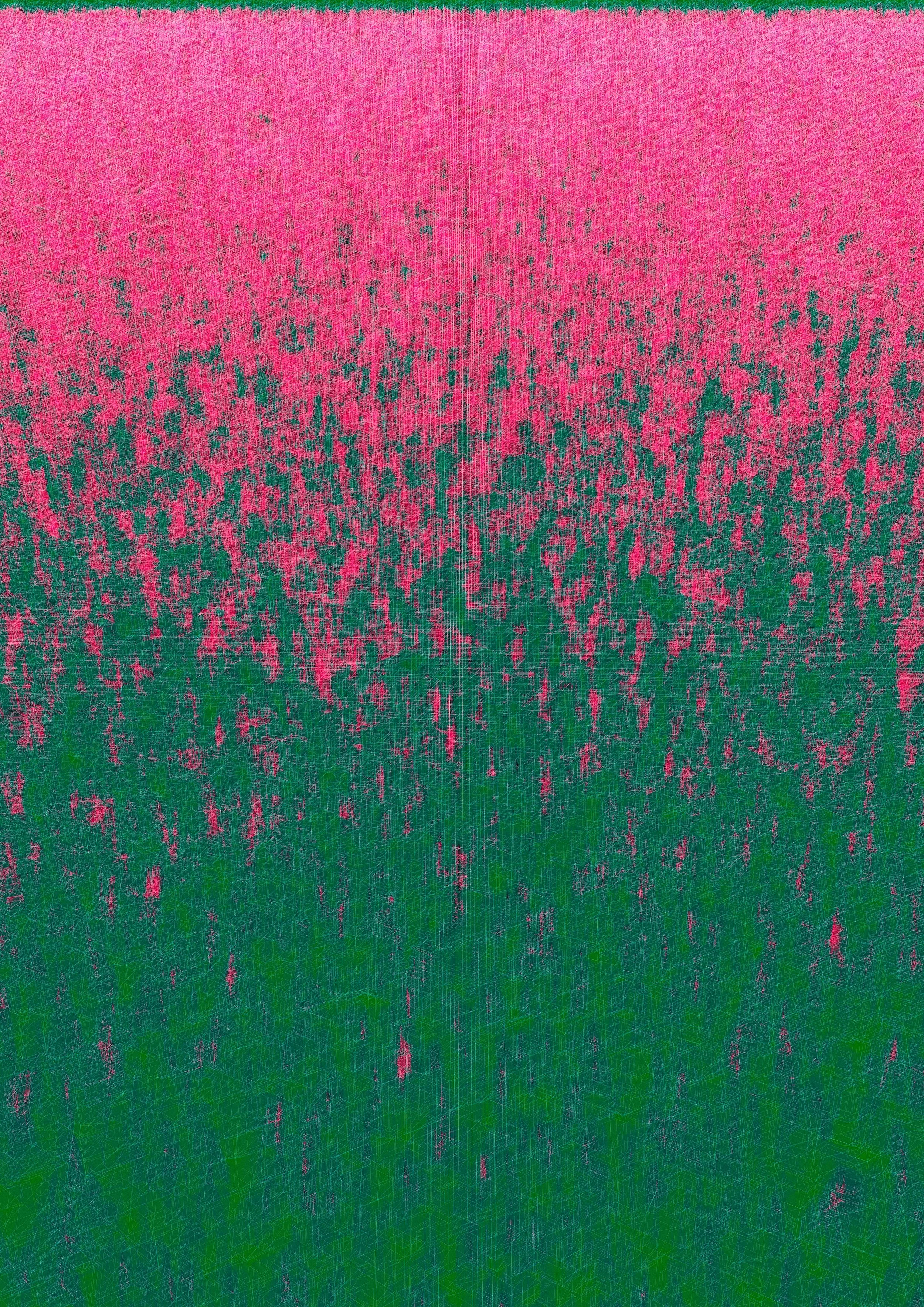
Iskra Velitchkova, Dolina i, 2022.
Nature as an early generative model
That persistence has a deeper explanation, and it is not only visual. Long before computers, plant forms were already developing through repeatable constraints that mathematicians and botanists would later attempt to describe.
Fibonacci numbers recur as tendencies in botanical structures. Many monocots organise floral parts in threes, buttercups commonly have five petals, while the florets and visible spiral families of composite flower heads can occur in counts such as thirteen, twenty-one, thirty-four, fifty-five or eighty-nine.
These patterns are related to phyllotaxis, the arrangement of leaves, florets and other plant organs around a growing centre. In many spiral configurations, successive primordia emerge near the golden angle, approximately 137.5 degrees, producing efficient packing through local processes rather than a centralised designer.
Radial symmetry is common among flowers, while orchids are characteristically, though not universally, bilaterally symmetrical. Approximate self-similarity appears dramatically in Romanesco cauliflower, whose repeated floral meristems produce a finite, fractal-like inflorescence.
Long before the first computer rendered a petal, botanists and artists were already searching for the systems beneath botanical appearance: classification, symmetry, branching and growth. In this sense, the flower can be read as a generative system avant la lettre — repetition and constraint producing variation rather than chaos.
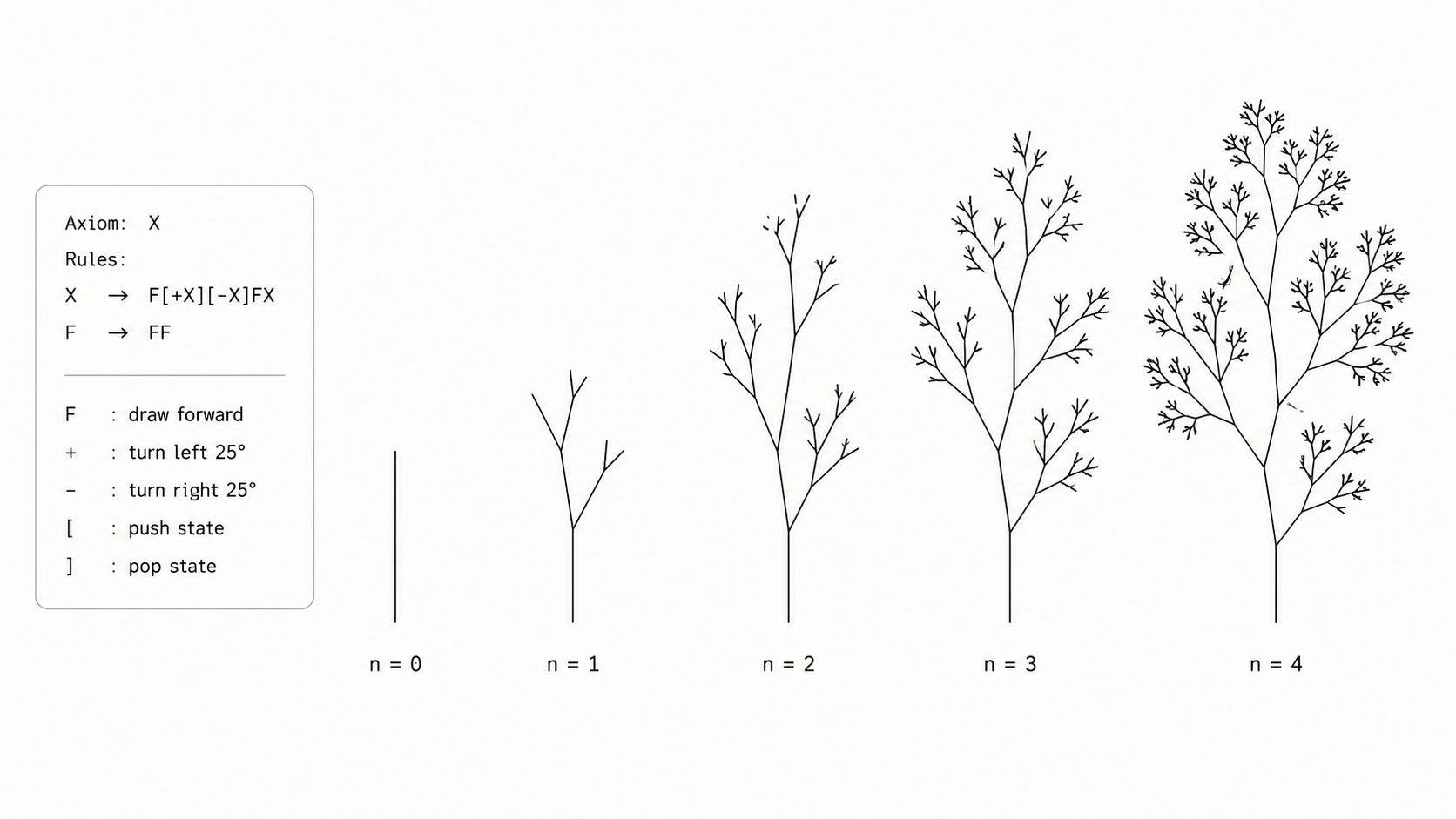
Aristid Lindenmayer, L-systems, 1968.
From representing flowers to simulating growth
The real turning point came when the computer stopped being used only to depict flowers and started being used to grow them.
Procedural botanical modelling, and in particular the L-systems introduced by Aristid Lindenmayer in the 1960s, made it possible to describe plant development through recursive rules rather than fixed images. Branches could divide, stems could extend and leaves or buds could appear according to a set of instructions repeated over time.
A plant could now be simulated as a process unfolding rather than reproduced as a finished picture. The image was no longer only composed; it emerged.
This shift from appearance to algorithm connects centuries of botanical study to later generative practices. It also helps explain why flowers, trees and branching organisms have appeared so frequently in computational art. They give visible form to one of the central promises of generative systems: that relatively simple rules can produce structures of extraordinary complexity.

David Young, Learning Nature (b63d,2400-19,4,9, 13,34,18-g), 2019.
The flower as a machine-learning dataset
Once artists began training neural networks rather than only writing procedural rules, the flower took on another role: it became data.
This marked a significant change. In a procedural system, the artist defines the rules through which a plant develops. In a machine-learning system, the artist selects the examples from which the model must infer what a flower might be.
The resulting image is shaped not only by the architecture of the model but by the construction of the dataset: what is photographed, collected, labelled, excluded and repeated. A model trained on commercial stock photographs will learn a different flower from one trained on botanical illustrations, family snapshots, studio drawings or images gathered from a single garden.
Many artists have used flowers as a contained testing ground for this process. Their familiarity makes distortion immediately legible. We recognise the stem, petal or bloom even when its proportions collapse, its textures bleed together or its species becomes impossible to identify.
David Young’s Learning Nature, for example, emerged from a small collection of photographs taken over a single summer on his farm in Bovina, New York. Rather than using a vast internet archive, Young worked with a deliberately restricted visual world. The resulting flowers hover between observation and invention, revealing how a model responds when it has relatively little information from which to generalise.
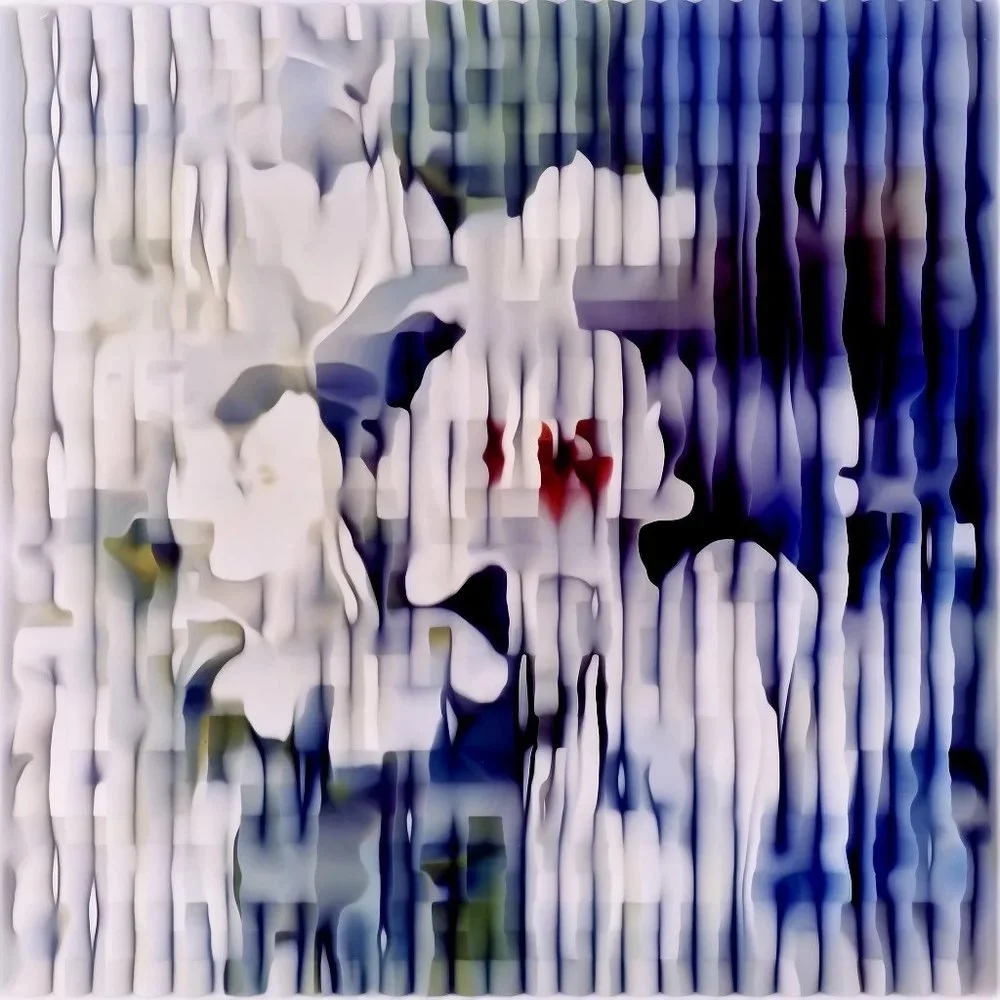
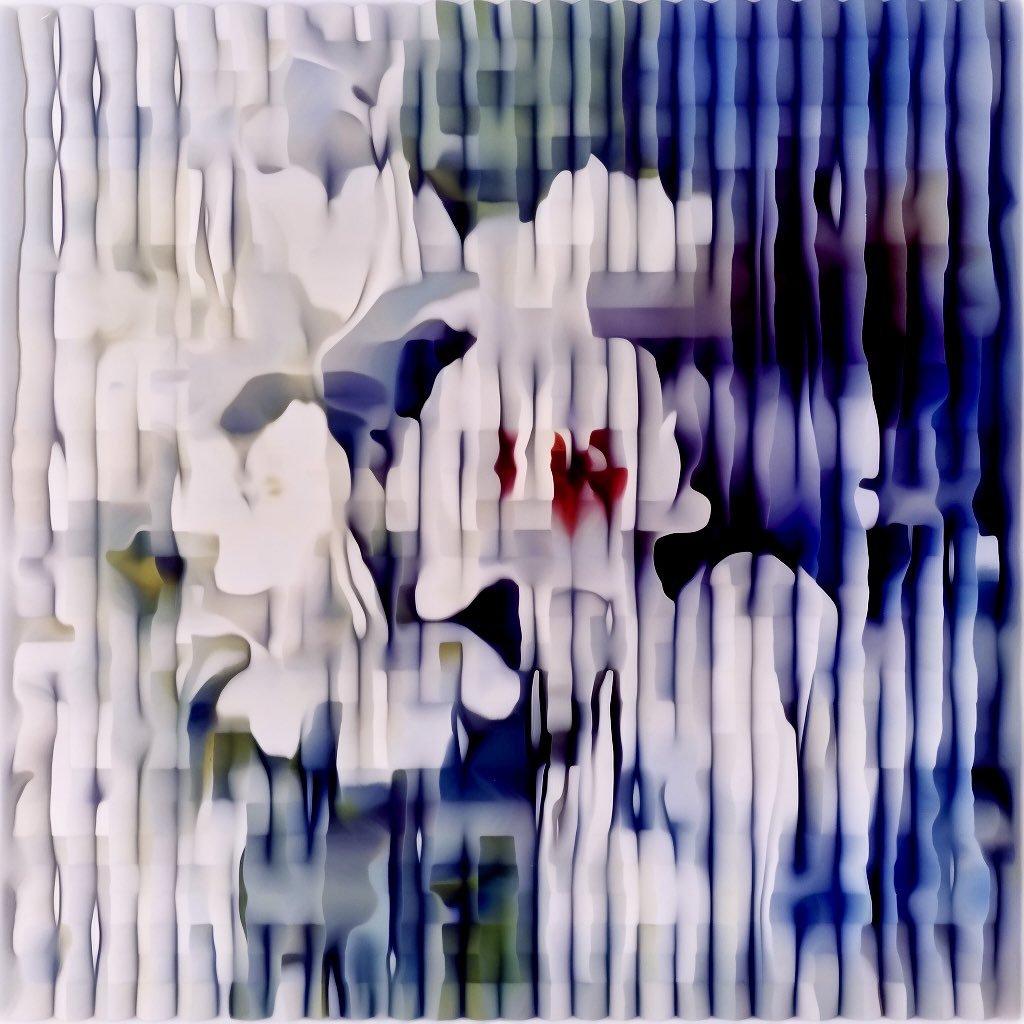
Helena Sarin, They don’t make GANs like that anymore, 2024.
Similar questions appear throughout Helena Sarin’s flower images, produced through models trained largely on her own drawings, paintings and photographs. Here, the dataset is not a neutral archive but an extension of an existing artistic language. The machine does not encounter “the flower” in general. It encounters a flower already filtered through another image-making practice.
Across numerous early GAN experiments, flowers and tulips served this same purpose: they were sufficiently contained to function as recognisable categories, yet sufficiently varied to expose how a model compresses, confuses and reconstructs form.
Sofia Crespo’s botanical images extend this inquiry into a broader field of synthetic organisms, natural-history imagery and speculative biology. The flower becomes one component within an artificial taxonomy in which familiar biological categories are reconstructed and destabilised by the model.
These practices differ in method and intention, but they share a fundamental question: when a machine produces a flower, is it reproducing a botanical form, a photographic convention or the structure of the archive through which that form was presented?
Sofia Crespo, foretold botany, 2020.
Who constructs the dataset?
No project has made the construction of the floral dataset more visible than Anna Ridler’s Myriad (Tulips).
In 2018, Ridler spent approximately three months in Utrecht photographing ten thousand individual tulips. She printed and hand-labelled the images according to visible attributes such as colour, form and condition, turning the archive into both a training resource and an artwork in its own right.
The importance of the project lies not only in its scale but in the visibility of its labour. Machine-learning datasets often appear to users as abstract, ready-made collections. Myriad instead reveals the many human decisions that precede the production of an artificial image.
Those photographs subsequently formed the training material for Mosaic Virus, in which GAN-generated tulips change in relation to fluctuations in the price of bitcoin. The work connects contemporary cryptocurrency speculation to the seventeenth-century market for rare tulips, including the streaked or “broken” flowers whose unusual patterns were caused by disease but interpreted as exceptional beauty.
Anna Ridler, Mosaic Virus, 2019.
With AI researcher David Pfau, Ridler later developed Bloemenveiling, an online auction of short GAN-generated tulip videos sold through Ethereum smart contracts. Automated bots were incorporated into the system to intensify speculative bidding, echoing both cryptocurrency markets and the auction mechanisms associated with the Dutch flower trade.
The projects demonstrate that the generative flower is never produced by an algorithm alone. It is shaped by collection, classification, labour, technology and the market structures through which it circulates.
The flower as colour and structure
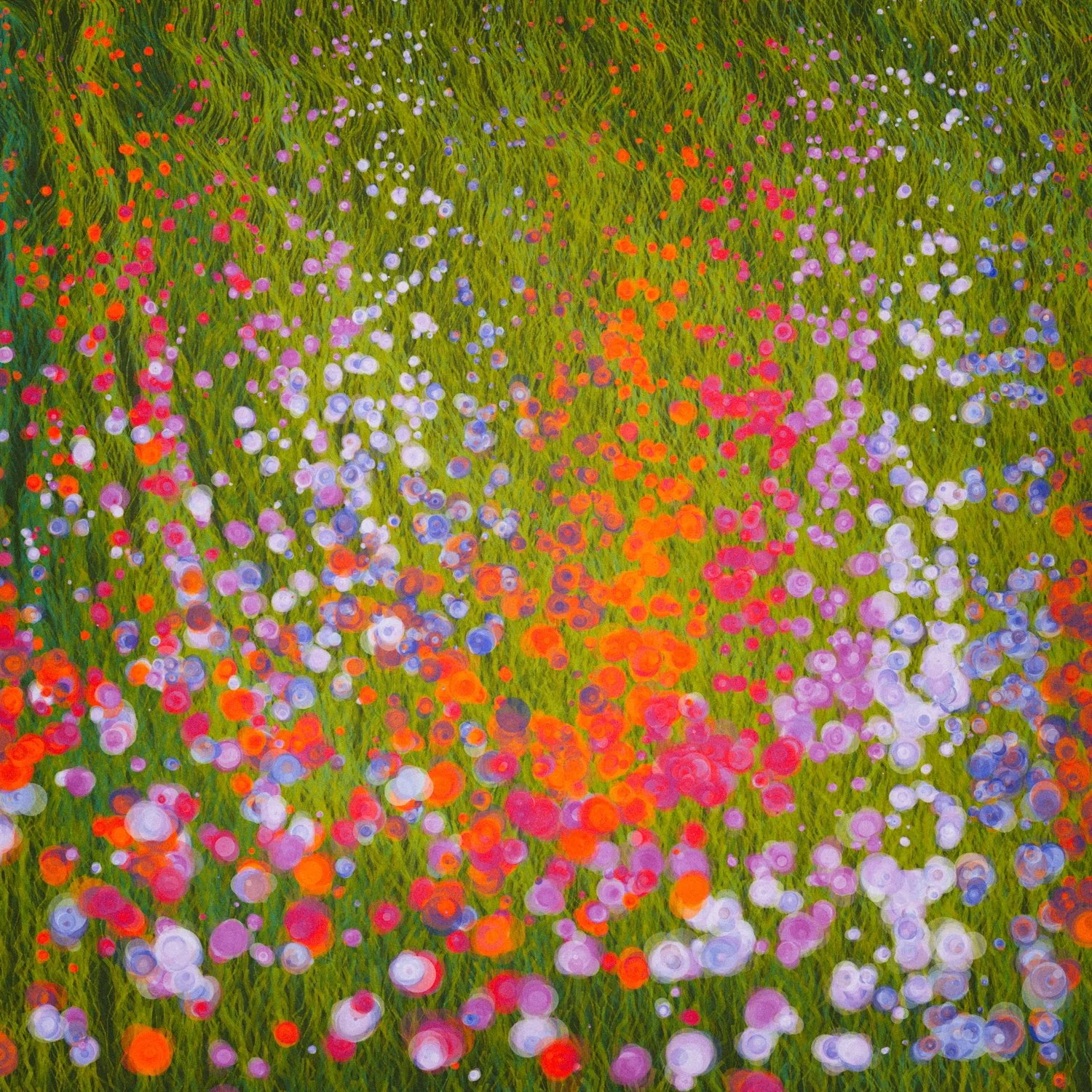
Not every computational flower is concerned with botanical recognition or machine learning. In many generative practices, the flower operates more abstractly, as a flexible structure through which colour, density, repetition and rhythm can be organised.
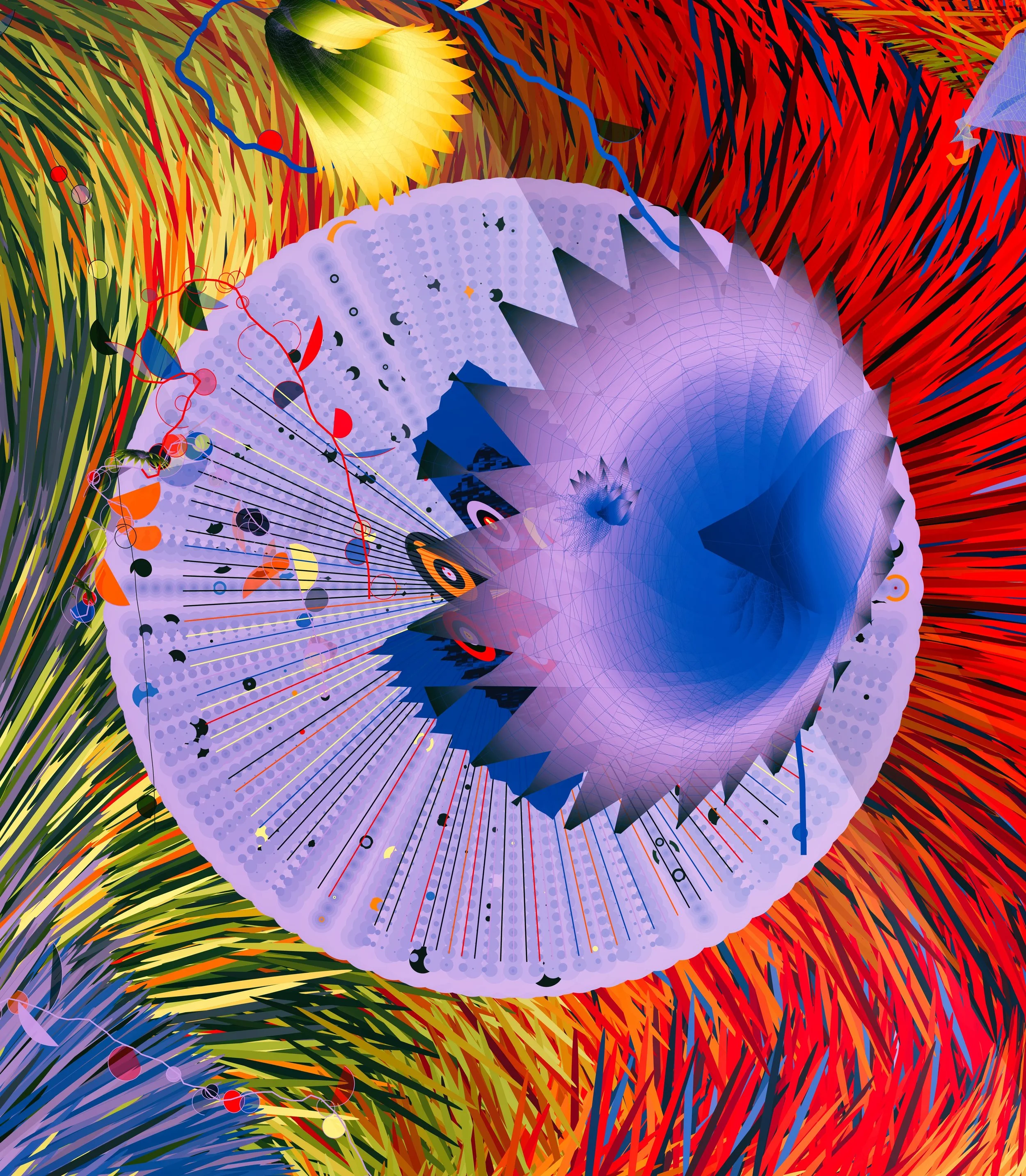
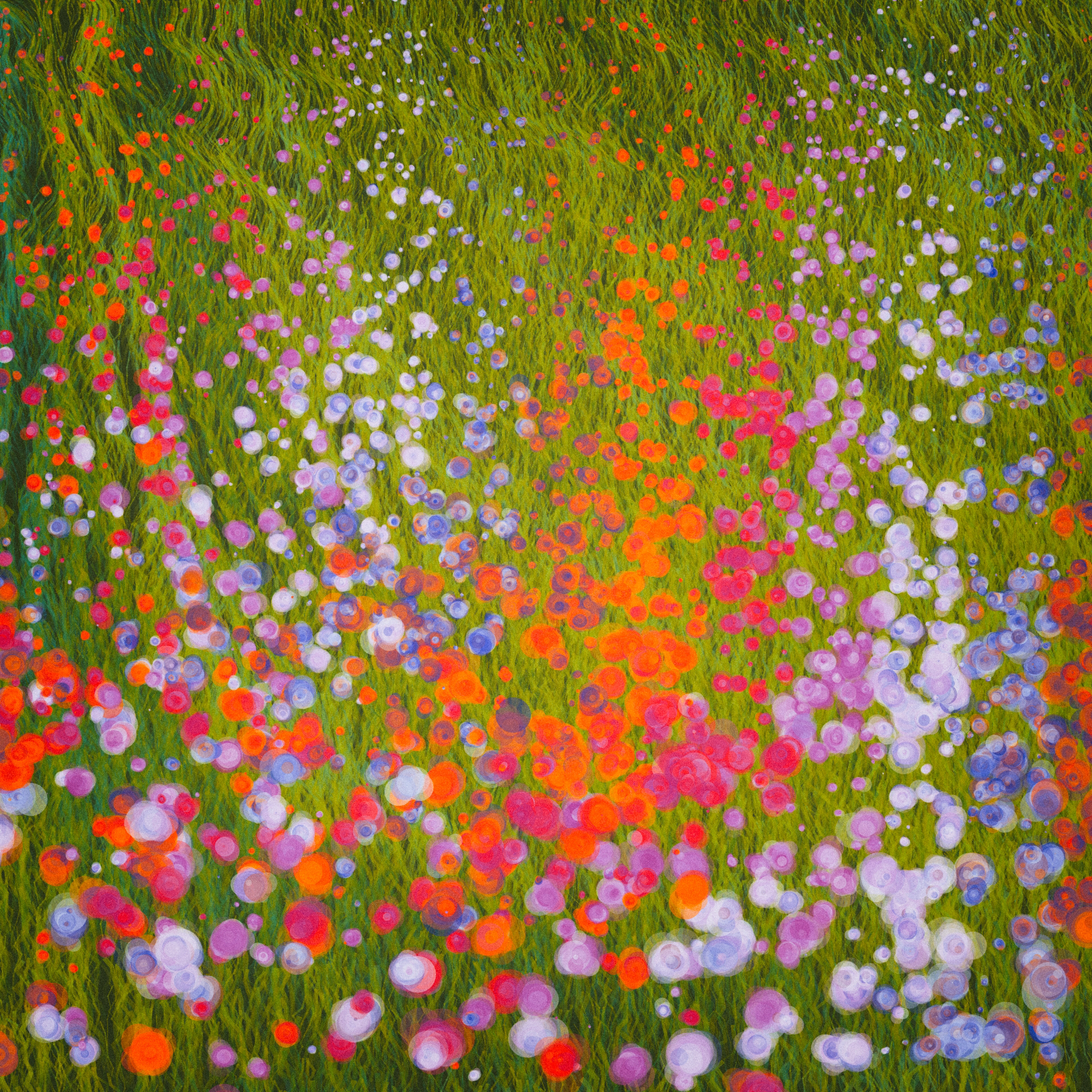
Manoloide, 41_88 Allegories, 2021.
Petals can become modules. Blossoms can become clusters. Stems and leaves can function as directional lines. A flower does not need to represent a particular species in order to retain its botanical association.
This approach is visible in works such as Manoloide’s Last Flowers and 88 Allegories. Here, floral forms are pulled away from botanical accuracy and transformed into dense fields of chromatic and geometric activity. The flower becomes less a specimen than a formal vocabulary: a way for code to organise colour and structure while preserving a trace of organic familiarity.
Such works belong to a much wider history of generative abstraction in which botanical forms repeatedly hover between representation and pattern. The viewer may see petals, leaves or gardens, but also grids, repetitions, collisions and computational decisions.
The flower is particularly suited to this ambiguity. It can remain recognisable while being almost completely reorganised.
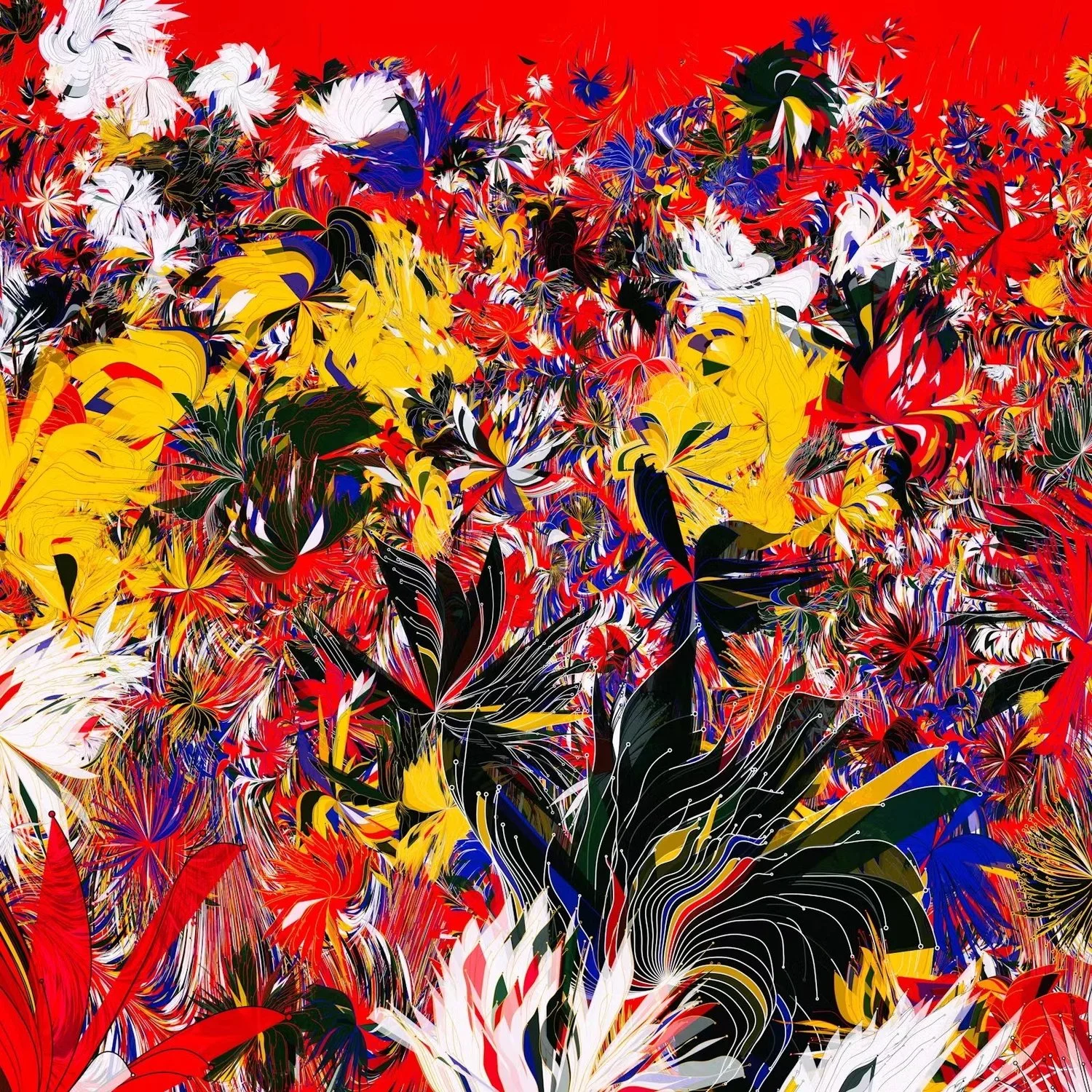
Manoloide, Last Flowers (Red), 2021.
From the individual flower to the coded ecosystem
The same generative logic can expand beyond the individual bloom.
Once flowers are treated as systems rather than isolated images, they can be connected to larger simulations of gardens, forests and environments. The question changes from how to generate one convincing organism to how many organisms might coexist, compete and develop within a shared computational space.
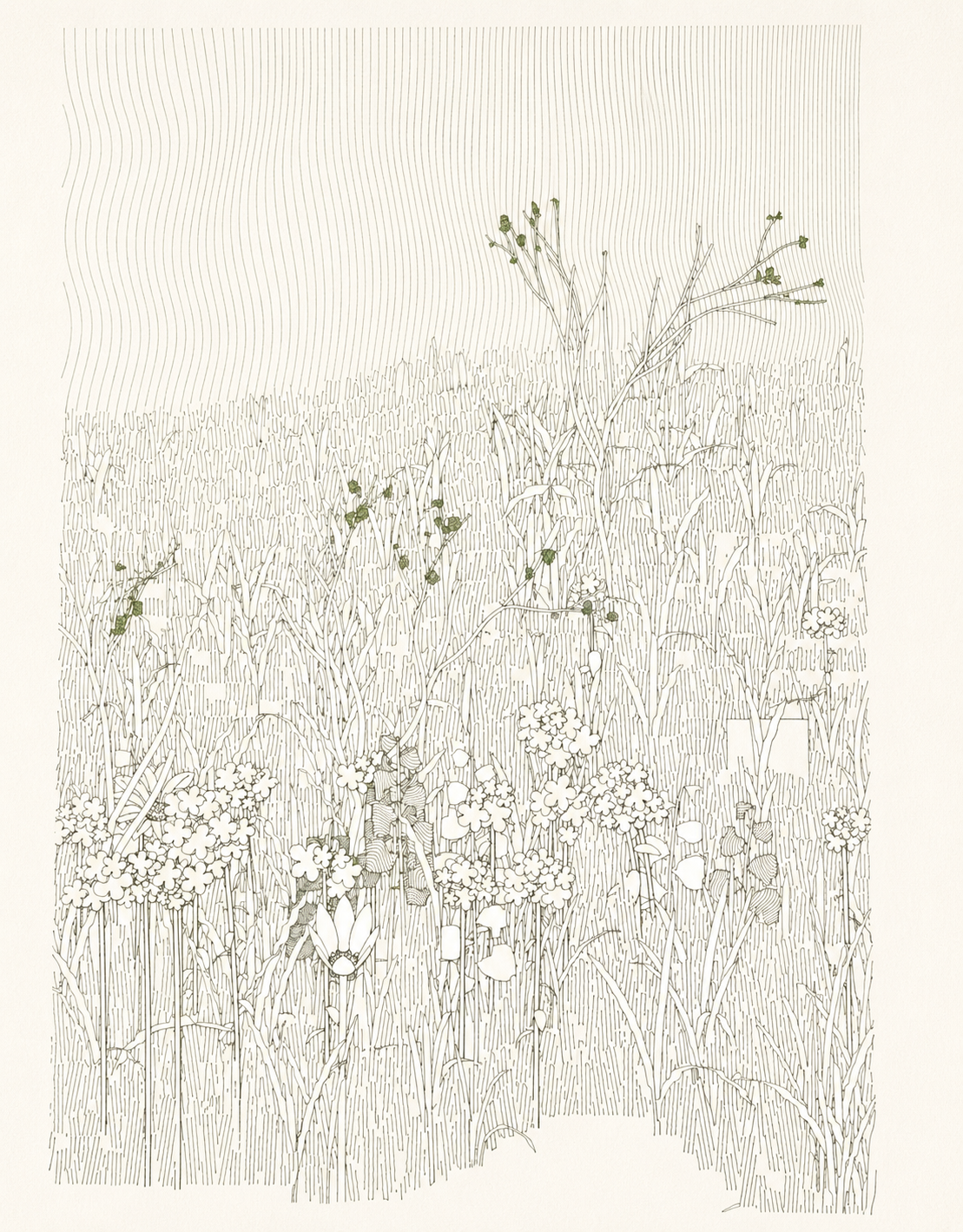
Zancan’s practice offers a prominent example of this expansion. Drawing on a long engagement with both painting and programming, his works move between individual plants, cultivated gardens, dense forests and imagined architectural ecosystems. Series such as Garden, Monoliths and The Lushtemples use mathematical structures to evoke natural growth without attempting to reproduce a specific landscape.
In projects such as Aux Arbres, the coded tree becomes part of a widely distributed digital forest. Individual outputs remain distinct, but they also contribute to the idea of a larger collective environment.
This movement from flower to garden and from garden to ecosystem reflects a broader development within generative art. The organism is no longer simply an object represented on a screen. It becomes one element within a system of relationships.
A coded ecosystem can contain hierarchy and randomness, competition and cooperation, repetition and mutation. It can also raise questions that extend beyond formal beauty: who controls the system, what forms of life are represented, and what kinds of ecological thinking can a digital environment support?
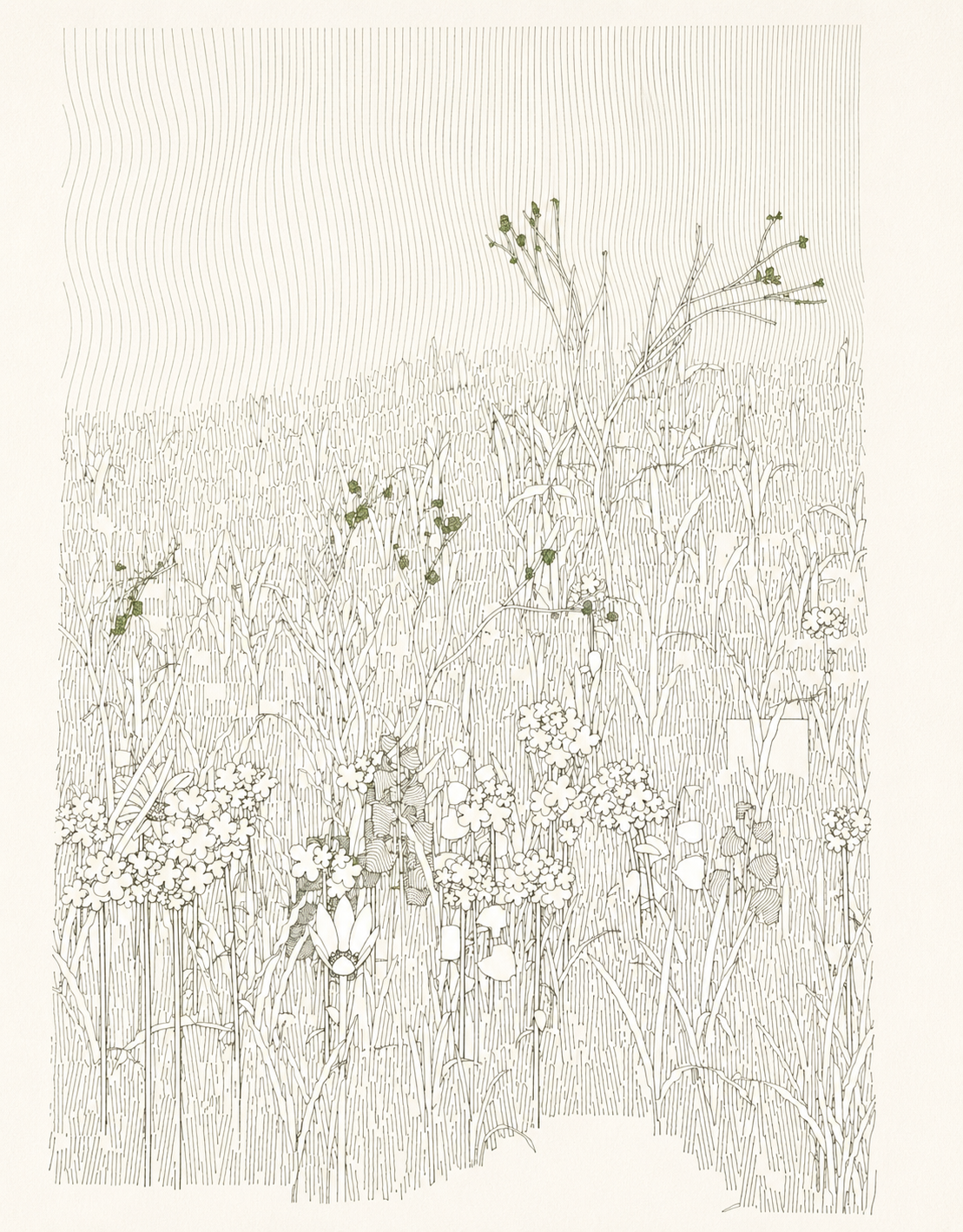
Zancan, Plotter Drawings, 2023. From a performance at Art Salon Paris.
The algorithmic flower
Across these histories, the flower appears in many different roles: as ornament, specimen, mathematical structure, recursive process, machine-learning dataset, speculative commodity and component of a coded ecosystem.
No single artist or technology owns this progression. Flowers have been used by numerous computational artists precisely because they bring several of the field’s central questions together in one familiar form.
Can complex structures emerge from simple rules? Can a machine learn nature from a small collection of images? What changes when an artist builds the dataset by hand? Can an archive become an artwork? How does an infinitely reproducible digital flower acquire scarcity and value? At what point does the simulation of one bloom become the simulation of an environment?
The algorithmic flower does not replace the natural one. It exposes the many systems through which nature is already perceived: mathematics, classification, photography, datasets, markets and code.
In generative art, the flower becomes less a fixed image than an evolving negotiation between organic growth and technological imagination. It is both one of nature’s oldest visual forms and one of computation’s most revealing models: a structure that repeats, varies and continuously becomes something new.
Featuring works by Iskra Velitchkova, David Young, Helena Sarin, Sofia Crespo, Anna Ridler, David Pfau, Manoloide, Aristid Lindenmayer, and Zancan

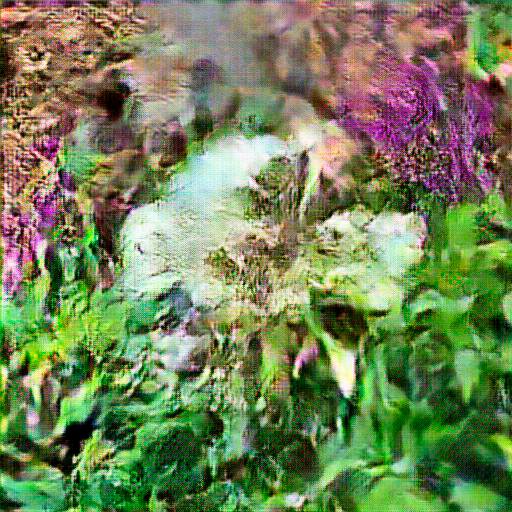

by Manoloide
processing
Hahnemühle Photo Rag Fine Art Print
Size 1.5 x 1.5 m
Unique
Unframed
The NFT is also available separately (price upon request): https://superrare.com/artwork/eth/0xb932a70a57673d89f4acffbe830e8ed7f75fb9e0/26163