
Who Will Become the Modern Goya?
Kate Vass in Conversation with Art Collector, aka maxand98
Which works from today will still matter fifty years from now and who gets to decide?
For maxand98, the answer cannot be found in present-day popularity, market consensus or institutional approval. Art history is filled with works that were ignored, misunderstood or inaccessible in their own time, only to become defining records of the societies that produced them. Goya’s Black Paintings, created privately and unknown to the public during his lifetime, become a recurring reference point in this conversation: evidence that the art most capable of enduring may emerge far from the centres of recognition.
Before becoming one of the most distinctive collectors and writers in on-chain art, maxand98 entered visual culture through literature, philosophy and repeated visits to Melbourne’s National Gallery of Victoria. Physical collecting initially appeared closed to him: galleries felt impenetrable, their social codes unfamiliar and the financial threshold prohibitive. The arrival of CryptoPunks changed that. Digital ownership offered a different point of entry, one that was global, technically legible and still sufficiently unsettled for conviction to precede consensus.
In this conversation, maxand98 reflects on his path from clinical medicine to collecting, criticism and crypto-art archaeology. He discusses purchasing his first CryptoPunk from a remote cabin in Tasmania, tracing thousands of frames in XCOPY’s work, and building a collection shaped by visceral responses to figurative art, colour and technical innovation rather than by a fixed curatorial programme.
The discussion extends beyond acquisition to the conditions under which digital art might survive. Source files, contracts, frame sequences and platform histories become part of connoisseurship; Discord archives and centralised websites become vulnerable cultural records; and DAOs, self-organised exhibitions and new forms of institution-building emerge as possible structures for preservation.
The question of the “modern Goya” remains deliberately unanswered. maxand98 resists predicting which artist or work will enter the canon, particularly at a moment when the medium itself is still being defined. What he offers instead is a principle: historical importance is rarely obvious in real time, and artists should not optimise for approval. They should be radical.
Nude Robot, Flesh Riders, 2022. Courtesy of the maxand98 Collection and the artist.
Kate Vass: Before entering the on-chain space, did you collect physical art, or was your relationship with art formed primarily through museums, books and exhibitions? What did the arrival of ownable digital art change for you?
maxand98: My mother was a teacher, my father worked a postal service office job, and as far as I know there's no connection to visual art anywhere in my immediate or extended family. But my mother was literary, and there were always books in the house. I was one of those book kids, reading under the covers at night when I was meant to be asleep. My older brother made me read to him. So my entry point was literature. As my reading got more sophisticated I went into philosophy, trying to understand Russian literature, Dostoyevsky, I think, though the exact sequence is hard to reconstruct now. From philosophy I found Nietzsche, and I remember being confused, surprised, and a little annoyed that he wrote in aphorisms in his later work.
What I came to realise was that some concepts are harder to articulate, or simply better conveyed, through unconventional writing.
“Aphorism, metaphor, music, and then visual art are better shortcuts to a type of communication, or just connect to a different and probably deeper part of the brain than straight English sentences seem to do.”
It's worth labouring over, because it's a key insight natural artists probably know from birth, I didn't. Your readers probably already know it. Around that time I was also reading writing by artists like Robert Motherwell [1] and Ad Reinhardt, and at some point I found Robert Hughes' Shock of the New, which became a durable, key influence. Someone who could so eloquently reverse-engineer visual art and visual artists within the context of history just seems like a kind of magic. Even after reading everything he has written and his biography, I still can't figure out how he did it.
Plus he was Australian, which was probably part of the appeal, the same way I once became obsessed with Patrick White.
After university I moved from the suburbs into the city and spent many weekends at the National Gallery of Victoria. I've been to plenty of galleries since, but a free one is an incredible community service. I used to join the tours built for tourists, every week, an important part of my education. The guide, usually an elderly woman, would go around the group asking where everyone was from, and I was always embarrassed to admit I was from Melbourne. They got to know me, because I kept coming back.
I never collected physical art, because there was no entry point for me. The traditional gallery world either didn't exist here the way it does in New York or London, or it was simply impenetrable. And I had no budget for it, so it wasn't accessible in any sense.
I dated visual artists, but always felt like an imposter or outsider at their exhibitions, either no connection at all, or a kind of distaste for what felt like a scene: who was wearing what, and so on.
Later I'd spent time deliberately reading and learning about Ethereum, for unrelated reasons. Then CryptoPunks arrived and everything clicked at once, I was immediately addicted. I could see it was new. I could see it was a kind of outsider art, and because I understood the technical detail, I was confident in its significance. From that point, everything changed.
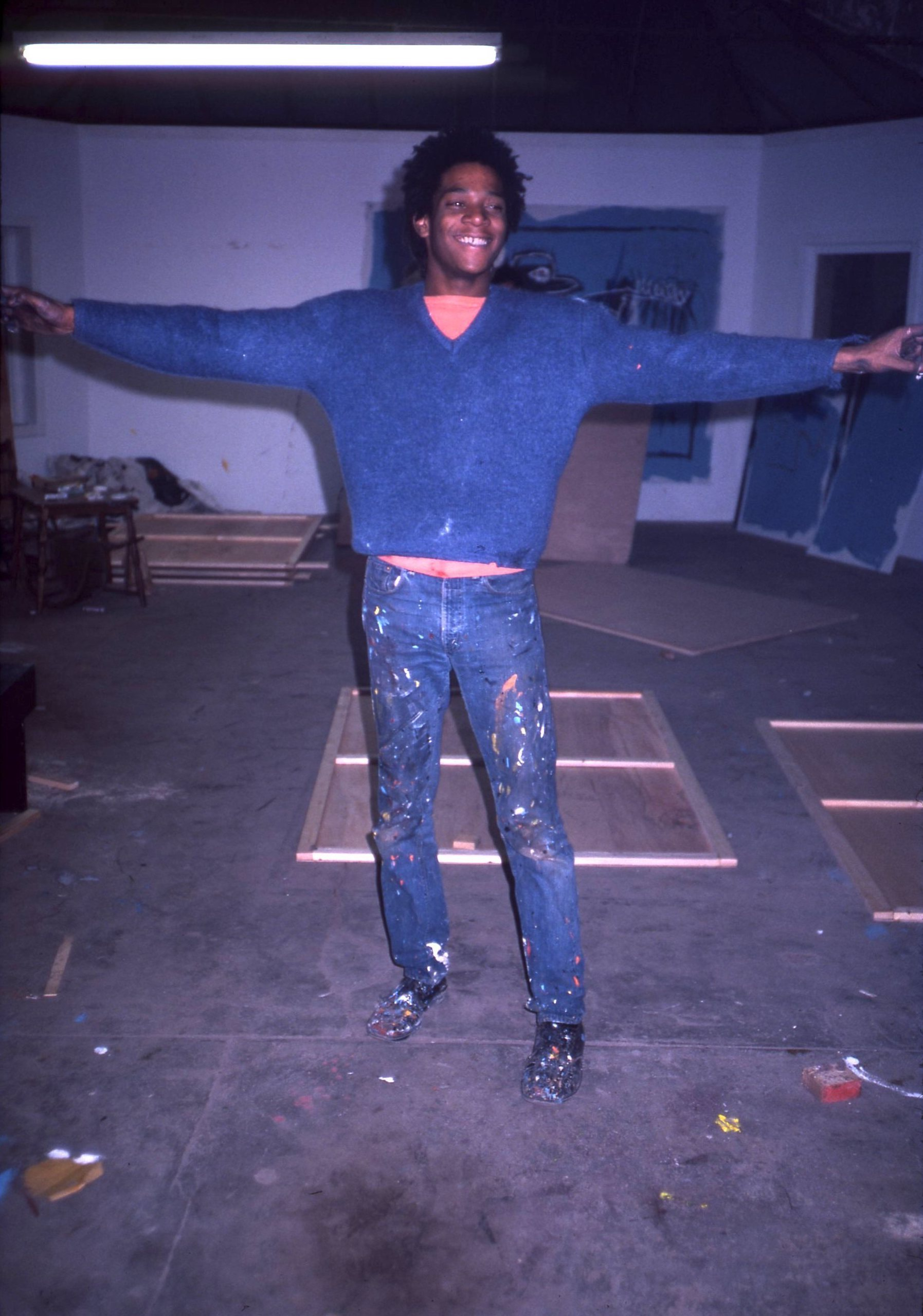
Seth Tillett, Jean Michel Basquiat in his first studio space, 1981. Courtesy of the maxand98 Collection and the artist.
KV: For years you were collecting and writing while still practising clinical medicine. Has medicine shaped the way you look at art, your attention to evidence, anomalies, provenance and diagnosis, or did collecting emerge partly as an escape from that way of thinking?
M98: That's an astute question, I've never answered it properly, or honestly, before. Maybe I'll do it here. Previously the answer depended on who was asking. It's multifaceted.
As a fifteen-year-old I did work experience in a doctor's surgery. I'd always had an interest in biology, how the body worked, the magic of the human form. So medicine was a natural fit early on, because in my mind it was one part of a larger project: trying to understand humanism, I suppose. I wasn't career-orientated, and I was a fairly average medical student academically. But once I had children, there was a financial necessity to pay the bills.
What's problematic about specialist medical careers is that they're an enormous black hole of time and energy, and they build a powerful identity that's very hard to dismantle. Workaholism and the failure to retire are chronic problems in that space. I still work part-time in clinical medicine to pay the bills, but I've dramatically de-escalated and withdrawn from most of it. Many people called me up and wondered if I was mentally ill to give up the salary and 15,000 patients to spend more time on crypto art, but here we are.
Medicine runs on peer review, which is both a feature and a bug. Anyone doing a substandard job is quickly identified and removed, but it's very difficult to innovate. Forward thinkers get called crazy, and cancelled, before they're vindicated. Barry Marshall is one example. [2] So a field like blockchain, where innovation is the whole point, sits incongruously with a career in medicine, at least in my experience. I still find switching between those modes of thinking difficult.
“I don't think collecting was a way of escaping. I think medicine as an education and a job was a subset of trying to learn what I needed to learn, then escape, because the interest in blockchain, crypto art and now AI was larger or more powerful.”
KV: Every collector has a first token. Do you remember yours? What pulled you in at the time, and do you still own it?
M98: My first was CryptoPunk 7508. I was on holiday, in the remote southwest of Tasmania, in a place called Strahan.[3] I don't know why I was looking at CryptoPunks, but I remember I only had my mobile phone, and I hit the transfer limits on my TradFi bank account buying them. The significance of the project, even though I wasn't a minter, and wasn't particularly early, radicalised me for a couple of reasons: I understood, in a way I hadn't before, that in a TradFi banking scenario you are not in control of your own money. And the fact that I could do this at that time, in a remote area of the planet, with nothing but a phone, proved that what would later be defined as the network state was already real, and that the nation state would be deprecated in time.
I don't own it anymore. In February 2021, when CryptoPunks blew up, I sold a zombie for a 10x return and needed time to process what had happened. It was a fast-moving period, and I didn't yet have confidence that what I'd done was real.
The last CryptoPunk I sold from that time was a blonde, and I later had a lot of difficulty buying one back. But I have two CryptoPunks now, and I'm happy with that.

Larva Labs, CryptoPunk #7508, 2017.

maxand98, The day after his first CryptoPunk purchase, Strahan, Tasmania, December 23, 2020. Courtesy of the maxand98 Photo Archive.
KV: In 2021 you published a digital-art manifesto that defined the medium as animated, anti-skeuomorphic, reflexive, generative, composable, and native to colours that cannot be rendered physically. Five years later, which of those propositions still hold for you, and which would you now challenge or remove?
M98: Most of it still holds. The logic was that manifestos have a long history in visual art, and I was borrowing that form as an early attempt to define what made crypto art important. It wasn't especially sophisticated, and there's nothing in it I'd change now, except perhaps the rise of agents, which I didn't predict. As far as I know, Artnome is the only other person who's attempted to define this.
KV: Your collection now moves between long-form generative art, XCOPY’s GIFs, and C0MPUTERBL00D’s hybrid drawings. How would you introduce the collection to someone encountering it for the first time? What deeper thread connects these apparently different practices?
M98: I still think that, even now in 2026, there are no real methods or standards for displaying digital art, online or in physical space, though I think that should be an academic discipline in its own right. I've had far better engagement with my own collection since building a website that presents the work and the artist's biography in a way that means something to me. Building it with a random-generator function was revealing, looking at what I'd actually collected, there are very clear threads. One is an interest in digital figurative art. I still think that, apart from XCOPY, no major artist has rendered figurative work that does the medium justice. Cem Hasimi, Nude Robot and C0MPUTERBL00D are examples I'm watching closely, along with Giant Swan.
“The other thread is colour theory - I also have colour synaesthesia, such that Mark Rothko, Ad Reinhardt, James Turrell, and lately Jeff Davis have been a very important component of my art interest. These are the two spokes, with neither dominant.”
Figurative art is what I'm most drawn to, I've long admired Lucian Freud, Francis Bacon, Michaël Borremans, George Condo and John Currin among the traditional painters. The other thread runs through colour: Jeff Davis's Portal, and much of the Art Blocks catalogue.
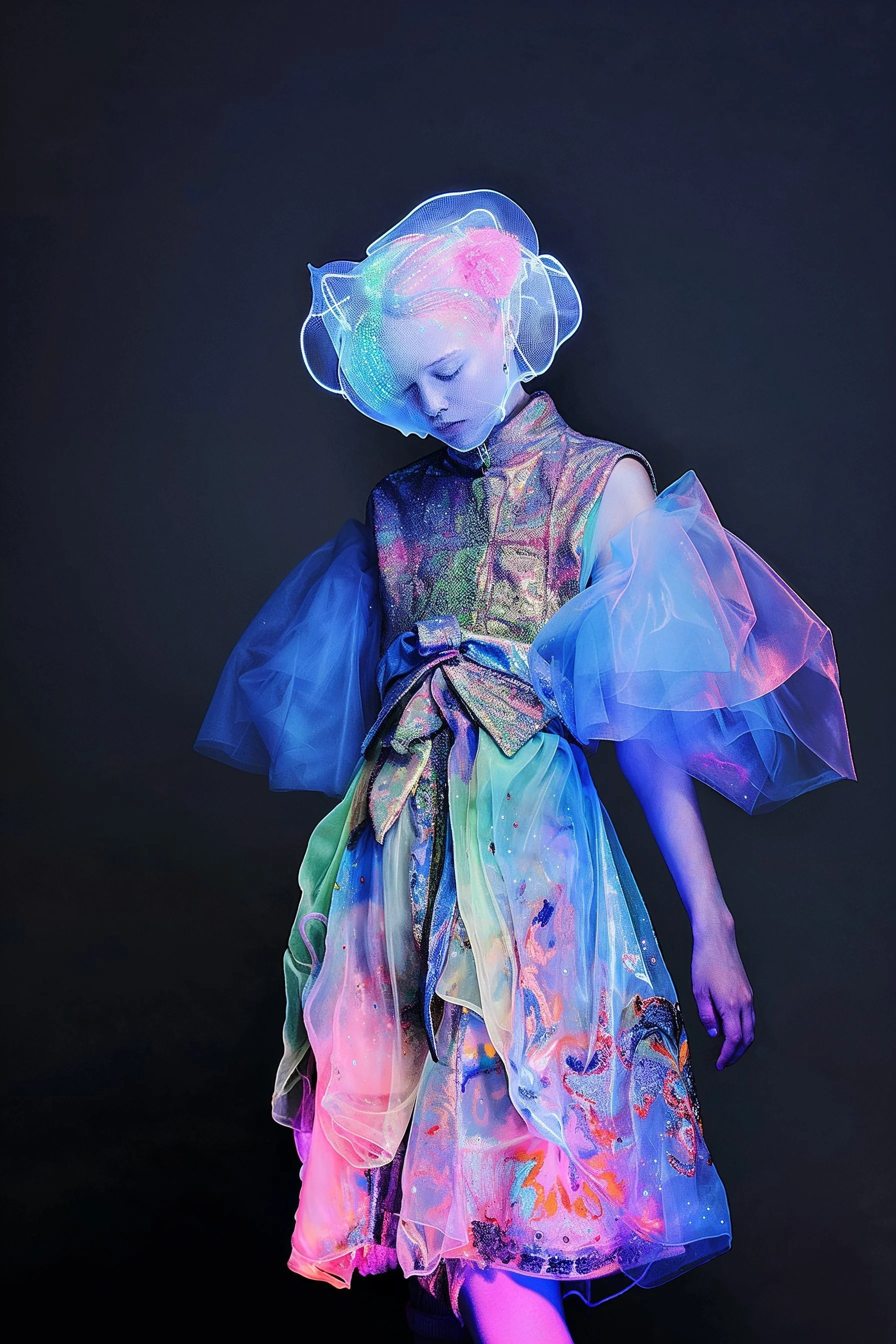
Claire Silver, morphogen, 2024. Courtesy of the maxand98 Collection and the artist.
KV: When you encounter a new work, what moves it from “interesting” to something you feel you need to own or live with? How much of that decision comes from instinct, research, the artist’s wider practice, the community around the work, or price? And what kinds of projects make you immediately step back?
M98: This is easy for me, because it's visceral. I almost never mint, but I carry a list, no intellectual analysis involved, of works I want to acquire. Diewiththemostlikes and Joe Pease are artists I'd love to collect but haven't managed to. Writing about an artist helps with that hunger; it's an indirect connection to them, almost a kind of pseudo-collecting.
“What’s wonderful about crypto art is that, in its early phases, the connection between quality and price is almost completely disconnected. You can buy phenomenal work for almost nothing.”
It's still crazy to me that you can buy an RD work for $200 and need thousands for a BAYC.
KV: Is there one work that best represents the collection, or one you would find particularly difficult to part with?
M98: I'd push back on the idea that anything I collect belongs to some defined “collection.” There's no plan or coherence to it, at least not yet. But if I had to choose one work, it would be Pete Burkeet's RAW.
The major problem with crypto art is that it's inherited the rules of Web2 censorship, and that prevents radical innovation. Look at art history: there are whole periods, Dada, or Goya's Black Paintings, where the art of the time was radical, provocative, confronting. Web2 censorship has almost entirely foreclosed on that: Instagram won't allow a nipple, YouTube auto-demonetises, and so on.
“This will drive a significant shift to censorship-resistant sovereignty with self-hosting, disintermediation of centralised observational web spaces like Instagram and OpenSea, and a shift towards Nostr and other technology like Zcash. There is very little art surfaced that is even on the level of a film director like Gaspar Noé.”
Pete Burkeet, RAW, 2024. Courtesy of the maxand98 Collection and the artist.
KV: You have argued that some early Art Blocks projects may be important because of their technical innovation rather than their aesthetic strength. How do you distinguish a technical milestone from a lasting artwork?
M98: It's impossible to know a lasting artwork unless you can time travel. Much of art history is about identifying and documenting the innovation that represents a new way of seeing, Cubism is a good example, as is abstract expressionism, among many other movements. The most emblematic case is Duchamp's urinal, because the technical innovation is almost entirely divorced from the aesthetics of a urinal.
“Art that was popular within a particular epoch is rarely the art that lasts. In fact, they may be inversely correlated. The fact that Goya’s Black Paintings can speak to us 200 years later, despite being unknown in their time, is one example I would point to.”
KV: In January 2023, you bought edition 11 of XCOPY’s The Doomed for 27 ETH. XCOPY had released the work on KnownOrigin in October 2018 as an edition of 100; the first edition sold for 0.075 ETH, and it took more than a year for all 100 to sell. What gave you conviction at that price, and what were you actually buying, the image, its place in history, or the indifference with which it was initially met?
M98: I can't remember the exact sequence, but at the time I was set on acquiring all 28 editions of XCOPY's KnownOrigin series, and bought a large number from Moderats in an OTC deal. I think I bought The Doomed from Jediwolf, but I can't recall exactly. I've written about this edition [4], I think it's a key work for XCOPY through a confluence of things: the idea that an editioned work, in a network context, can be more valuable than a 1/1 because of the shared relationships and provenance, and how many times XCOPY had iterated on the motif on his Tumblr before this.
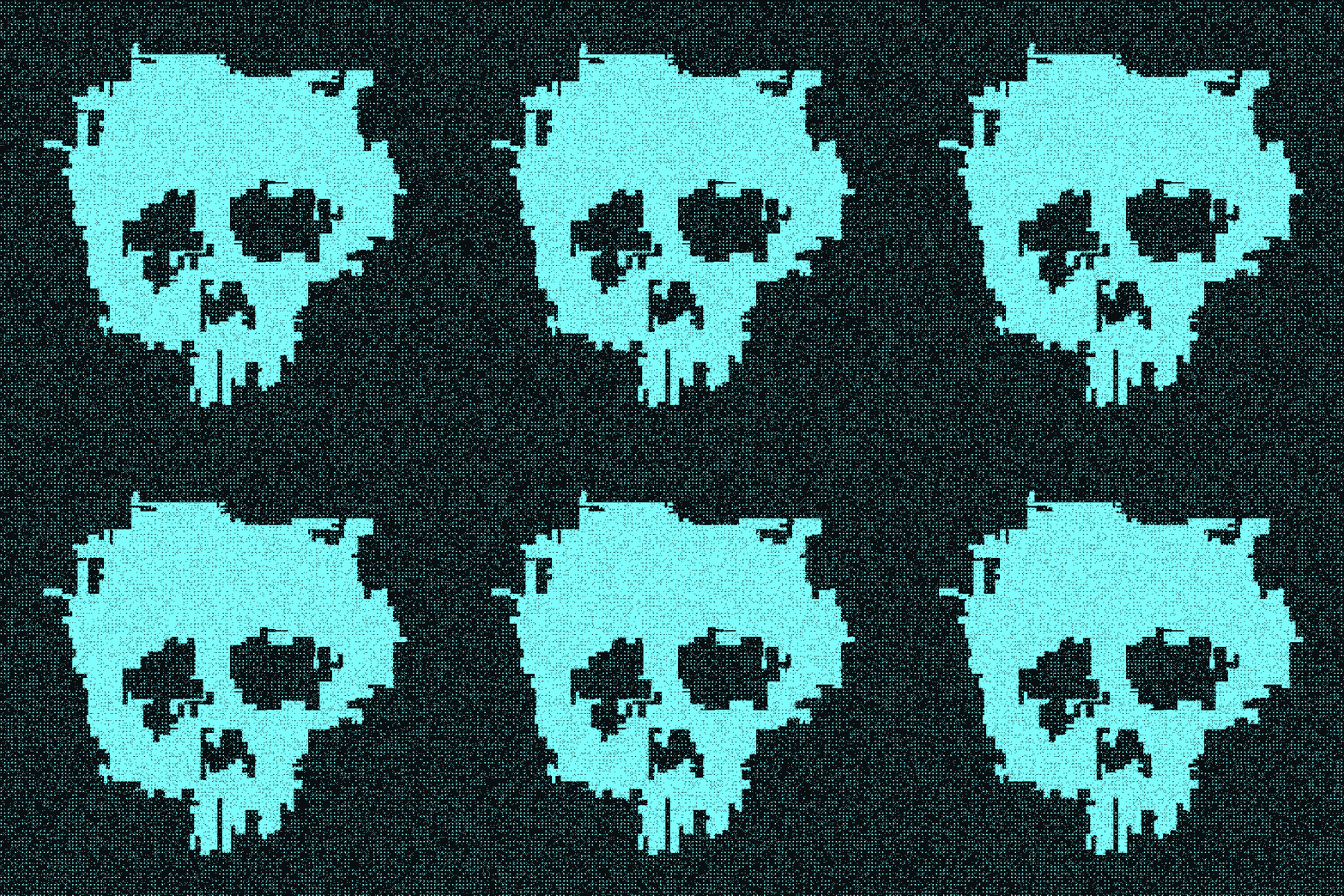
XCOPY, The Doomed, 2018. Courtesy of the maxand98 Collection and the artist.
KV: You began writing as maxand98 while still working in clinical medicine. You've since argued that Web3 anonymity is a closing window, and suggested that once you knew you were leaving medicine, there was less reason not to write under your own name. Where did the name come from, and why have you continued to use it?
M98: It's a sobering feeling, to self-censor or be censored, and I think that's a telling sign of what's happening in society. You have to have a view on the tech-dominant Palantir state, which is probably most advanced in China but coming to a jurisdiction near you soon enough. If you've ever travelled to Singapore, you understand why: that model of society is attractive, clean, safe, graffiti-free, and in many ways sterile. There's no doubt artistic innovation isn't valued in clinical medicine, and the power structures are such that dissenting views are a career negative.
“Explaining the name will dox me more than I want to be doxxed currently, but even the fact that you have been able to link my professional career and crypto art profile is one example of what I'm talking about. I have an agent working full-time to remove the medical presence, but clearly need to up that game.”
KV: XCOPY is central to both your collection and your writing. For your essay on The Doomed, you went through 1,167 GIFs and all 18,755 frames, tracing the motif back to January 2013 and through its later variations. Does serious connoisseurship in digital art now require treating source files, frame sequences, contracts and platform history as part of the artwork?
M98: This kind of crypto archaeology is still nascent. ZachXBT is worth studying, because I think that methodology, applied to crypto art history, will be fruitful. Most people don't grasp that IPFS provenance, on-chain provenance and Web2 provenance are entirely different propositions. Artnome, Mdiac and others understand this, and institutions like DoomedDAO, SquigglesDAO and other collecting groups have an important role to play in documenting, preserving and commenting on this history. None of it is preserved automatically, it takes effort, and sustained attention.
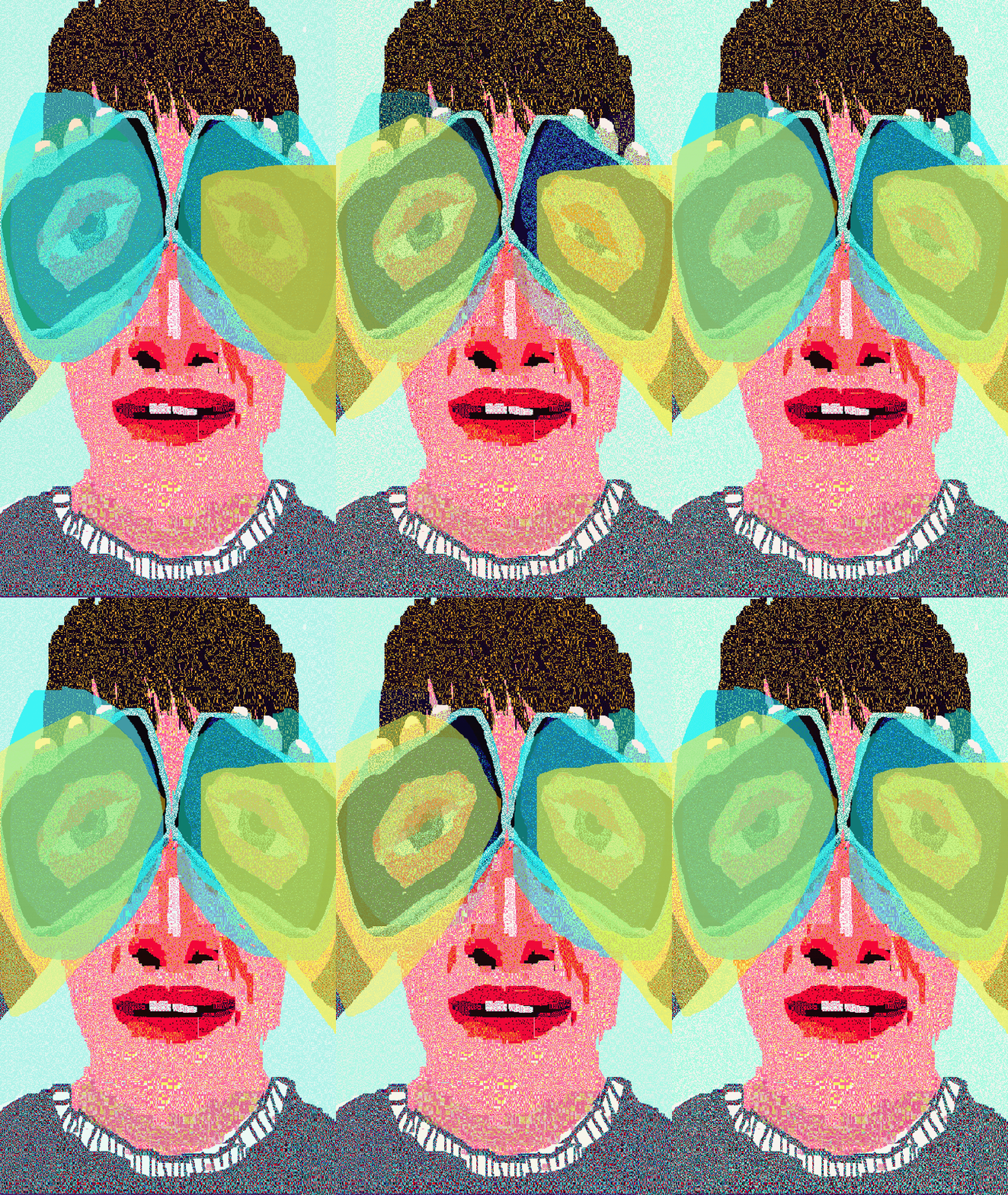
RJ, The Eyes #77, 2026. Courtesy of the maxand98 Collection and the artist.
KV: You are one of six co-founders of DoomedDAO. What can a group understand about an artist that a single collector might miss, and how does shared ownership change the traditionally private experience of collecting art?
M98: I think a mistake was made early on, building DAOs to be programmatically dependent, like Nouns, before the technology was mature. DoomedDAO has 164 members: anonymous, horizontal, connected globally, zero overhead, sharing a multi-year Discord history of expertise and interest in the artist. So much excellent work has come out of that banner, and I'm genuinely enthusiastic about what these groups can do going forward. The Tech Won't Save Us exhibition was one example.
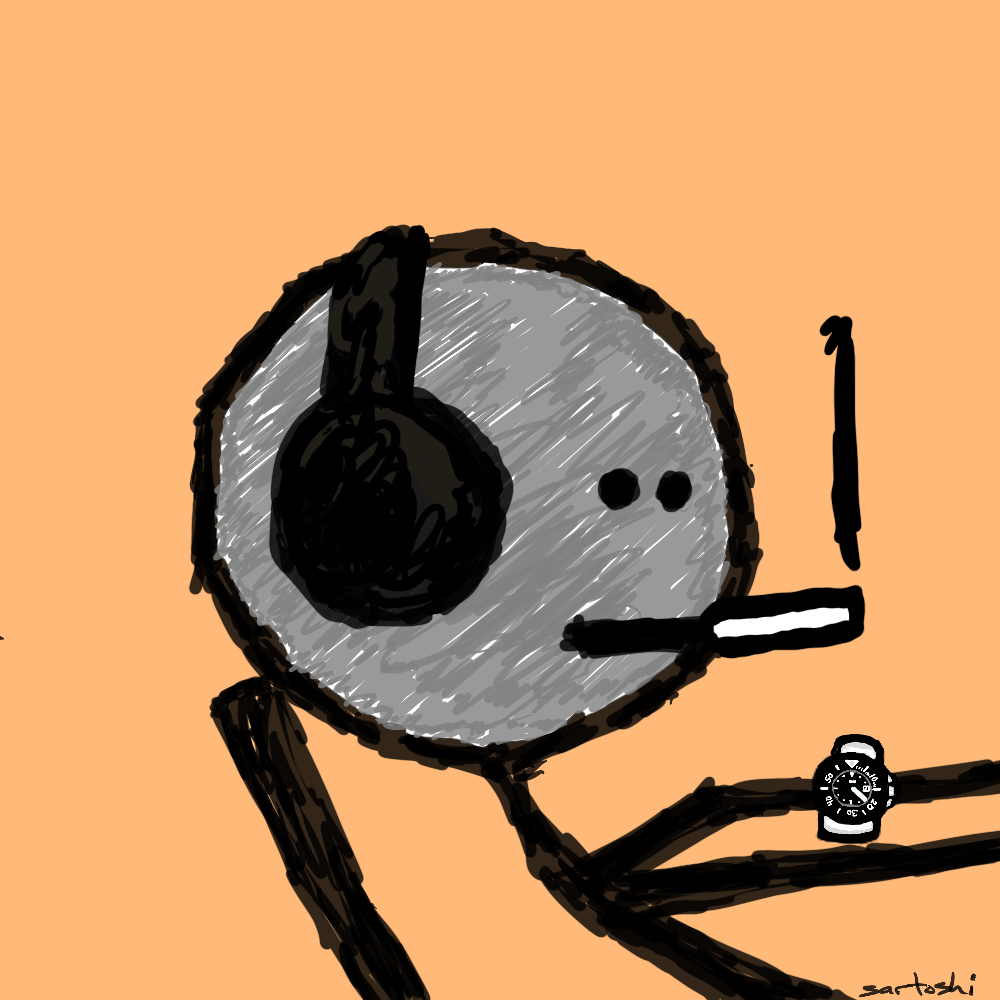
sartoshi, mfer #7016, 2021. Courtesy of the maxand98 Collection and the artist.
KV: In March 2022, you projected 69 mfers onto Melbourne’s Nylex silos without permission or announcement, placing internet-native art on one of the city’s most recognisable landmarks. Was this simply a playful act of provocation, or did you already see it as a way of bringing on-chain culture to people who would never otherwise encounter it?
M98: I wanted to build expertise in the physical presence of crypto art, and this was one fun way to do it. The obvious motif was documenting the ephemeral. The original plan was to project it onto the facade of the NGV, but the contractor wouldn't go for it. MSCHF was the inspiration.
“I think, in general, moving back to my discussion on Web2 censorship, my view is that the crypto art space is too censored, too safe, and not provocative enough in its current iteration. There are a large number of opportunities in decentralised blockchain technology to just do what you want without permission from the state or anyone else.”
KV: In 2025, when you could not travel to the New York presentation of XCOPY: Tech Won’t Save Us, you leased a street-front gallery in Melbourne and built your own version of the exhibition. What made building a local node feel necessary?
M98: I had a baby coming, but I was directly inspired by Eli Scheinman and Benny Redbeard, who showed up in person at Zero 10 Miami and stepped into the real world. I thought to myself, "What is the most direct and uncomfortable thing that I could do?" and so set a deadline to create a mirror of the SuperRare exhibition. Because XCOPY is CC0, this was easy and permissionless, no one in the DAO could have stopped it even if they'd wanted to. I was excited by that. I also embarrassed myself; it wasn't very professional. But I learned a lot about digital art display, including that an LED wall showing XCOPY's work needs one pixel per LED to render it faithfully, and a few other technical lessons about showing crypto art in an IRL, physical context.
I met many wonderful people in the local crypto art scene, Nuclear Samurai, SonOfLasG, GT, Jane, and plenty of others, just by getting out of my office and doing something in the real world. I'm still trying to lean into that instinct: do the most uncomfortable thing.
KV: You spent two years debating whether a physical book was inconsistent with the idea of digital purity, yet you are now developing a book documenting XCOPY's KnownOrigin editions. What changed your mind, and what can a book do that the blockchain record alone cannot?
M98: It's still a work in progress, we'll see. Your own book efforts through your gallery mattered to me, as did other NFT books, like NFT Now, the CryptoPunks book, which I bought and read, and the Meridians book. Crypto art can't thrive as a purely internet-based medium; it needs physical touchpoints. I came back to the book after the XCOPY exhibition, because I think it's one of the engagement points still missing. It's also been much harder than I expected, and I'm still wrestling with the fear of embarrassing myself again.
KV: Much of crypto art’s early history still survives in informal conversations, recordings and essays rather than formal archives. What is most at risk of disappearing?
M98: Anything Web2, anything centralised. XCOPY's Tumblr archive could disappear overnight. Discord is another platform where much of crypto art history lives. I'd hope the company itself, or interested parties, are using the export function to preserve it. It makes sense to me that most of it eventually moves onto decentralised platforms, like Ethereum.
Giant Swan, Metamorphosis, 2021. Courtesy of the maxand98 Collection and the artist.
KV: You have argued that museums, books and physical exhibitions remain essential entry points into digital art. What would serious institutional engagement with crypto art look like?
M98: The answer, I think, is that new institutions need to be formed, that's the intellectual underpinning of the work behind DoomedDAO and AB5D.
I don't particularly like the direction traditional art museums are going, it's uninteresting to me, or maybe I'm just getting older. I don't care whether MoMA collects crypto art. But my medium-term view is that many cities, or network states, will want their own version of Node Gallery sooner rather than later. I'd like to see Node open-source their designs and expertise for digital art exhibitions, so it can be replicated worldwide. I think that physical decentralisation would be the next real validation for CryptoPunks.
KV: You have described the postmodernist gap as a vacuum waiting to be filled by something significant, with crypto art as the only serious current candidate, although its canon is still unsettled. If you had to choose one work from the past five years that you believe will still matter in 2075, which would it be, and why?
M98: I don't think anyone can really answer this. I'd say it's unlikely to be any of the candidates currently being discussed. It's impossible to predict, in any epoch, what will matter, let alone now, with AGI imminent. My only guess is that technical innovations like Art Blocks, where the output is decided at minting rather than by the artist, will have some role in the eventual canon.
“I hope I’m alive in 2075 to see who becomes the modern Goya. My unsolicited advice to any artist is to be radical.”
Alotta Money, Santa Mental, 2022. Courtesy of the maxand98 Collection and the artist.
maxand98 on X
Featured in this interview, artworks by Alotta Money, Claire Silver, Giant Swan, Nude Robot, Pete Burkeet, Larva Labs, RJ, XCOPY, sartoshi and Seth Tillett.
Further Reading 1. Robert Motherwell, catalogue essay, Museum of Modern Art.
2. Barry Marshall discovered Helicobacter pylori, the bacterium that causes stomach ulcers, once one of the most common reasons for abdominal surgery, now almost entirely eliminated. I watched him give a lecture at the hospital where I trained; the person introducing him, then head of the Gastroenterology Society, was the same person who had once denied his research grant. Barry did his own thing, swallowed the bacteria himself, proved the thesis, and won a Nobel Prize, and called out his introducer, in public, on the way up. A genuinely radicalising thing to witness.
3. maxand98 Article 'XCOPY The Doomed', 2018