
Josh Yakov on criticism, curiosity and finding value before consensus
Josh Yakov, known online as Jiggy (@delta_alpha_ohm), describes himself as a “rabbit-hole researcher.” His collecting moves accordingly: across generative systems, early blockchain experiments, computational aesthetics, science, design and the cultures that form around them.
His route into digital art passed through cryptocurrency, Art Blocks, SuperRare and Foundation before the grassroots environment around Hic et Nunc, and later fx(hash), fundamentally changed the way he approached collecting. In previous conversations, Yakov has described collecting as an attempt to separate signal from noise: to understand what matters beyond attention, market momentum or consensus.
For this conversation, we started somewhere else: how is taste actually formed?
At a moment when algorithms, markets, institutions and social networks continuously tell us what deserves our attention, Yakov argues for something slower and considerably harder: curiosity, research, criticism and the willingness to remain uncertain long enough to discover something before everyone else agrees that it matters.
The works reproduced throughout, by Zach Lieberman, Bjørn Staal, Huw Messie and others, are drawn from his collection. Some are discussed in the conversation; others are left to speak for themselves.
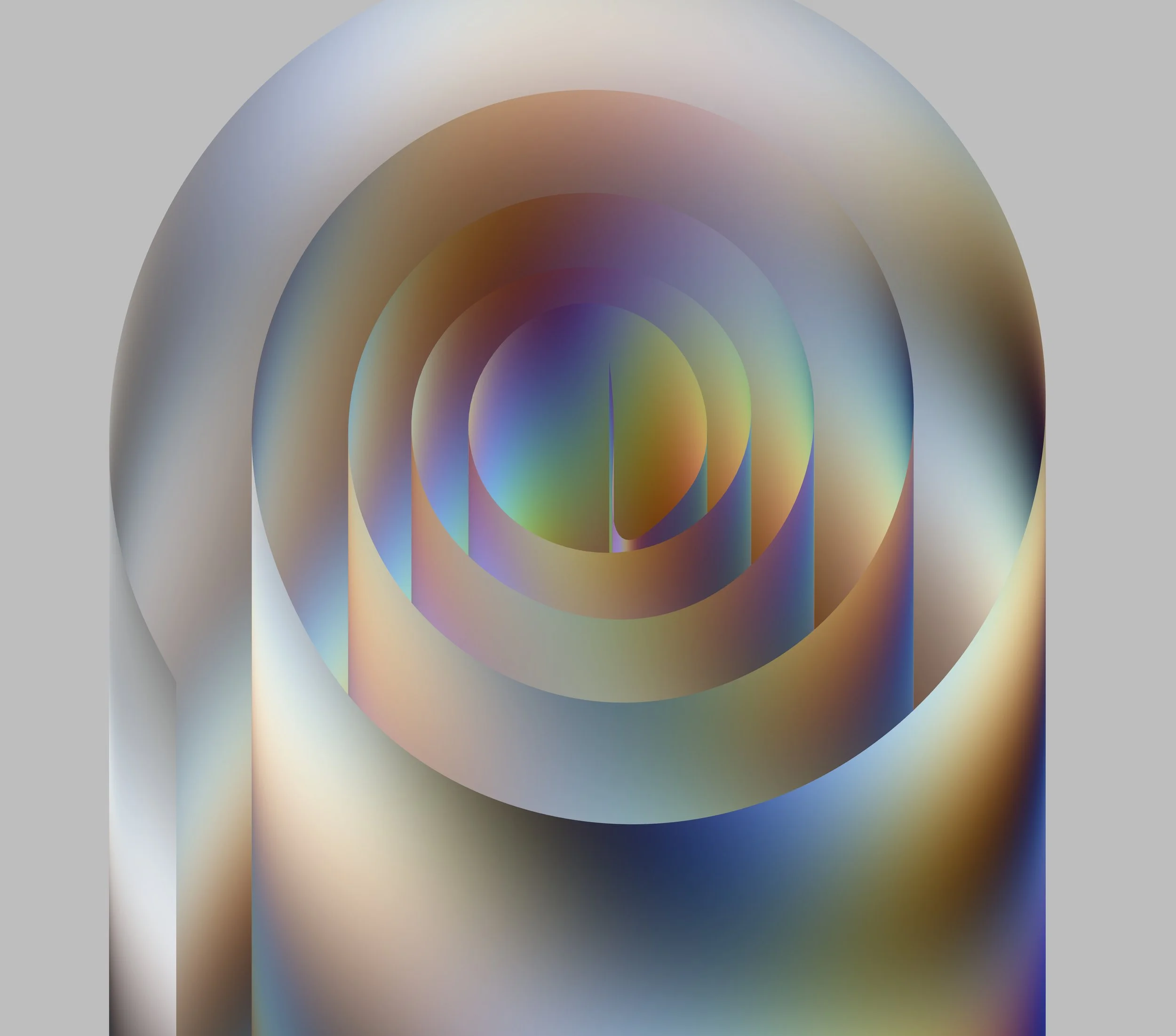
Zach Lieberman, Color ribbon study, 2022. Courtesy of the Jiggy Collection and the artist.
Kate Vass: You describe yourself as a rabbit-hole researcher. Your interests move between mathematics, finance, sociology, cooking and art. What has collecting taught you that those other disciplines couldn’t?
Josh Yakov: Maybe that it is impossible to be completely logical about it.
I was recently reading Nassim Nicholas Taleb’s Skin in the Game and thinking about rationality almost as a survival mechanism. But collecting art doesn’t behave entirely rationally. You can approach it with intention, research and certain criteria, and then something happens that you can’t explain. There is serendipity.
Generative art embodies that particularly well. You establish systems and rules, but something emerges that wasn’t entirely foreseeable.
If collecting has taught me anything, it’s that there is always something more to learn, and that some of the most important things aren’t easily explained. That uncertainty is part of what keeps me interested.
KV: You have spoken before about distinguishing signal from noise. How do you recognize something meaningful before there is consensus around it?
JY: I don’t think there is a perfect formula. That’s part of the difficulty of discovery.
Scientific discovery doesn’t come from one perfect method either. You research, test hypotheses, get things wrong and continue. Collecting can work in a similar way. You have to become comfortable with not knowing while learning to recognize clues.
Institutions have systems, and those systems can provide balance; there are reasons some of those methods have endured. But systems aren’t infallible, and once you understand how boards, advisers and other structures influence decisions, institutional validation stops looking entirely neutral.
That makes discernment important. I try to learn from individuals as much as from institutions: artists, collectors, researchers, people with very specific knowledge. Sometimes one person opens a door onto something you didn’t even realize existed.
The point isn’t to reject consensus automatically. It’s to understand how the consensus was formed before using it as evidence of quality.

Matt DesLauriers, Latent Dispatch Studies – Butterfly, 2025. Courtesy of the Jiggy Collection and the artist.
KV: Then is taste subjective? Or can there actually be good and bad taste?
JY: Cooking made me think about this a lot.
Taste is obviously personal. Your experiences are different from mine; even biologically, we experience things differently. But in a kitchen there are also things that are objectively wrong. You can oversalt something. You can burn it.
At the same time, you can deliberately push something so far that what would normally be considered “burnt” becomes desirable.
So I don’t think subjective versus objective is a binary. It exists on a spectrum.
I approach art in a similar way. Personal experience matters enormously, but there are still questions of rigor, technical understanding, originality, context and depth. We sometimes use “it’s subjective” as a way of avoiding the harder work of making distinctions.
And that harder work is what interests me.
I was recently talking with another former chef, an incredibly special artist, who's also managed some of the best artists and galleries and is beginning at a new institution, who put me onto Georges Bataille's writing on taste. In my humble opinion, I think much of the tech discourse on taste could learn from him as well as Ruby Justice Thelot's metalabel zine "A Few Essays on Taste." Both Bataille and Thelot have deeply studied the history of it and get it from a multicultural perspective. Bataille, whom I am fond of, rejects the status quo and understands it from a system perspective, which I feel is ever more prescient in our hypernetworked lives. Both of these examples as well as my friend represent this sort of artist's artist, curator's curator, critic's critic, researcher's researcher - that simultaneously is current and ahead of its time while having knowledge of the past and a vision for the future.
KV: So taste itself requires work?
JY: Absolutely.
One of the things I learned studying finance was the importance of site visits. A company can tell you something in its quarterly report, but when you visit in person, you notice things that aren’t visible in the numbers.
Studio visits work in a similar way.
When you spend time with an artist, you start to see the inner workings of the practice: what they’re researching, what they reject, how critical they are of their own work, what they notice that other people don’t.
I remember visiting Andreas Gysin in Lugano. His work was already important to me, but being around him made me understand the level of research and rigor behind it. Later we saw an exhibition on Japanese design, and Andreas was noticing details in the typography and design that I simply didn’t have the knowledge to see.
Those encounters matter because you can’t compress all of that into a social-media timeline.
Collectors have enormous access to information and to people. What surprises me is how often they don’t use it. They have the resources to go deeper, but sometimes they don’t do the work, or perhaps nobody has shown them how.
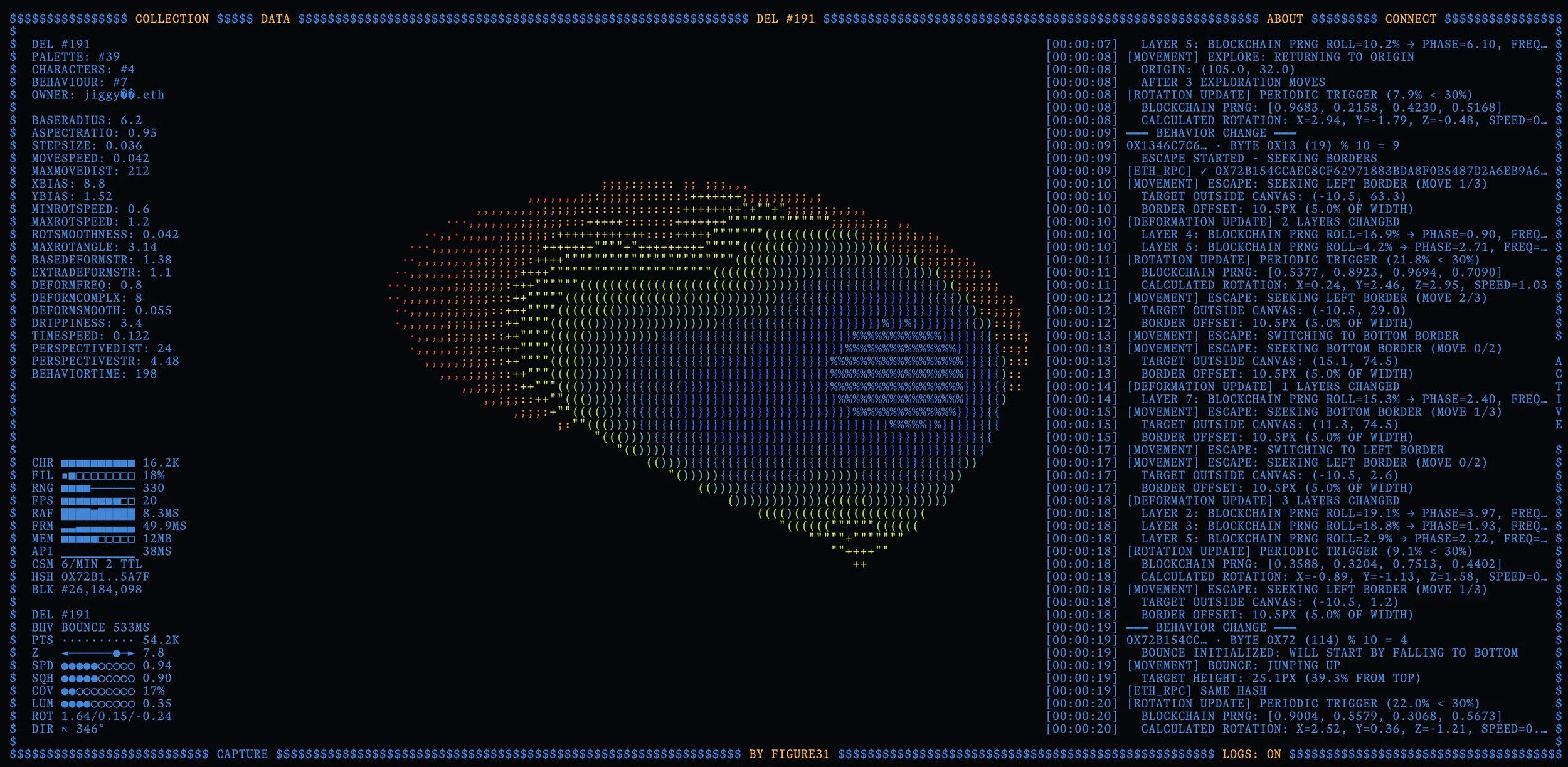
Loucas Braconnier, DEL #191, 2026. Courtesy of the Jiggy Collection and the artist.
KV: You recently discussed taste with Ruby Justice Thelot at Heft Gallery in New York, to mark the second edition of his A Few Essays on Taste, published with Metalabel. Is there something from that conversation, or from Ruby’s thinking, that stays with you?
JY: Ruby has a how-to on developing taste that I keep coming back to. It sets out ten steps. The third step is to say yes: for the first year, accept the invitations you would normally turn down, whether it’s a show, an opening or a restaurant you’ve never tried. He describes taste as knowledge and curiosity, with love as a third ingredient. I think that’s right, and it’s why I see curiosity as relational. It happens between you and other people, places and things.
The fourth step is to listen when you enter a cultural space, because knowledge is shared. The booker, the curator, the fans arguing at the back of the room all know something you don’t. That’s very close to what I mean about learning from individuals as much as from institutions.
And then there’s the sixth: go deep on what you love. Explore the whole body of work, return to it, see it live. That’s the rabbit hole, and it’s also the fun part. People sometimes talk about taste as a burden or a credential, but the work of it is genuinely enjoyable. As Ruby puts it, you develop “an irreproducible connection with the work.”
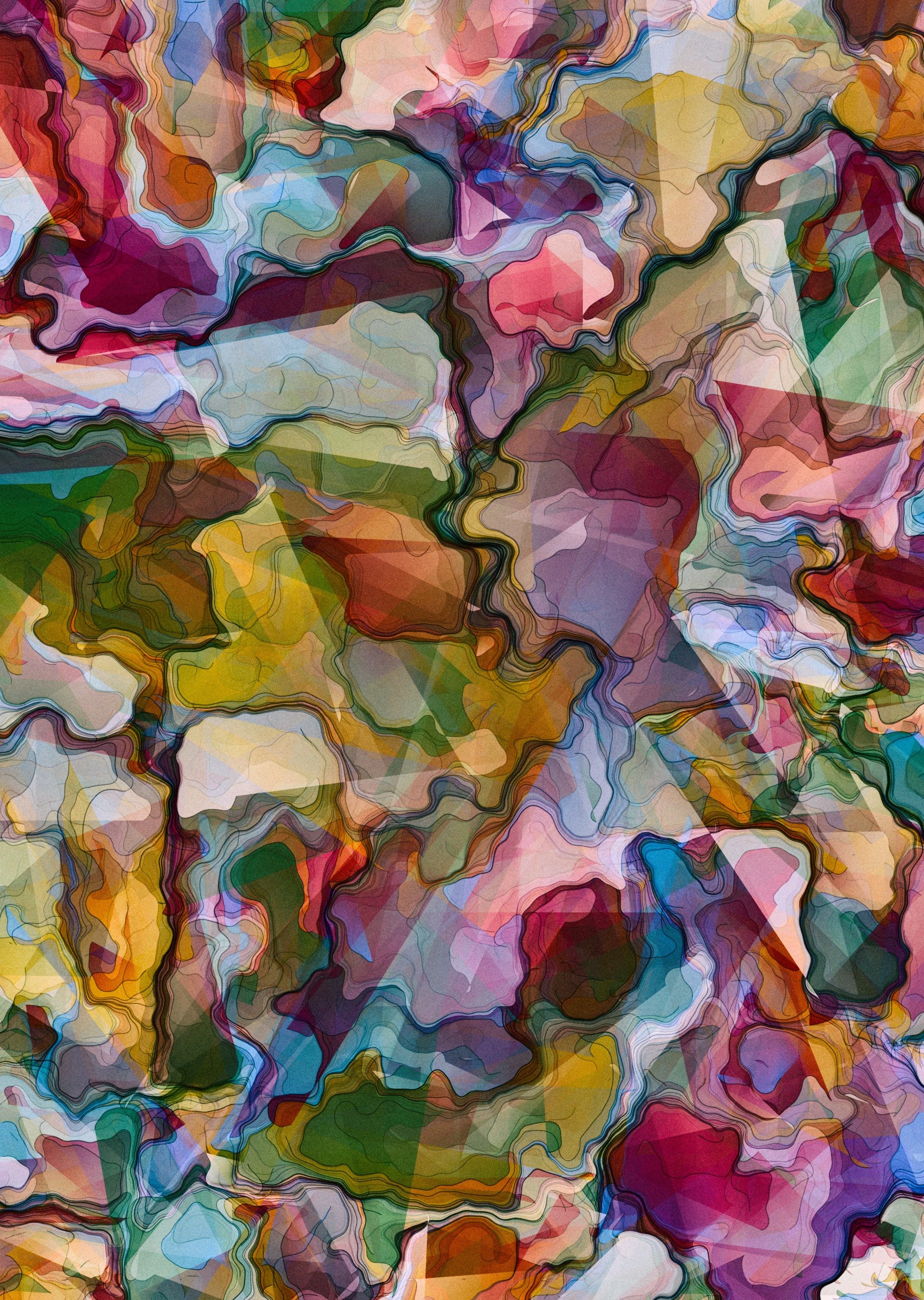
Manoloide, Tecrrain #028, 2025. Courtesy of the Jiggy Collection and the artist.
KV: That leads naturally to criticism, which the digital-art space sometimes seems uncomfortable with. Why does criticism matter?
JY: Because criticism is part of caring.
There is a tendency, especially in relatively small communities, for everything to become affirmative: this is amazing, that project is incredible, everyone supports everyone.
But if every response is positive, you stop learning.
Criticism doesn’t mean attacking people. It means being willing to say that something doesn’t work, or that you disagree, and then explaining why. Ideally, the other person challenges you back.
Healthy disagreement creates knowledge.
I’ve probably been too cautious about expressing my own opinions at different moments. But increasingly I think discourse needs friction. If everyone is afraid of upsetting everyone else, you end up with a culture that validates itself rather than interrogating itself.
What people sometimes forget is that criticism often comes from love. You criticize something because you care about it enough to want it to become better.
KV: Let’s test that against value. Imagine a work you deeply admire suddenly has a market value of zero. Nothing about the artwork has changed. Has anything actually been lost?
JY: Yes. I think saying nothing has been lost would be dishonest.
Even if you personally don’t care about selling it, market value interacts with attention. The two aren’t identical, but they aren’t entirely separable either. Price can affect whether something is exhibited, discussed, researched or even remembered.
But financial value isn’t the only mechanism.
A work can become publicly accessible; its story can continue to circulate; its ideas can influence other artists. In those cases, its cultural value may eventually outweigh its market value.
So I don’t think a price of zero makes a work meaningless. But pretending that economics has no relationship to the way cultural attention is allocated isn’t realistic either.
Huw Messie, The Boxer, 2021. Courtesy of the Jiggy Collection and the artist.
KV: Digital culture creates another paradox. Financial value often depends on scarcity, while cultural value depends on circulation. Does being copied diminish a digital artwork, or make it more important?
JY: Potentially both.
A work can remain scarce as an owned object while its image, ideas and story travel through a network. Museums, publications, exhibitions and collections can amplify that story without changing the provenance of the original.
The danger is turning cultural importance into a popularity contest.
If visibility alone becomes the measure, then whoever has the largest audience or the most capital can manufacture the appearance of importance. You see versions of that in the language of the market: everyone becomes a “distinguished collector,” every sale is positioned as historically significant.
But real histories take time.
There are extraordinary stories sitting inside collections that haven’t been properly told yet. Their relevance may only become visible years later. That’s why cities, exhibitions, archives, collectors and institutions all matter: they create contexts in which those stories can survive long enough to be understood.
KV: Does that give collectors a responsibility to write history?
JY: A responsibility, yes. Authority, no.
Collectors can preserve works, document context, support artists and make stories visible. But I would be uncomfortable with collectors deciding unilaterally what becomes history, because collectors already hold economic power.
I don’t want that power centralized.
One of the fascinating things about digital art has been its networked character. Artists, collectors, platforms, curators, galleries, programmers and communities all participate in producing meaning.
History should emerge through that plurality, not because somebody bought something and announced that it was important.
Time still has the final vote.
Bjørn Staal, Entangled #156/256, 2024. Courtesy of the Jiggy Collection and the artist.
KV: Your first NFT was a CryptoPunk, yet you’re skeptical of the way “community” became a value proposition in Web3. What separates a genuine cultural community from marketing?
JY: “Community” became such a broad word that at some point it could mean almost anything.
CryptoPunks are undeniably important to me, historically and artistically. But afterward we saw many projects use art as a marketing mechanism for creating community, rather than a community forming because something culturally interesting was happening.
Those are very different things.
The communities that still interest me tend to emerge from the ground up. RGB Montreal is one example. What matters there isn’t simply ownership; it’s people gathering around visual culture, music, performance, technology and experimentation.
That’s also something I valued about Tezos early on. Hic et Nunc, and later fx(hash), had a grassroots, collaborative quality. The relative openness of those systems allowed unexpected artists, collectors and conversations to encounter one another. That changed how I thought about collecting.
KV: Tezos seems to have played an important role in your collecting journey. At a moment when Ethereum had become the more established, prestigious and financially dominant ecosystem, Tezos developed a lower-cost, more experimental, grassroots culture. Did collecting there require stepping outside an existing consensus? And what did that environment allow you to recognize, discover or support that you might not have encountered within the more established market?
JY: It required me to step out of “consensus” to an extent, but not entirely. There’s a degree of intuition and instinct, but also research, that I think is mandatory for those who are good collectors and are curious. I have in the past equated a blockchain to a country with no borders. Imagine if a collector only collected from one country, but not the rest of the world. It would be a bit silly and a bit ignorant, in my humble opinion.
The way we do not choose where we are from, or the conditions we grow up in, is not dissimilar to how artists or collectors come to collect on one chain, or grow up somewhere: we are often creatures of our environment. With the same logic, and having grown up in New York, there’s a realization that being born here or immigrating here is often more a precondition, or destiny, than a choice of free will.
With this logic, I see it more as that kind of environment allowing me to get a bit more of an education, versus the established norms that Ethereum represented or posited. Don’t get me wrong, there has still been much experimentation on Ethereum. But even in 2020 and 2021, one could view it as “institutional” to some degree, or see artists’ and collectors’ activity there as what it would be like in a big city or at a big art education: an Ivy League school, or its equivalent in the U.S.
This resulted in me looking outside the spectrum. And because the technology and the scene were still so nascent, many of the most interesting artists, collectors and community members made their early markings there, and some of their best work as well.
To go back to the point of location and the outskirts, and to connect it to discovery, I would also like to make an analogy with food, farming and foraging. When I used to cook, even in big cities, I would often frequent the farmer’s market. The farmer’s market, I would argue, brought purveyors together in a common gathering place that was highly trafficked, even though the farms themselves came from the ends of the spectrum in terms of where they were physically located, which aided in soil production and ideal conditions.
And then there is the ultimate random element: the seeds the farmers grew came from many different sources, whether a farm the farmer had previously worked at or something that came in the wind via a bird. Seeds are generally inexpensive; the barrier to entry for that market is low. The high barrier is the research. And if you can do the research, then the outcome, and the joy of it, is literally and figuratively fruitful.
ciphrd, Clusters in Figuro, 2021. Courtesy of the Jiggy Collection and the artist.
KV: Looking at the works you selected for this interview, emergence appears again and again. Why?
JY: I think I’m drawn to works in which relatively simple systems produce something much harder to explain.
Clusters in Figuro, by ciphrd, is a particularly important example for me. I discovered Baptiste around the time fx(hash) was launching. It was his first 1/1 on Ethereum and only his second minted work.
The work is a real-time particle system in which different kinds of particles follow relatively simple rules, and life-like behaviors begin to emerge.
What makes it even more interesting to me is its relationship to Jeffrey Ventrella’s research. Baptiste’s work belongs to a longer investigation into artificial life, particle systems and the beauty of chaotic computational behavior. Later, Ventrella himself would mint his first blockchain works on fx(hash), which gives the story a strange circularity.
And the collector isn’t entirely outside the system either. The transaction hash becomes an input into the simulation, generating another unique video.
The only people who have seen mine so far are Baptiste and me.
KV: Mario Klingemann’s work in your selection operates very differently. Why is it important to you?
JY: Because it now feels almost prophetic.
Klingemann was dealing with synthetic portraiture, machine-generated identity and the narcissism embedded in image culture before today’s AI-generated social-media environment became normal.
Looking back, it intersects with things that later became enormous: PFP culture, artificial identity, algorithmic portraiture, digital art entering Art Basel, even the strange psychology of social media under AI.
Portraiture has always been entangled with patronage, status, celebrity and self-image. What Klingemann did was thread those histories through machine vision and network culture.
The work feels even stranger now because the culture around it has caught up.
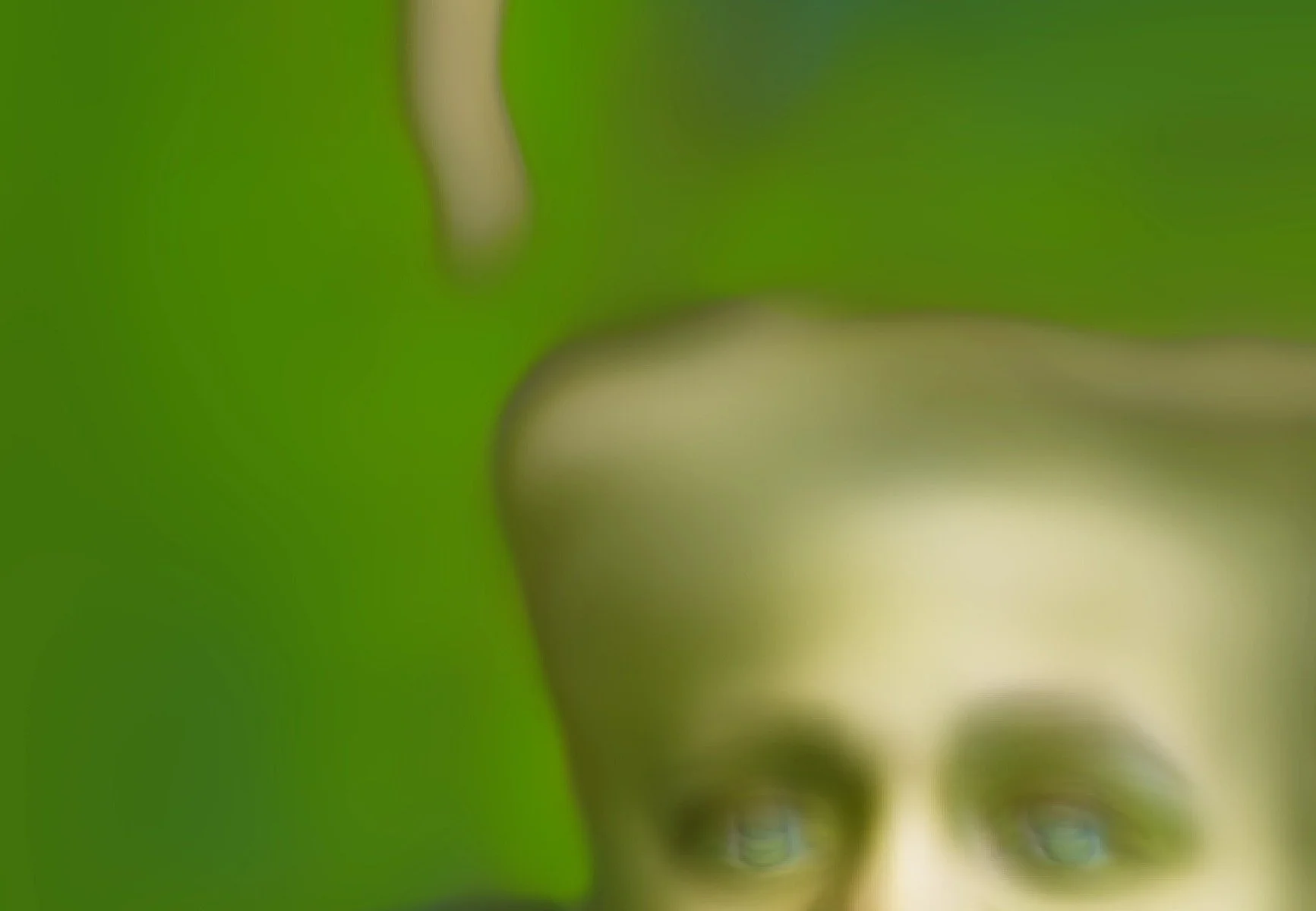
Mario Klingemann, 0xFACE05.D1BA7396FDB6, 2021. Courtesy of the Jiggy Collection and the artist.
KV: William Mapan’s Recursive Painting #01 seems almost the opposite: visually quiet and deceptively simple.
JY: Some of the works I cherish most have that quality.
There are works I don’t particularly want to explain, because the encounter is enough.
With William, I’m fascinated by the way he produces something on a screen that somehow has the texture and presence of paint. And Recursive Painting is conceptually elegant, because the visual recursion relates simultaneously to the loop of the GIF and to recursive operations within code.
There is complexity behind it, but it doesn’t need to announce its complexity.
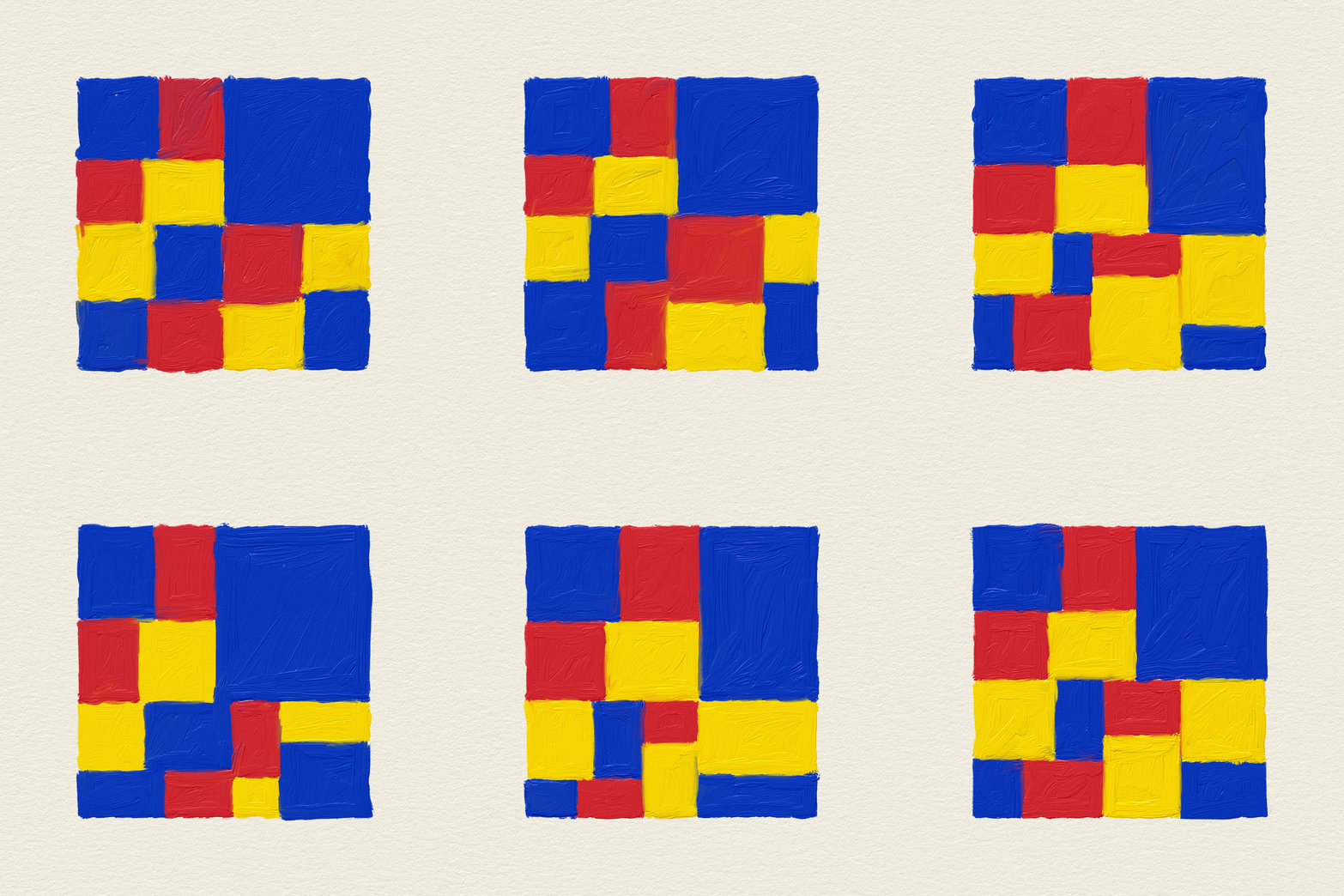
William Mapan, Recursive Painting #01, 2021. Courtesy of the Jiggy Collection and the artist.
KV: Several of the more recent works you selected move toward AI, interpretability and even quantum systems. Has your collecting focus changed?
JY: My interests probably keep following the questions I don’t understand yet.
With Karyn Nakamura, for example, I’m fascinated by the relationship between interpretability and aesthetics. Her systems can feel mystical while remaining grounded in computational logic. She combines something as old, in internet terms, as the website with contemporary tools and blockchain infrastructure.
Figure31’s DEL interests me differently: terminal culture, ASCII aesthetics, AI logic, different modes of navigating information. It feels simultaneously archaic and futuristic.
Matt DesLauriers’s Latent Dispatch Studies brings me back to entanglement. And the works from the quantum project extend that question beyond metaphor, toward a reality in which the computational systems themselves may operate according to principles that feel profoundly unintuitive to us today.
I’m less interested in art that merely illustrates technology than in work where the technology changes the logic of what the artwork can be.
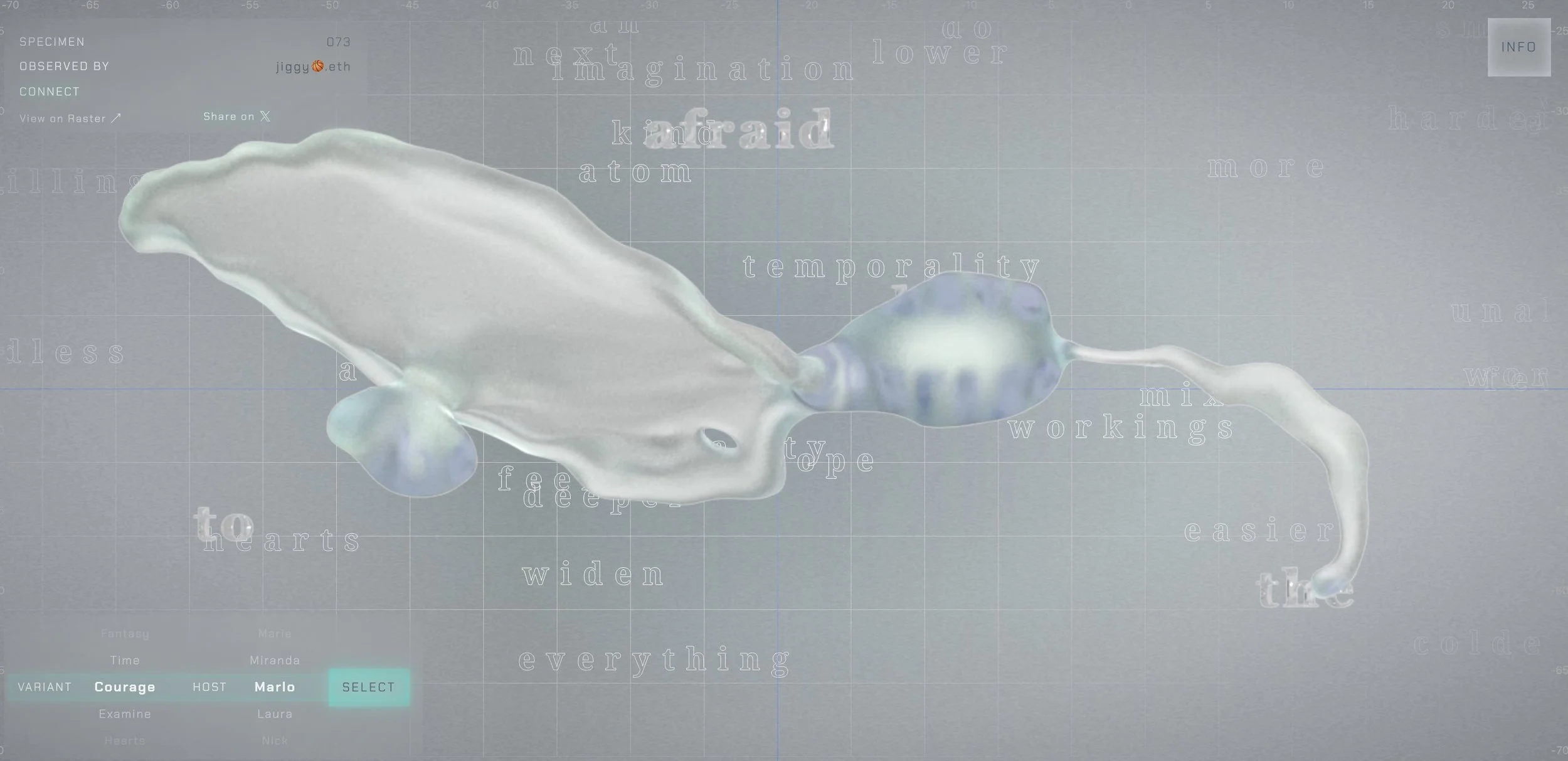
Karyn Nakamura, Spitball_73, 2026. Courtesy of the Jiggy Collection and the artist.
KV: If you could preserve only one work from your collection for another generation, what would it be?
JY: Personally, I don’t think the answer has changed: Iskra Velitchkova’s Dolina I and Dolina II.
The connection was immediate, before I even understood why.
My grandmother was a painter from Bulgaria, and Bulgaria’s Rose Valley has a deep cultural association with roses. When I later understood the context behind Iskra’s work, it felt almost impossible to describe the connection as coincidence.
There are works you research your way into. There are others where something happens intuitively first, and the knowledge arrives later.
Those are the encounters you don’t forget.
KV: And if, instead of one artwork, you could preserve one principle from this period of digital culture?
JY: Decentralized curiosity.
Not decentralization as a slogan, and not an entirely algorithmic system. I mean a culture in which different people can disagree, experiment and contribute without one authority determining everything.
I try not to stay inside one echo chamber. If your entire understanding of digital art comes from the same social-media timeline as everyone else’s, eventually everyone discovers the same artists, repeats the same references and develops the same taste.
Travel matters. Studios matter. Libraries matter. Cooking matters. Science matters. Music matters. People outside the art world matter.
The more you bring back into your understanding of art, the more likely you are to recognize something that hasn’t already been recognized for you.
Maybe collecting ultimately comes back to that: remaining curious enough that consensus isn’t necessary before you’re willing to look.
Feauring works by Zach Lieberman, Matt DesLauriers, Loucas Braconnier, Manoloide, Huw Messie, Bjørn Staal, ciphrd, Mario Klingemann, William Mapan, Karyn Nakamura, and Iskra Velitchkova.
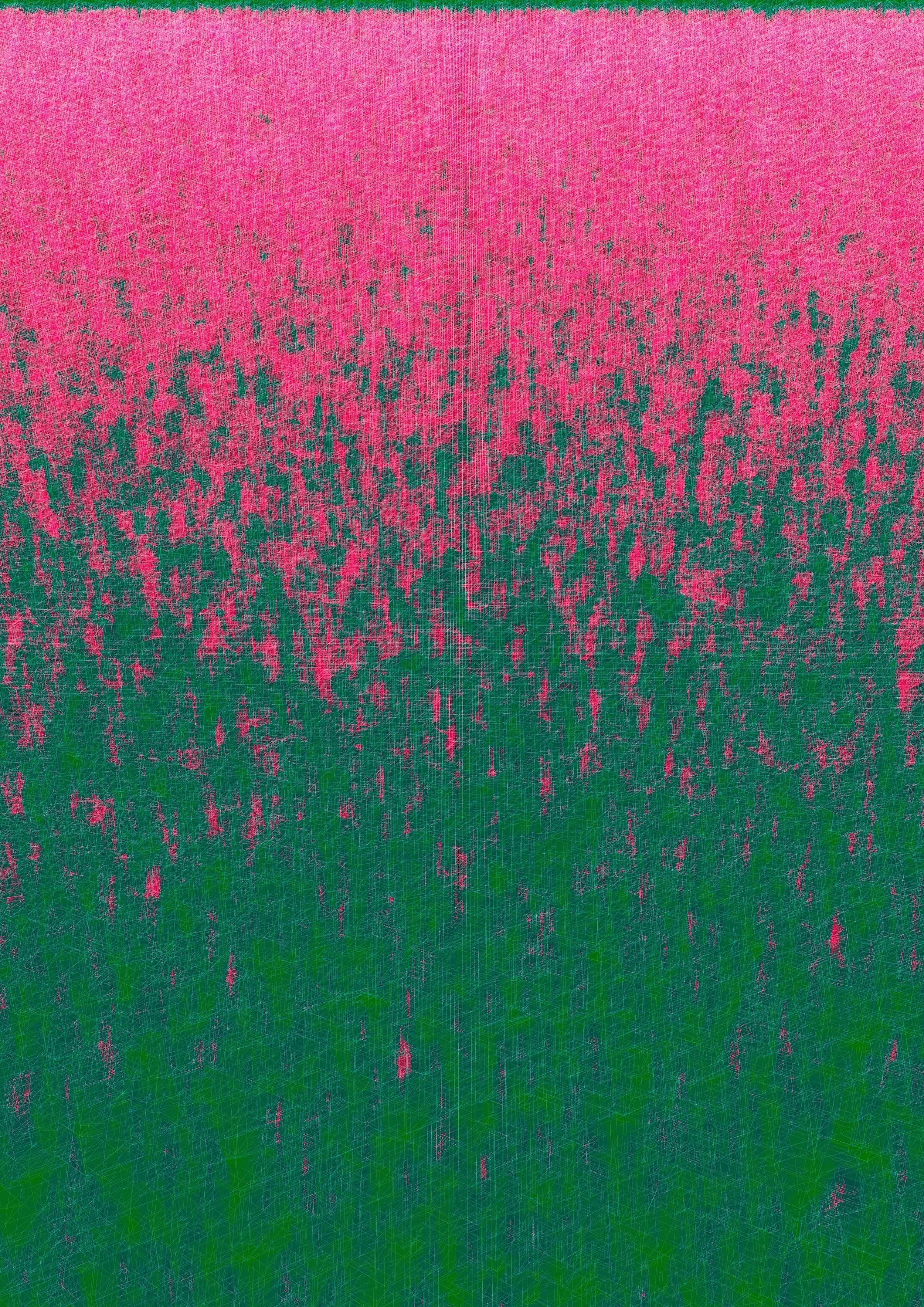
Iskra Velitchkova, Dolina I, 2022. Courtesy of the Jiggy Collection and the artist.
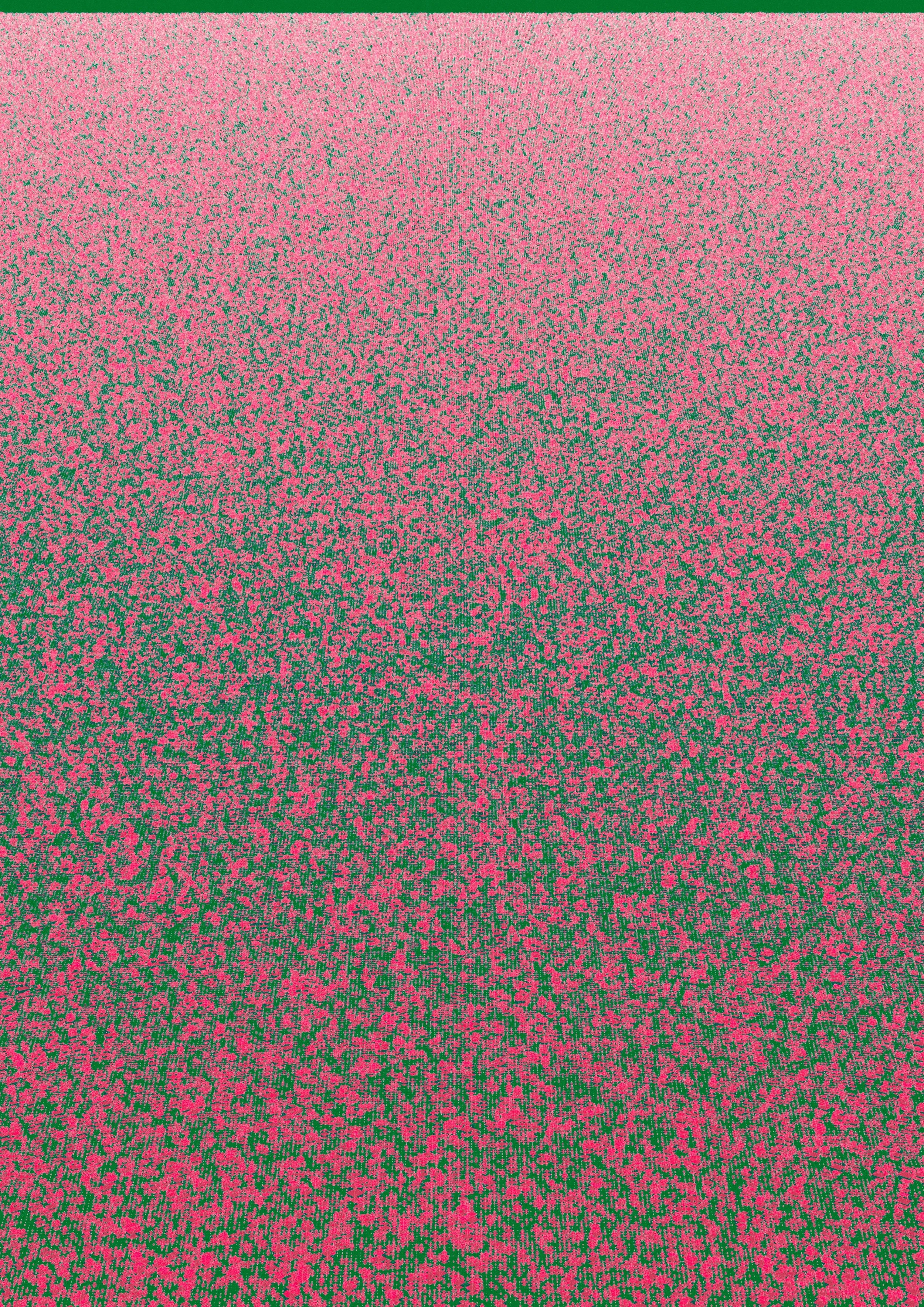
Iskra Velitchkova, Dolina II, 2022. Courtesy of the Jiggy Collection and the artist.