
The Longevity Obsession: The End of Natural Death
What happens to culture, capital, and the mind when humans stop aging, and are any of us truly prepared for the civilization that follows?
By Kate Vass · Art, Technology & the Future of Human Time
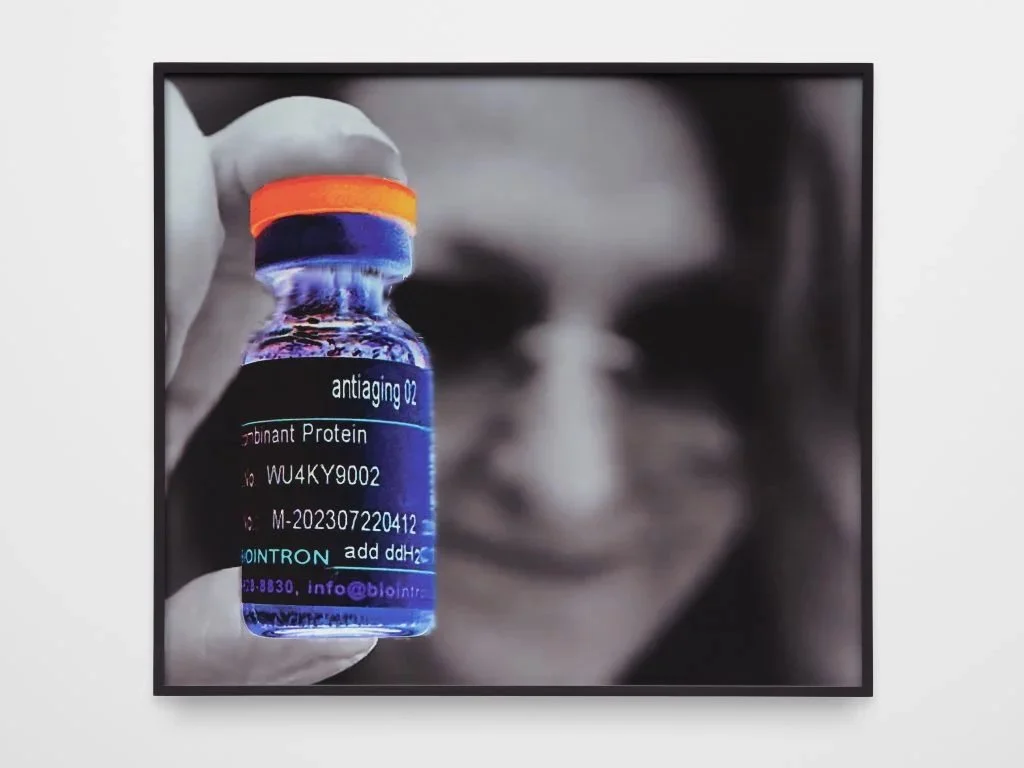
Lynn Hershman Leeson, Self-Portrait, 2025. Photo Courtesy of the artist and Altman Siegel.
"Longevity is not healthcare. It is capital formation extended into biology." - Kate Vass
I. The Personal Question
Health today is no longer the absence of disease. It has become a project - ongoing, metric-driven, socially visible. And now, if you follow the discourse closely enough, it is becoming something else entirely: a preparation for radical extension. Longevity protocols. Senolytics. Peptides. Continuous glucose monitoring. AI-designed therapeutics. Founders who speak openly about living to 150.
"Looking perfect is not the same as being healthy. Obsessing over health is not necessarily health."
Let me start somewhere small and uncomfortable. Not with billion-dollar research programs or gene-editing protocols, but with a question I ask myself regularly and cannot fully answer.
I do not drink or smoke. I exercise. I eat healthily and avoid artificial sugar. I sleep deliberately. I read. I attempt moderation in almost everything - including, ironically, my own pursuit of health.
By most measurable standards, and based on the longevity books I read, I am doing the right things in the hope of living longer and healthier - setting aside, for the sake of this argument, accidents, war, and the simple fact that we do not know our fate. Control, after all, is always partial.
And so I wonder: if I enter this world more formally - track more, supplement more, intervene more, will I actually live longer? Or will I simply participate more deeply in an anxiety dressed up as optimization?
The question that begins as personal quickly becomes planetary. Because if I have a chance to extend my life, and millions do the same, the consequences cascade through every system we have built around the assumption that human lives end when they do.
II. The Research Trajectory
Aging as a Variable, Not a Verdict
“Human longevity is no longer speculative. What was once the domain of mythology - Methuselah, the Fountain of Youth, alchemy, has become translational science.”
Advances in cellular reprogramming using Yamanaka factors, senolytic compounds that selectively clear aging cells, AI-assisted drug discovery targeting specific biological pathways, and CRISPR-based gene editing have shifted the conversation. In animal models, lifespan extensions of 20 to 40 percent have been observed. Biogerontology has moved from describing aging to attempting to modify it.
We should be precise: no intervention has yet reliably extended healthy human lifespan to 120 or 150 years. Current validated gains are primarily in healthspan, compressing the period of late-life decline. But the direction of research is unambiguous, and investment is accelerating. Venture capital is flowing into the sector in volumes that suggest the market believes a threshold is approaching.
Global life expectancy has already doubled over two centuries, from roughly 35 years in 1800 to over 72 today. In Switzerland, it exceeds 83 years. These gains came from sanitation, antibiotics, and public health infrastructure, not from aging reversal. The next leap, if it comes, will be different in kind. It will not merely add years to the end of life. It will restructure the entire arc.
Wangechi Mutu, The End of Eating Everything, 2013. Courtesy of the artist.
A video and mixed-media installation exploring transformation, bodily hybridity, and post-human narratives.
III. Power, Succession & Capital
When Incumbents Do Not Age Out
“Modern societies - economic, political, institutional, are structured around generational replacement. Succession is not merely sentimental. It is functional.”
Schumpeter described creative destruction as capitalism's engine: new entrants displace incumbents, carrying new ideas into systems that have calcified. Much of this turnover is driven, directly or indirectly, by biology. Leaders retire. Founders age out. The generation in power eventually hands control to the generation that has been waiting.
If founders lead companies for fifty or sixty years, does institutional memory become an asset or a lock? Does accumulated experience stabilize organizations or does it entrench particular visions past their moment of relevance? If the same thirty people sit on the boards of the most powerful institutions for six decades, what happens to the cost of entry for new ideas?
"Longevity extends experience. But it also extends dominance."
In political systems, the dynamics are equally fraught. Democratic institutions have evolved with the assumption that leaders eventually exit through elections, term limits, and biological aging. Where term limits are weak or absent, biological aging has been an informal constraint. Remove it, and what remains?
Capital compounds this. Wealth accumulates through time. Those who access longevity technologies first will almost certainly be those who already hold capital. Extended productive decades mean extended compounding not only of money, but of influence, network, and narrative control. Longevity, if unevenly distributed, is not merely a health intervention. It is a mechanism for concentrating power across generational timescales previously impossible.
The next trillion-dollar market may not be AI. It may be extended human time and the question of who gets to buy it.
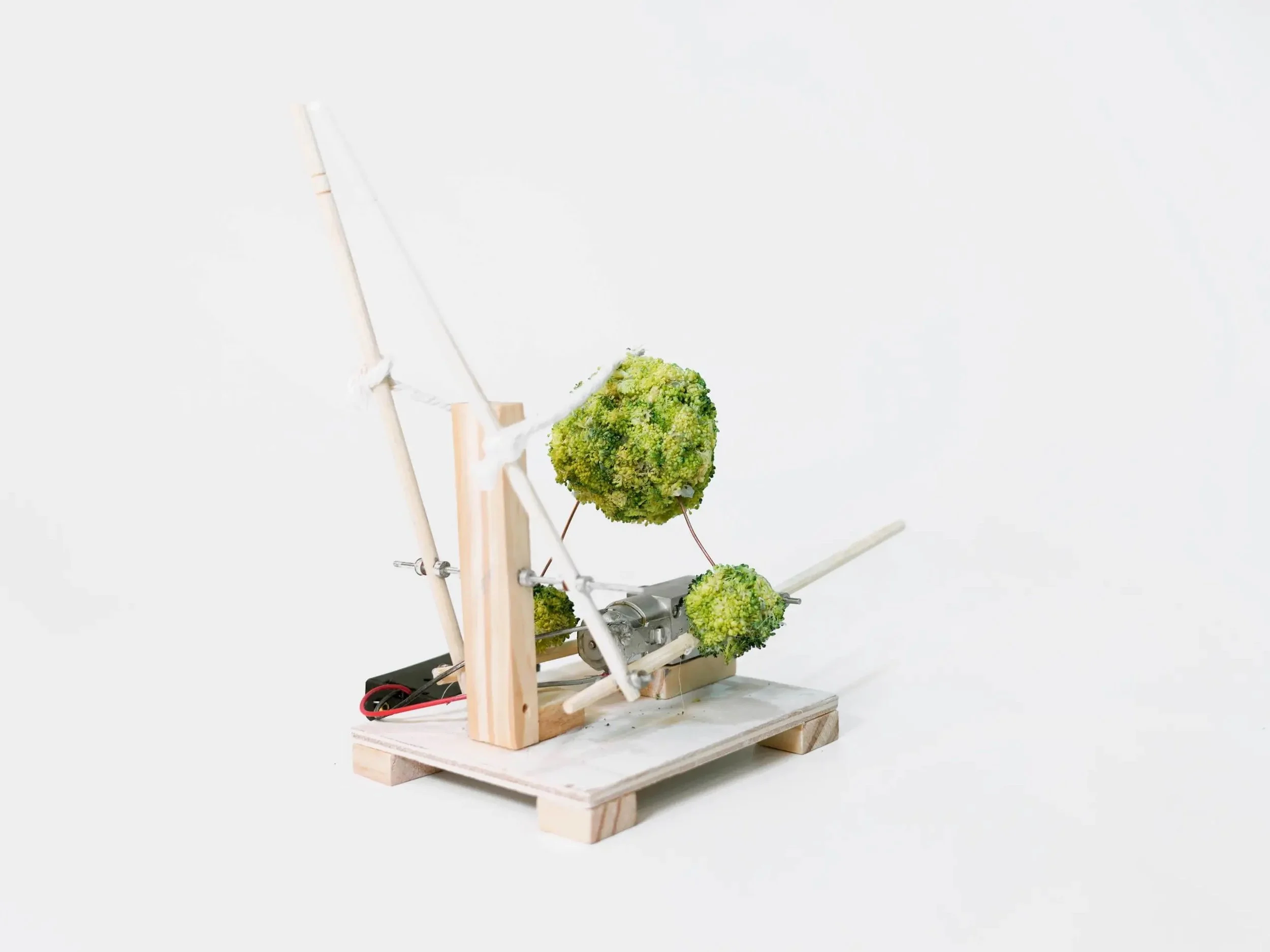
Reality Design Lab (Ke Huang & Botao Amber Hu), Cybroc, 2024. Courtesy of the artists.
The kinetic installation satirizes longevity culture directly - its rituals, aesthetics, & implicit ideology. It examines what happens when health becomes performance, when biological enhancement becomes identity.
IV. Borders, Bodies & Infrastructure
A World That Cannot Hold More
“Longevity does not occur in a vacuum. It interacts with fertility, migration, climate, and the material limits of the cities and states we already struggle to maintain.”
Switzerland is debating population caps near ten million residents. The concern is not abstract - it is concrete: housing costs, transport infrastructure, ecological pressure, the quality of services in dense urban environments. Similar debates run through Germany, the Netherlands, and parts of Scandinavia. China faces the opposite pressure: demographic contraction from decades of suppressed fertility, now irreversible in the near term.
If longevity extends significantly while fertility remains low, which is the pattern in most developed economies, age pyramids invert further. The ratio of retirees to working-age adults rises. Pension systems already under strain face a structural crisis. The social contract built around the assumption that people work for forty years and then die was not designed for eighty-year productive careers.
Alternatively, if both longevity and fertility rise, overpopulation concerns intensify. Resources, ecological systems, and infrastructure face compounded pressure. Border politics are already among the most volatile in contemporary democracies would be reshaped by demographic pressure that no single country controls.
Can one realistically imagine living to 150 in a world already struggling to sustain eight billion people at adequate quality of life? Or is the desire for radical longevity quietly, and somewhat dangerously, detached from planetary context?
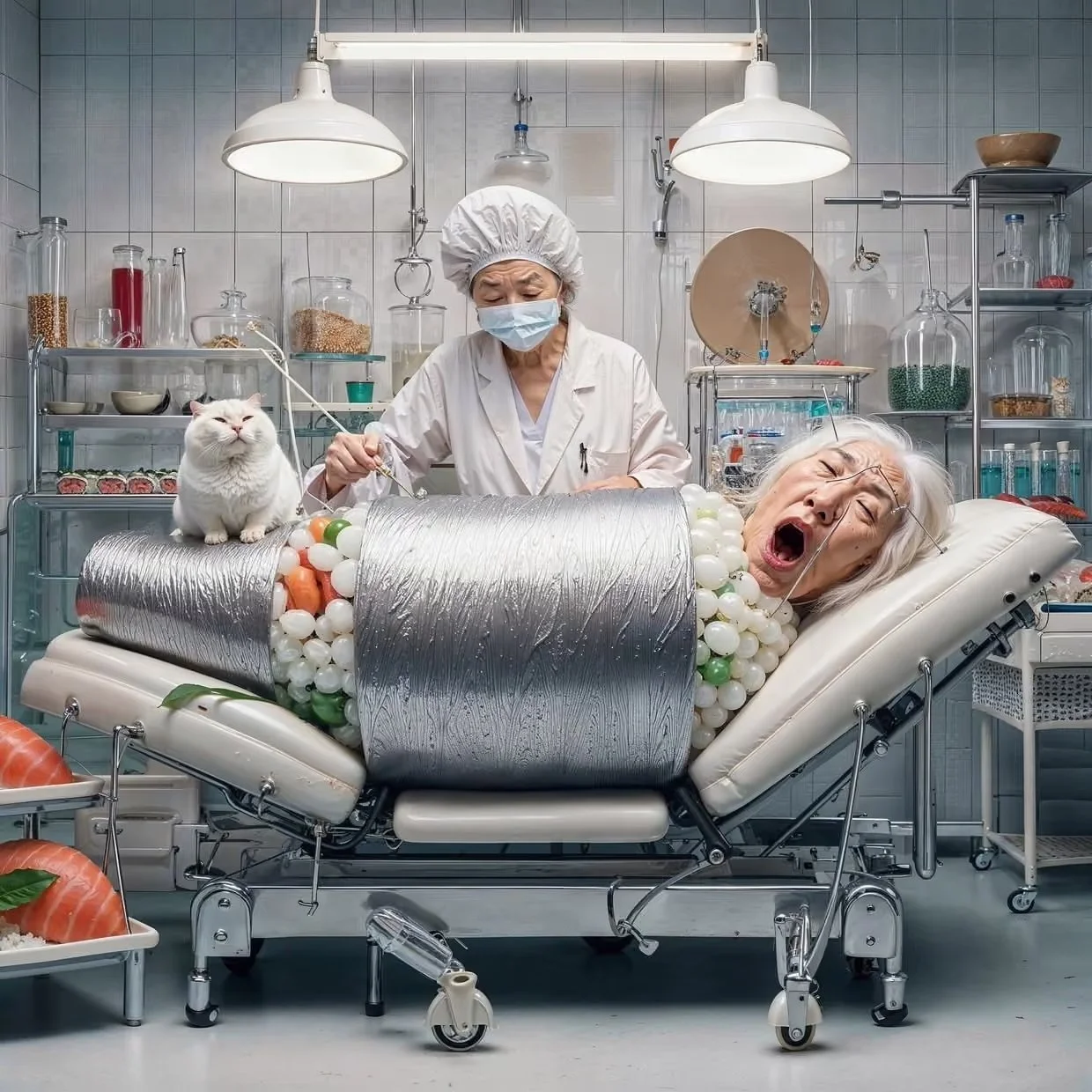
Niceaunties, Chapter No. 2, Spa Menu #0104, 2024. Courtesy of the artist.
The project centers on the 'auntie' figure in Southeast Asian culture, transforming these, at times, overlooked figures into protagonists of joy, power, and vibrant life rebellion.
V. Playing God & The Balance
When Humans Enter the Domain of the Fundamental
“There is a recurring pattern in the history of human ambition. When we enter domains that were previously beyond our reach - nuclear fission, ecosystem engineering, atmospheric chemistry - unintended consequences follow with a particular kind of inevitability.”
We are now intervening in aging itself. We are simultaneously reviving extinct species through de-extinction projects, advancing artificial womb research, and developing prenatal screening capable of eliminating certain disease trajectories before birth. We are moving toward the ability to remove fragility from the biological equation.
There is no credible historical or empirical record indicating that the universe maintains a moral ledger of human overreach and administers corrections on a schedule. You may or may not believe in divine punishment. However, it is difficult to deny that complex systems tend to self-adjust. Climate instability, pandemic emergence, and geopolitical fragmentation are not metaphysical interventions; they are systemic responses to imbalance. They are what happens when one variable is pushed far enough outside its historical range that the surrounding system reorganizes.
“Duality is structural. When one pole expands, the system corrects elsewhere - not as punishment, but as physics."
Many philosophical traditions across cultures and centuries have understood this. Yin and yang. The balance between creation and dissolution. Light and darkness not as opposites to overcome, but as interdependent forces that stabilise each other. Death, in this framing, has not been a failure of the biological system. It has been part of how life sustains itself across time, recycling resources, clearing space, driving renewal.
If we remove death from the equation, what performs that function? And if the system must correct somewhere, where does the pressure emerge? In ecological collapse? In social instability? In forms of violence we have not yet imagined, war?
I hold this question carefully. I am not arguing against research. I am arguing for humility at the scale of the intervention.
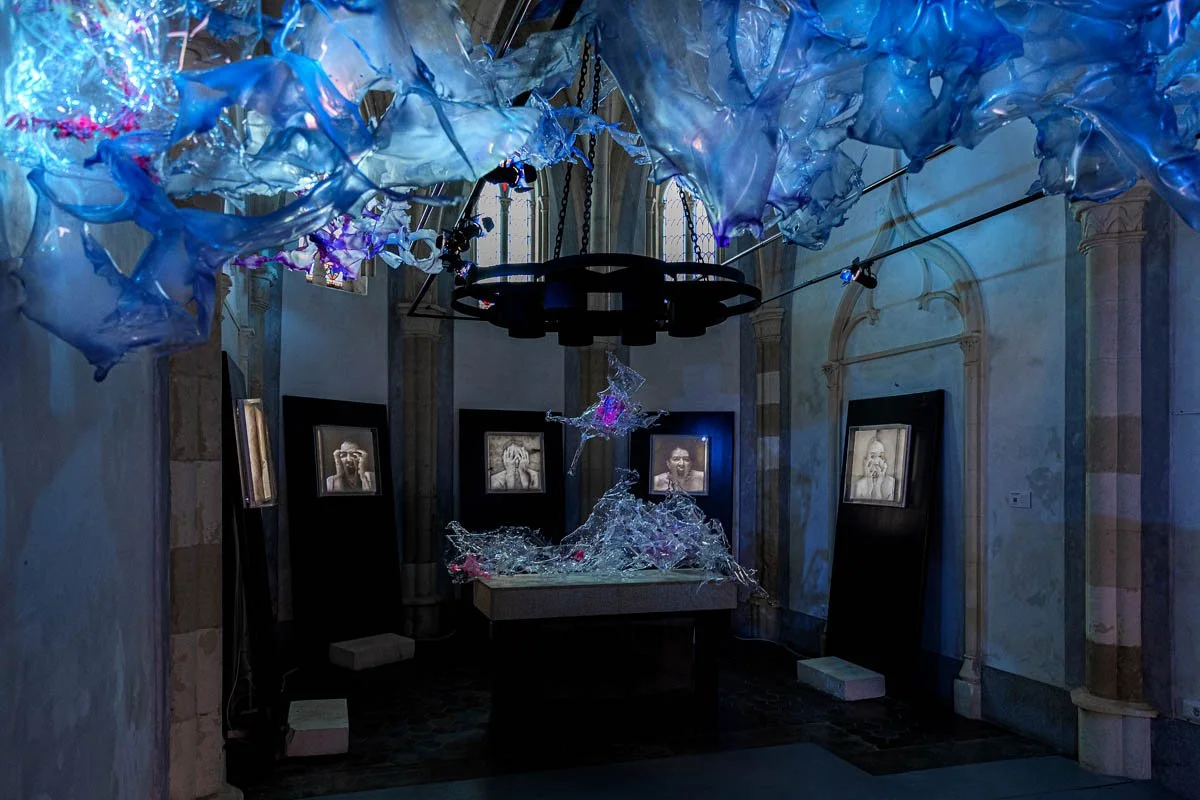
Aljoscha, Convergence of Chronoglow, 2026 at Capella de Gràcia, LOAC, Alaior, Menorca, Spain. Courtesy of the artist. Bioism practice imagines entirely new forms of life - speculative organisms, ethical futures, systems of biological existence beyond current categories.
VI. The Mind's Endurance
Can the Brain Sustain What the Body Survives?
“The dimension of extended longevity that receives the least attention in optimistic projections is also, I suspect, the one that matters most: not whether the body can last, but whether the mind can.”
Rates of depression, anxiety, and loneliness are already rising in populations where physical health has improved dramatically. The World Health Organisation identifies depression as a leading cause of disability globally. Loneliness is described as an epidemic across multiple high-income countries simultaneously. This is happening now, with current lifespans.
The brain evolved under conditions of much shorter lives. It was not designed to accumulate a century of memory, loss, adaptation, grief, and transformation while continuing to function with full coherence. Neurodegenerative disease already becomes more prevalent with age even within current lifespan ranges. We have not solved this. We are not close to solving it.
If we extend biological life significantly without commensurate advances in cognitive and psychological health, what do we produce? Not flourishing, but a prolonged vulnerability. Bodies that persist. Minds that strain.
"Will mental stability become the new scarce resource in long-lived societies? Will we all be running on pharmaceutical calibration just to remain functional?"
The pharmacological landscape is already heading this direction. Antidepressants, anxiolytics, cognitive enhancers, psychedelic-assisted therapies, these are increasingly normalised not as emergency interventions but as maintenance. Will society, in an era of 120-year lives, depend on continuous neurochemical management in the way it depends on statins for cardiovascular health? Will "functioning" simply mean being successfully medicated?
And more philosophically: can a self that has lived for 100 years and accumulated 100 years of loss and complexity remain coherent? Or does the extended self become something we do not yet have a language for, not quite a single person, not quite continuous, but a layered sequence of adaptations that only superficially resembles the early self that began?
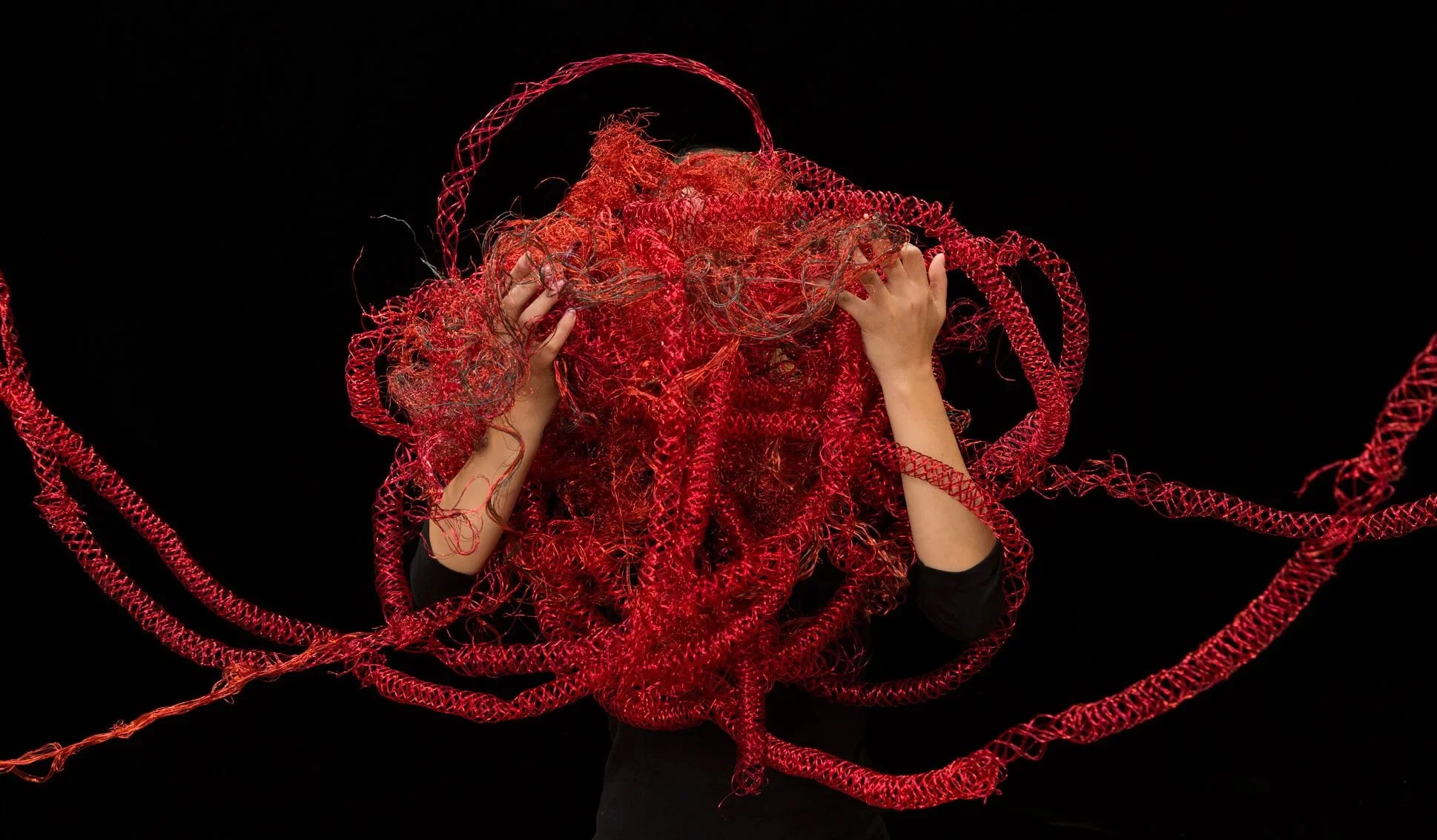
Nene Humphrey, Circling the Center, 2008-ongoing. Courtesy of the artist.
The work integrates neuroscience, embodied experience, and emotional vulnerability in her installations. Her work explores how nervous systems hold memory, bodies carry time, how affect accumulates and transforms across life.
VII. Culture Without Mortality
What Art Owes to the Awareness of Ending
“Art has always been in conversation with death. Not only as subject, but as structural condition. The knowledge that time is finite is not merely a source of melancholy. It is a source of urgency, of meaning, of the particular compression that makes certain works feel necessary.”
Keats wrote in the shadow of tuberculosis at twenty-five. Bach composed under the constant awareness of his own mortality and that of those he loved. Basquiat burned through images as though running out of time, which he was. The awareness of ending is not incidental to these bodies of work. It is architecturally present in them.
Would extended lifespan deepen creativity through accumulated experience? Or would it diffuse urgency? If an artist anticipates a century of creation, does the pressure that produces certain kinds of intensity simply dissolve into a longer, less driven horizon?
Cultural revolutions have historically been driven by youth, by generations that have not yet invested in the existing order and therefore have less to lose by overturning it. Demographic youth drives transformation, aesthetically and politically. If the demographic weight shifts toward long-lived elders, if the cultural centre of gravity moves away from those in their twenties and thirties and toward those in their eighties and nineties who simply no longer age out, does cultural innovation slow? Does rebellion lose its structural fuel?
Or - and this is the more hopeful reading - does longevity produce a different kind of creativity? Not reactive and urgent, but cumulative and synthetic. Less revolution. More sustained inquiry. The question is whether that slower, deeper mode produces the kinds of rupture that civilizations also seem to need.
Lynn Hershman-Leeson, Teknolust, 2002. Courtesy of the artist.
Lynn Hershman Leeson has long explored identity, technology, and the body. In Teknolust, she examines biotechnology, cloning, and digital identity through a narrative of AI and genetic replication, questioning what constitutes a “self” when identity can be technologically reproduced and biologically manipulated - a prescient reflection on aging, continuity, and constructed personhood.
VIII. The Escape Fantasy
Mars, Longevity, and the Desire to Leave
“There is an undercurrent in the longevity and deep-tech ecosystem that I find worth naming directly, even though it is rarely named so bluntly: the escape fantasy.”
Private companies invest billions in space colonisation. The narrative is cast as ambition - a second planet, a backup civilisation, the expansion of human possibility. But it runs alongside, and sometimes converges with, the longevity discourse in a way that deserves scrutiny. Both projects share a common structure: the existing conditions are treated as a problem to be transcended rather than a relationship to be repaired.
Can we realistically imagine extending human life to 150-200 years while the Earth remains polluted, unequal, and ecologically strained and simultaneously plan to leave? Not as a philosophical paradox, but as an actual allocation of capital, attention, and talent?
I do not think the ambition is wrong. I think the sequence is revealing. When we prioritise personal biological extension and planetary escape over the slower, less dramatic work of ecological repair and social equity, we are making a statement about who the future is for. Extended life on a damaged planet is not triumph. It is a prolonged experience of instability, available primarily to those who can afford insulation from its worst effects.
No peptide protects against ecological collapse. No supplement isolates you from the volatility that comes from a world where systemic conditions continue to deteriorate. Individual optimisation is not separable from collective fragility or war.

Hitoshi Nomura, CMB Score: 13.8 Billion Years/Temperature Fluctuation. Courtesy of the artist.
CMB Score: 13.8 Billion Years/Temperature Fluctuation, presented at ARTCOURT Gallery by Japanese artist Hitoshi Nomura, reflects work developed over decades about time itself - transformation, decay, and the passage of process rather than accumulation of product.
IX. What Death Has Been Quietly Doing
I began with a small personal question, I end with a much larger one, and I find I cannot separate them.
If humans routinely live to 120 or 150, power cycles extend. Innovation may deepen or stagnate. Political systems may stabilise or ossify. Capital concentrates over timescales previously impossible. Borders tighten under demographic pressure or fracture under migration necessity. Minds strain under the accumulation of extended consciousness in a world of relentless information load. Culture loses the generational rebellion that has historically been one of its engines of renewal.
These are not science fiction scenarios. They are the logical extensions of research trajectories already underway, funded by capital that has made its bets.
The ethical gap is real. Technology accelerates past the frameworks built to manage it. Intergenerational justice, access equity, psychological adaptation, governance reform - none of these are close to catching up with what is being built in laboratories and funded by venture capital right now.
Religious and cultural traditions across human history have structured life around finitude. Meaning has been built, in large part, around the fact of ending. What replaces that structure if ending becomes optional or indefinitely deferred?
I am not arguing against life extension. I am arguing for a kind of civilisational seriousness about what we are actually doing when we pursue it. The question is not whether to extend life. It is whether civilisation can metabolise extended time without losing dynamism, equity, and the capacity for genuine renewal.
Before we engineer the end of natural death, perhaps we should decide whether we understand what death has been quietly doing for us all along and what we will build in its absence.
Artists featured: Lynn Hershman Leeson, Wangechi Mutu, Ke Huang, Niceaunties, Aljoscha, Nene Humphrey and Hitoshi Nomura.
KATE VASS - FOUNDER, CURATOR, WRITER & ADVISOR, WORKING AT THE INTERSECTION OF ART, TECHNOLOGY, AND FUTURES THINKING.