
 Image 1 of 1
by Jonathan McCabe
Video H.264 video, 1080 × 1080 pixels, 25 frames per second, Duration: 5 minutes.
In his 1952 paper The Chemical Basis of Morphogenesis Alan Turing hypothesised that a system of interacting chemicals could spontaneously produce a pattern of stripes or dots. The simplest model is that chemical “A” stimulates its own production and also that of chemical “B”. B destroys A and also itself. If B diffuses or spreads faster than A, a stable pattern of regions of high A separated by gaps develops.
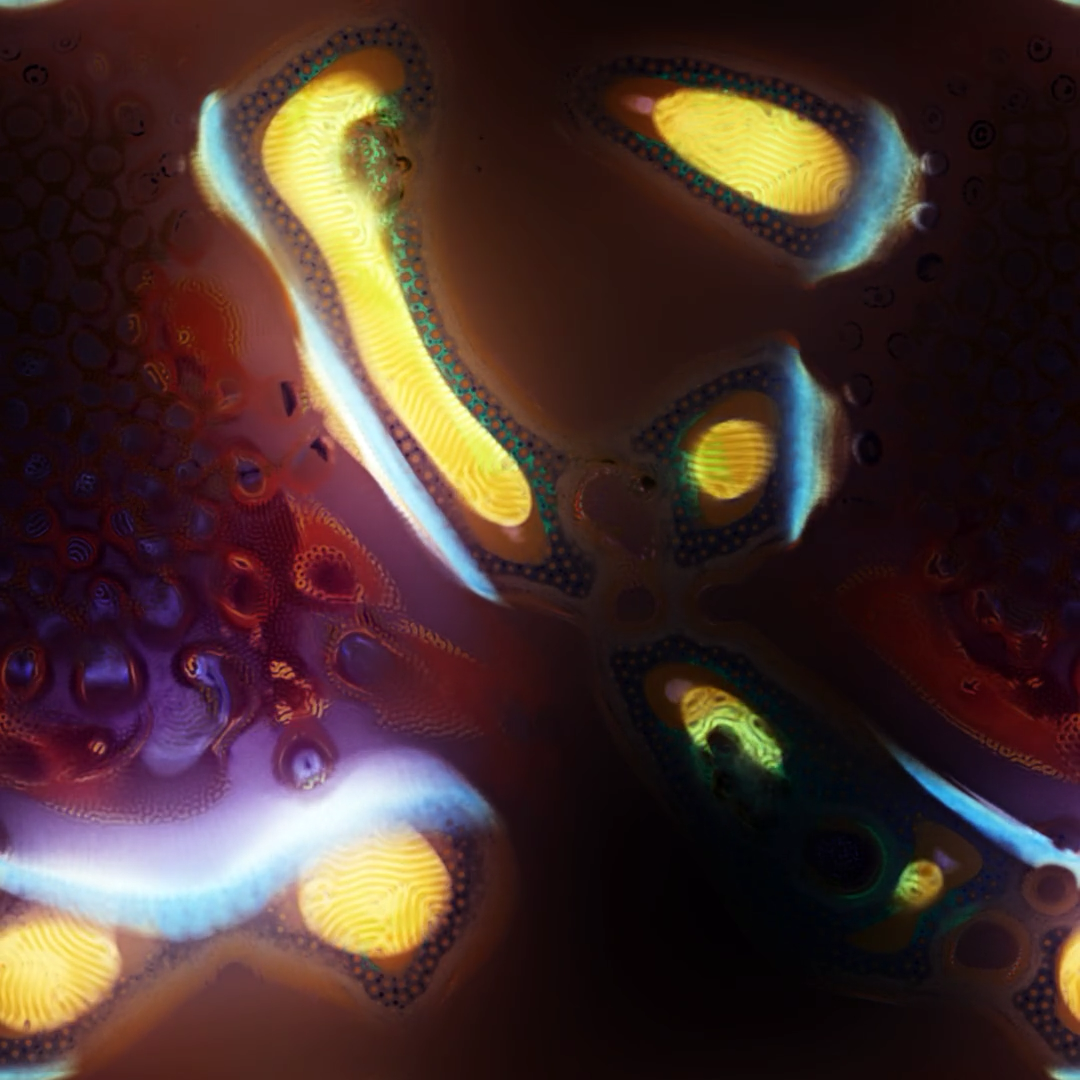
In this work 128 Turing patterns of various sizes interact, re-enforcing or eroding each other. Forms emerge from the initial chaos of random initialisation of pixels. A semi-stable packing of rounded shapes develops, never settling to a final pattern.
This set of Turing patterns was evolved from an initially random population of 1000 sets of 128 patterns. New sets were made by randomly taking half the patterns from one set and half from another. The most interesting sets were selected and recombined over 11 generations.
Exhibited at EMERGENCE, Kate Vass Galerie, Zürich, Switzerland, 2026.
by Jonathan McCabe
Video H.264 video, 1080 × 1080 pixels, 25 frames per second, Duration: 5 minutes.
In his 1952 paper The Chemical Basis of Morphogenesis Alan Turing hypothesised that a system of interacting chemicals could spontaneously produce a pattern of stripes or dots. The simplest model is that chemical “A” stimulates its own production and also that of chemical “B”. B destroys A and also itself. If B diffuses or spreads faster than A, a stable pattern of regions of high A separated by gaps develops.
In this work 128 Turing patterns of various sizes interact, re-enforcing or eroding each other. Forms emerge from the initial chaos of random initialisation of pixels. A semi-stable packing of rounded shapes develops, never settling to a final pattern.
This set of Turing patterns was evolved from an initially random population of 1000 sets of 128 patterns. New sets were made by randomly taking half the patterns from one set and half from another. The most interesting sets were selected and recombined over 11 generations.
Exhibited at EMERGENCE, Kate Vass Galerie, Zürich, Switzerland, 2026.